Anthropic After the IPO
Who paid in, who holds the votes, and who decides what the public benefit fund gives away.
Broadcom supplies Anthropic with computing equipment and offers financing to help it pay the rent. On November 20, it also bought about $1 billion of Anthropic’s stock. The purchase added ownership to a relationship in which Broadcom already stood to collect payments for the equipment and, if Anthropic borrowed, lend it the money to make some of them. In our October account of those arrangements, Broadcom was not named among the equity investors.
Anthropic went public with several of its suppliers buying shares alongside public investors. The company estimates it will retain about $117 billion from the offering and concurrent private sale after fees and expenses. Its shares traded back near their $83 offer price on Friday before closing at $88.91, but those trades were between investors. They did not change what Anthropic raised.
The money raised
Google’s purchase brought Anthropic about $10 billion in cash while reducing the financing it could request from Google later. Before the sale, that agreement offered another $20 billion, subject to conditions. Afterward, $10 billion remained. Anthropic had more money available immediately, but the purchase counted toward financing Google had already committed to provide.
AMD’s purchase fulfilled part of an earlier commitment too. It had agreed to buy up to $5 billion of Anthropic stock as delivery and deployment of its chips reached specified milestones. The $2.5 billion it paid at closing counts against that commitment “on a dollar-for-dollar basis.” As those milestones are met, the first $2.5 billion of financing they would make available is already covered by the purchase. Further payments become available only above that amount, with up to another $2.5 billion remaining.
Together, the Google and AMD purchases converted $12.5 billion of previously disclosed financing into cash and reduced future financing available by the same amount. Anthropic no longer has to wait for those funds or meet the conditions that would have governed drawing them later. They are now part of the money raised at closing, rather than a separate source of financing still available afterward.
Those purchases were part of the $26 billion private sale alongside the IPO. The public offering itself was about $81 billion before the underwriters exercised their option to buy extra shares. Adding the private sale brings the total to about $107 billion; including those extra shares brings it to nearly $120 billion. These are gross transaction totals, including about $2 billion paid to existing shareholders who sold stock. After excluding those proceeds and deducting fees and expenses, Anthropic estimates it will retain about $117 billion.
The company says it intends to use the proceeds for general corporate purposes, including compute and infrastructure. About $70.7 billion of its contractual commitments falls due in the twelve months after September 30. That is part of roughly $900 billion in commitments extending over a much longer period, nearly all for compute and infrastructure. As we described in The Cost of Anthropic’s Growth, Anthropic orders capacity well before it expects to use it. The closing puts more cash behind those commitments.
Owners without votes
The seven private buyers were Google, NVIDIA, AMD, Broadcom, Micron, Microsoft and TSMC Partners. Five of them already sell Anthropic chips or computing capacity, directly or through partners. Micron and TSMC make memory and chips for the industry. All of their new shares are Class N, which carry the same claim on profits as ordinary shares and no vote on general matters.
Amazon and Google, two of the largest outside holders, also hold Class N. The prospectus puts Amazon at 14.6 percent and Google at 13.4 percent of Anthropic's outstanding stock after the offering and the private sale, before counting the underwriters' extra shares, which dilute both slightly. Amazon was not part of the private sale. Its stake comes from earlier investments, including notes that converted into shares as the company went public.
Alongside their shareholdings, suppliers have contractual rights governing when Anthropic can draw financing, which delivery milestones unlock payments, and what happens if rent goes unpaid. Those contracts give suppliers rights that their shares do not, although the existence of those rights does not show that a supplier has used them to pressure Anthropic.
The founders and the trust
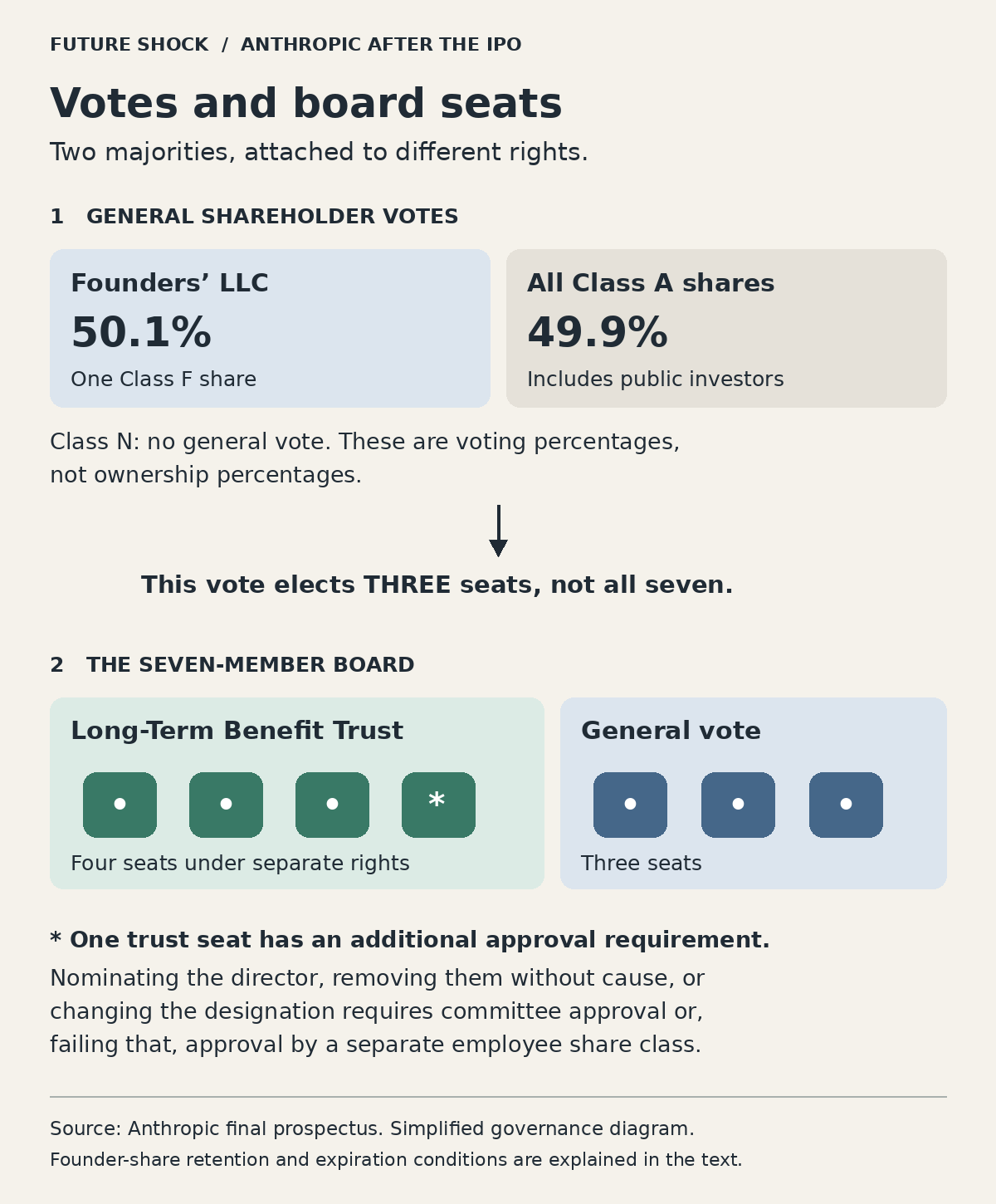
The founders hold a majority of the general shareholder vote, while the Long-Term Benefit Trust has separate rights to elect a majority of the board. The IPO added to the founders’ voting power without replacing the trust’s board majority.
The new charter gives a single Class F share to an LLC of Anthropic’s seven co-founders. That share carries 50.1 percent of the vote on matters submitted to shareholders generally, but no claim on profits. All the ordinary Class A shares, including those sold to the public this week, share the remaining 49.9 percent.
That general vote elects three of Anthropic’s seven directors. The founder share holds a majority of the vote for those seats by itself. The Long-Term Benefit Trust elects the other four through separate rights it has held since February under the private-company charter. Holding a majority of the general vote therefore does not let the founders elect the entire board.
The trustees who choose those directors are a separate body from Anthropic’s board. The trust has five authorized trustee positions, one of them vacant when the prospectus was filed. Existing trustees appoint trustees by majority vote, with advance notice to the board’s Nominating and Governance Committee. Trustees serve renewable annual terms with no term limit. The prospectus says trustees and company executives have worked closely together on sourcing, interviewing and selecting trustees.
Anthropic says the trust is meant to help balance shareholders’ financial interests, the interests of people affected by its work, and its public-benefit purpose. Its trustees receive a fixed cash fee unrelated to the company’s profits. The IPO kept its four seats but added an approval requirement for one of them: nominating the designated director, removing that director without cause, or changing which director holds the designation needs a board committee’s approval. If the committee does not agree, approval can instead come from a vote of a separate employee share class. Removal for cause does not require either approval.
The founders’ voting rights also come with conditions. On shareholder-vote record dates, each original co-founder must retain, together with related holders and including shares subject to options, RSUs and other convertible securities, at least 2 percent of their combined closing Class A holdings—not 2 percent of Anthropic. That is a retention requirement, not a guarantee of continued membership. If fewer than three qualifying members remain for 90 consecutive days, the founder share expires after a further 450 days.
The share can end sooner through agreed redemption or dissolution of the LLC. Outside the 450-day transition period, successor membership ends at the IPO’s tenth anniversary. Successors may serve during the transition period, even after that anniversary, but cannot stop or extend its expiry. The founders’ majority vote thus depends on the LLC continuing to meet the conditions for holding it.
The public benefit fund
In October we reported Anthropic's plan to put 5 percent of its shares into a public benefit fund, subject to stockholder approval. The final prospectus says Anthropic contributed 846,840,960 Class N shares to the Anthropic Public Benefit Fund, a subsidiary the company wholly owns. That represents 5 percent of Anthropic's fully diluted shares as of June 30, assuming full conversion of Amazon's notes. The prospectus treats those shares as legally outstanding and leaves them out of the accounting share count while the subsidiary holds them.
Those shares can be donated, transferred or sold in support of Anthropic's public-benefit initiatives. In its October announcement, the company said the fund might make large donations to nonprofits or direct distributions to specific populations, citing labor-market instability affecting workers as one possible focus. The prospectus also describes research contributions and programs making Claude available to underserved communities, but those are examples of Anthropic's broader public-benefit initiatives, not a specific allocation of the fund.
Anthropic's board will decide what the fund gives away until it approves a governance structure. The company expects designated managers to take over those decisions under the new structure. The initial managers are Dario Amodei, Daniela Amodei and Jack Clark, three of the co-founders behind the Class F share, along with Buddy Shah, who has chaired the Long-Term Benefit Trust since June 2023. The prospectus's description of the fund sets no minimum payout.
The safety allocation
At the opening bell on Thursday, Dario Amodei said Anthropic “will pace the training and deployment of AI systems, taking as long as is necessary to have confidence that they are safe.” He said its stronger financial position “only strengthens our resolve to do the right thing.”
How much computing capacity Anthropic devotes to safety is a separate question. The prospectus says the company “must allocate limited resources, capital, and talent between safety-focused workloads and other initiatives.” An outside assessment had been intended to examine that allocation, but that part of the work was canceled before it produced findings.
In mid-August, the evaluation nonprofit METR began an assessment at Anthropic whose contracted scope included “a verification of Anthropic’s compute allocation,” especially between capabilities and safety. According to METR’s report, Anthropic canceled that component “before METR came to any substantive conclusions on compute usage.” METR says Anthropic wanted to keep the engagement focused on risk assessment for the time being. The cancellation predates the IPO; our earlier piece on that assessment did not mention it.
In the assessment that continued, METR said access broadly surpassed its expectations, though Anthropic could turn down requests and neither side had intended to give METR full employee-like access. That cooperation did not supply a finding on the allocation question removed from the scope.
According to METR, Anthropic said it would revisit compute allocation verification later, but the report gives no date for that work to resume.
Future Shock uses several AI models in its research and writing, including Anthropic's Claude.