Bright Signals — July 15, 2026
Two good-news stories: autonomous farm equipment is pulling younger workers into agriculture, and a whale-ID platform built from tourist photos just won an AI for Good award.
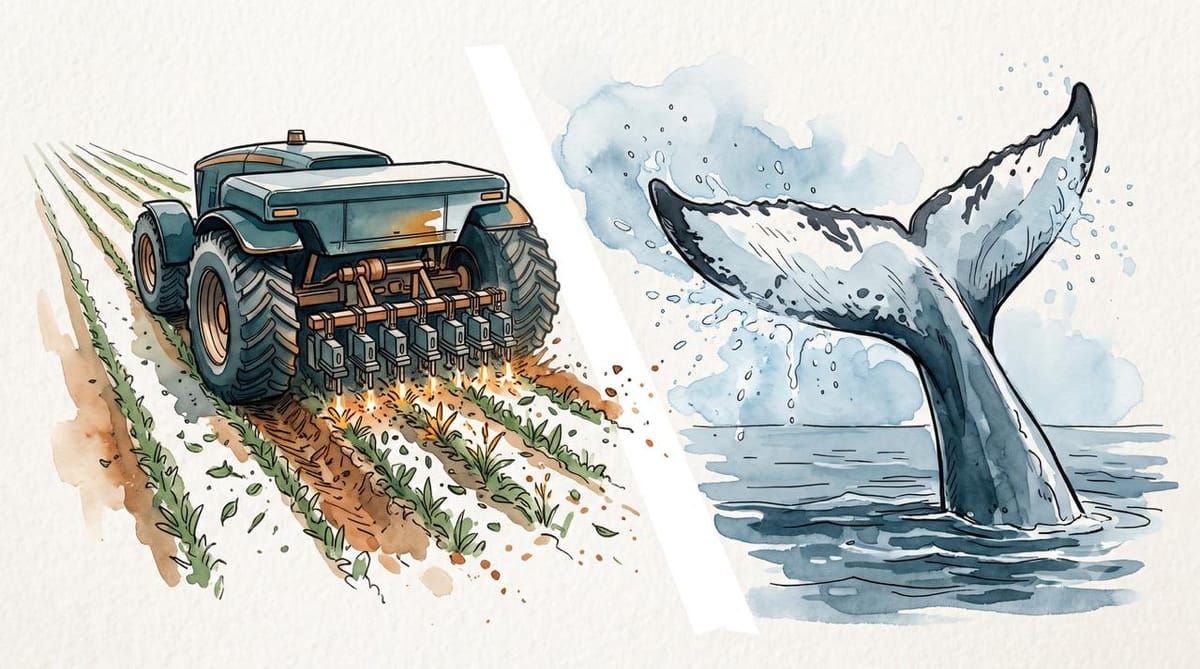
This week’s good news starts with a joystick on a sod farm and a whale tail in a tourist’s camera roll.
The Gamer Who Came for the Tractor
At Super-Sod, autonomous harvesters come with gaming-style chairs and joysticks, and some of the younger workers operating them arrived because they were curious about the technology. The setup looks less like the farm equipment they grew up imagining than a machine they already know how to approach.
“It’s a challenge, hiring people who want to work in agriculture,” the company told the New York Times. Farm work still brings to mind “sitting on a tractor and sweating,” but Super-Sod found a different recruiting pitch in its autonomous equipment. “Gamer kids are coming out and running some of our autonomous units,” the company said, and some began taking an interest in the farm around the machine.
The machines changed both the recruiting pool and the job waiting on the other side. Familiar controls gave some technology-minded workers a reason to look at agriculture, while the autonomous operating model allowed one person to plan and monitor three or four tractors. The joystick opened the door; learning the farm still came afterward.
At Oakleigh Farm, robots took over much of the milking, feeding, and cleaning that had fixed the family’s life around a rigid twice-daily schedule. The automation gave them more control over when the work happened. On a California onion farm, Carbon Robotics’ LaserWeeder uses computer vision to find weeds and burn them one plant at a time. Hand-weeding has not disappeared, but the machine reduces herbicide use and leaves workers with fewer rows to clear manually.
The economics put a hard boundary around that story. The featured LaserWeeder costs about $1.2 million, plus roughly $300,000 for the tractor, placing it beyond the reach of many smaller farms. Automation can also displace workers, and equipment at this price may widen the advantage of large operations.
At Super-Sod, autonomous machinery attracted younger workers who had never pictured themselves in agriculture. One farm does not make a national trend, but it is a new recruiting pitch for an industry that badly needs one.
A Whale’s Face Is Its Tail
A humpback lifts its tail before a dive and cameras swing up along the rail. The whale disappears, the whale-watching boat moves on, and the photographs settle into phones and memory cards for the rest of the trip.
Uploaded to Happywhale, the photograph can become part of that animal’s biography. The platform uses computer vision to match the shape and markings of a humpback’s tail fluke, which are distinct enough to identify individuals. A picture from a whale-watching trip might connect to the same animal photographed by a researcher years earlier and thousands of miles away.
Each match adds another location and date to the record. Across thousands of animals, those sightings reveal migration routes, population changes, and places where whales repeatedly encounter heavy ship traffic. A comparison that once took more than an hour of a researcher’s time can now arrive in seconds.
On July 8, the International Telecommunication Union named Happywhale the 2026 AI for Good “AI for Planet” winner.
The ITU and Happywhale report more than 1.5 million photographs, over 120,000 identified cetaceans, and contributions from roughly 53,000 citizen scientists in more than 100 countries. NOAA-supported researchers used the archive to track the recovery of North Pacific humpbacks, followed by a sharp decline associated with a major marine heatwave.
Around the Antarctic Peninsula, Happywhale says its records helped researchers locate areas where whales and ships were most likely to collide. That evidence contributed to a slow-navigation zone covering roughly 40,000 to 50,000 square kilometers. Photographs submitted from boats had become part of the case for where ships should slow down.
Happywhale has been building this record for years, and the July award recognizes work already underway. Several of the scale figures above come from Happywhale’s own reporting, as does the account of its role in creating the Antarctic slow-navigation zone. The software can establish when and where an animal was seen. Protecting it still depends on researchers interpreting that record and regulators or shipping operators deciding what to do with it.