The Grid Under the Cloud
The next decade of AI will be shaped by the places that can power, cool, permit, and physically host it.
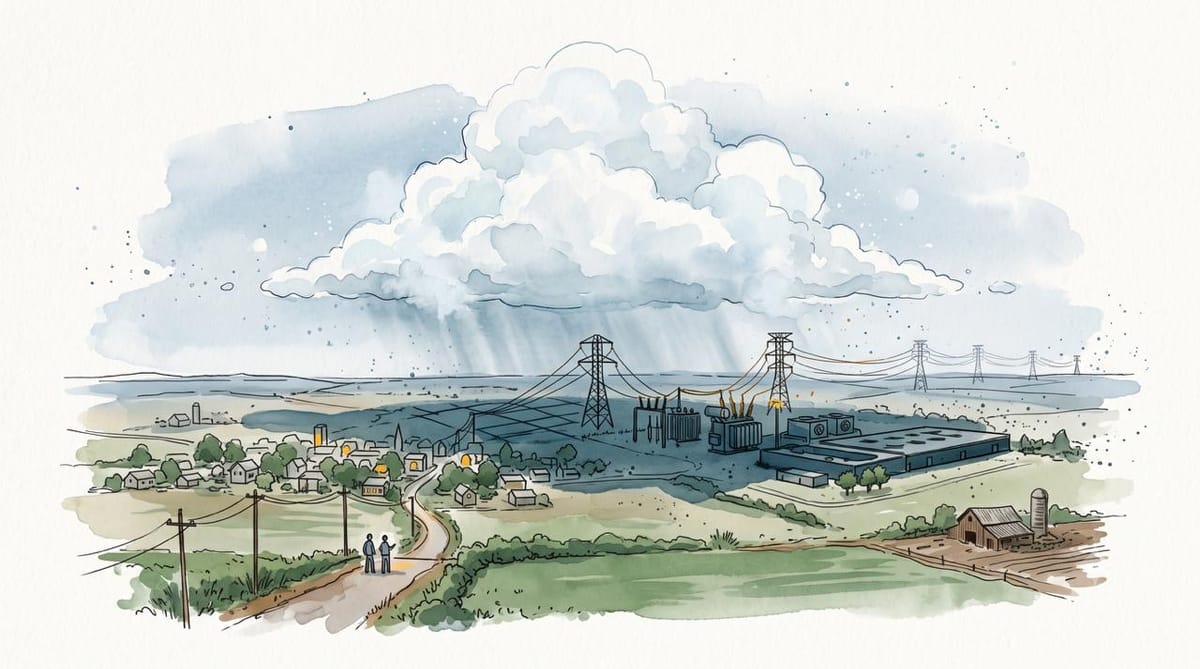
A fair-weather cumulus cloud, the kind that drifts over a summer afternoon and looks like it weighs nothing, holds about 1.1 million pounds of water. Five hundred tons, give or take, hanging over your head. Warm, moist air rises and cools as the pressure drops, condensing its water vapor into microscopic droplets. Each droplet falls so slowly that updrafts and ordinary turbulence can keep it circulating in the air. Only when enough droplets combine into heavier drops does some of that weight come down as rain.
The computing cloud pulls off a different version of the same illusion. Open a chatbot or spin up a server and the physical machinery recedes behind the interface. The building, substation, cooling loop, and power bill still exist; they are simply somewhere else, managed by people you will probably never meet.
In the town of Cassville, Wisconsin, the weight of the cloud became real.
In April, residents packed into the town garage, past a Caterpillar road grader and a workbench, to vote on a proposed data center. An attorney read the ordinance off a laptop propped on a snowplow. The developer had stayed anonymous, and nobody in the room knew for certain who wanted to build or exactly where. Residents had been told to expect a 400- to 500-megawatt facility covering about 500 acres of the Driftless area. They worried about what a project that size might do to the aquifer they relied on. They voted 44 to 0 to ban it, turning down an estimated $5.5 million a year in property taxes and 50 jobs in the process.
Cassville had been shortlisted largely because the Cardinal-Hickory Creek high-voltage transmission line went into service nearby in 2024. When the town said no, the developer began scouting sites in Indiana and North Dakota. The town attorney said the company was looking for “the lowest-hanging fruit with the least amount of regulations.”
Cassville is one of the places where AI's physical requirements are becoming hard to hide. Model releases attract the attention, but turning those models into usable capacity depends on power, cooling, land, construction, and permission.
Two clocks
AI companies are increasing spending and compute capacity much faster than the power infrastructure beneath them can be built. The IEA estimates that capital spending by five major technology companies passed $400 billion in 2025 and could rise another 75 percent in 2026. Satellite tracking suggests that purpose-built AI data-center capacity tripled in eighteen months. Over the same period, the energy required for an individual AI task continued to fall sharply, making each unit of compute capable of doing more work.
A large power transformer, which steps voltage between the grid and a facility, can take roughly two years or more to arrive after it is ordered. That lead time is long enough for several generations of AI models to come and go before a campus receives one of the basic pieces of equipment needed to power them.
Then there is the line to the grid itself. As of the end of 2025, about 2,060 gigawatts of generation and storage were sitting in interconnection queues, waiting for permission to connect. The median project that came online in 2025 had spent more than five years in that line. Of the capacity that requested a connection between 2000 and 2020, only 13 percent had been built by the end of 2025. Three quarters of it was withdrawn.
A data-center developer can move from one model generation to the next while it waits for a transformer. SemiAnalysis describes utilities initially offering 500 megawatts by 2027 and later pushing delivery to 2029 because transformers and high-voltage breakers were unavailable. Concrete and copper set the schedule long after the software is ready.
Compute has geography
Once power and grid access become scarce, location starts deciding who can add compute and when. A model can be copied across borders almost instantly. The infrastructure needed to run it cannot. A viable site needs enough generation, room on the transmission system, land that can be assembled, a workable cooling system, and a local government willing to approve the project. Missing any one of those can delay a campus for years or push it somewhere else.
Those conditions are unevenly distributed, so usable AI capacity clusters. Data centers accounted for 22 percent of Ireland's electricity demand in 2024, up from 5 percent in 2015. Rapid growth around Dublin placed significant pressure on the local grid, and Ireland's 2021 policy imposed additional requirements on new applicants. The country has since introduced a new national connection framework, but the underlying problem remains: concentrated demand changes where new facilities can connect and how quickly.
The pressure is spreading. The IEA expects global data-center electricity use to rise from 485 terawatt-hours in 2025 to roughly 950 by 2030, with AI-focused facilities growing fastest. A region that already has power, transmission capacity, cooling options, and a workable permitting path can turn that demand into new compute. A region that lacks one of them may have capital and talent and still end up waiting.
Cassville is one small example of that sorting process. The developer followed the transmission line, then looked for a friendlier state when local politics closed the site. Hyperscalers repeat versions of that calculation across regions, directing new capacity toward the places where machines can get power and permission.
The town meets the frontier
A data center arrives with benefits and costs that are spread across different groups. Federal officials can count the resulting compute toward national capacity and treat it as part of the competition to build AI infrastructure at home. State officials see construction spending, tax revenue, and the chance to attract other technology investment. The companies using the facility gain access to power and compute that can serve customers far beyond the state.
The costs stay closer to the site. A local utility may need new generation, substations, or transmission lines to serve a single customer drawing hundreds of megawatts. Residents live beside the construction, depend on the same water supply, and may share a grid whose upgrades will last long after the project's tax agreement is signed. The jobs and revenue are real, but so are questions about who pays for the infrastructure and how much of the economic benefit remains in the community.
Cassville's vote makes more sense from that distance. The residents were not choosing between AI progress and no AI progress. They were deciding whether their town should exchange 500 acres, access to shared infrastructure, and some control over future development for an estimated $5.5 million a year in property taxes and 50 jobs. Another state could still host the facility. Cassville was deciding whether it wanted to be the place carrying it.
Virginia's Joint Legislative Audit and Review Commission projected that unconstrained data-center growth could add up to $444 a year to a typical Dominion residential bill by 2040. State regulators have since approved a separate rate class, effective in 2027, that requires large data centers to cover most of the capacity costs associated with their demand instead of shifting those costs to other customers.
What the grid selects
Grid delays favor companies that can provide their own power. SemiAnalysis projects that behind-the-meter generation, built on site for a single facility, will supply well over half of new US data-center capacity by 2028. Its forecast has available grid headroom turning negative around 2027. Building a gas plant beside the servers offers a faster route, but only the largest companies can afford it.
xAI used dozens of gas turbines in Southaven, Mississippi, to supply power for its Colossus computing campus near Memphis while permanent infrastructure was still being built. State regulators treated the temporary, mobile turbines as exempt from preconstruction permitting under specified conditions. The NAACP and environmental groups dispute that exemption and have sued over alleged Clean Air Act violations, arguing that the turbines operated as an unpermitted power plant in a city whose population is roughly 39 percent Black. The case puts the speed advantage beside the community being asked to absorb its emissions.
Model capabilities can spread around the world in a matter of days. Building the capacity to run them at scale takes years, and every new campus still has to occupy a particular piece of land, connect to a particular grid, and reach some form of agreement with the people already there.
The cloud may be global, but its infrastructure is always local.