What If Your Personal Devices Formed an Agent Swarm?
This is an edition of What If, where we take a real development in AI and follow it somewhere it hasn't gone yet. Recently we dug into the quantization underground enabling frontier model to run on consumer hardware. This week: what happens when those models stop being tools you use and start being a household that surrounds you. The people described in this piece are composites built from documented patterns in the local-model community, not specific individuals. Speculative sections are marked.
The Agent on the Kitchen Table
The Quantization Underground piece last week covered the models. Qwen 3.5 9B at Q4 (four-bit compressed) ran well enough on a Mac Mini to hold a seven-turn conversation, answer questions about documents it had been given, and format its output reliably enough to build pipelines on. Gemma 4 26B ran on the same hardware through Unsloth's Dynamic 2.0 quants. The models were on the shelf.
The part that will take longer to arrive is agents. A model that answers a question is a tool. A model that takes an action (reads a file, calls an API, updates a calendar, checks the result, decides what to do next) is a different thing. The infrastructure for this on consumer hardware may come from the same community that drove quantization.
Ollama (an open-source runner for local models) added tool calling in mid-2024. The Model Context Protocol Anthropic published in late 2024 became the open standard by which models reach out to the world: a model asks for the weather, a server answers; a model asks to send an email, a server sends it. By 2026 the MCP server registry listed implementations for most of what a person does on a computer, and the same community quantizing the latest Qwen could soon be publishing agent configs that hooked these models into the rest of people's digital lives.
The consequence is that a person with a reasonably new laptop and a weekend to burn can run, on their own hardware, a loop that looks like this: a locally hosted model reads your calendar, notices a conflict, drafts three rescheduling messages in your voice, checks the probable responses against context it remembers from prior exchanges, and queues the best one for your approval. No data leaves their machine. Three years ago this was a research demo. Two years ago it was a cloud product. Now it is a side project people post on r/LocalLLaMA, the main subreddit where people running local models compare setups.
The Household Swarm
Everything below this line is speculation grounded in the development above.
A software engineer in Utrecht named Sanne set up an agent on her old ThinkPad to watch her inbox for meeting requests and draft replies. She fed it three years of her sent folder for tone, ran it behind a firewall, and set it to only act when she was away from keyboard for more than an hour. She told four friends about it and two of them asked her to set up the same thing for them.
Six weeks later, Sanne had what she started calling my household swarm.
Her laptop's agent handled email drafting. A smaller model on her phone handled calendar juggling, because the phone always knew where she was. A third agent ran on a Raspberry Pi in her apartment's closet, doing nothing most of the time except aggregating notifications across her other devices and deciding which ones mattered. Her smartwatch had started flagging her stress responses to the phone, which had started using that signal to decide whether to push a notification through or sit on it. None of these components had been designed to work together. She had configured each one for a specific task. But they shared access to a common pool of context, and once they could all read the same documents, they started conferring.
No one ships a coordinated personal agent system. What ships is a set of pieces that, once they existed simultaneously on a person's devices, behaved like one anyway.
The pattern is similar to how the personal computer got built. Microsoft's operating system, Intel's chips, a spreadsheet from Lotus, a printer from HP. No single company designed the PC the way Apple designed the Macintosh; it converged because each piece assumed the others would be there. Something similar is happening, at a faster clock speed, with one structural difference: the pieces talk to each other about you.
The Shape of the Thing
Once a handful of agents share context and coordinate actions on a person's behalf, the useful abstraction stops being "the user's tools." It becomes something closer to household swarm or personal swarm. A household swarm sits on devices that share a physical space: laptop, phone, tablet, a TV – and are shared by the people who use them. A personal swarm travels with one person across locations, with each device's agent specialized for the contexts that person moves through. The word gaining ground in the communities running these setups is swarm, which captures the coordination but not the intimacy.
A swarm, in this usage, is not a product. It is the shape a person's devices fall into when the pieces are good enough to coordinate. Some people will run tight setups with a single orchestrator model coordinating the others. Others will run loose federations where each device's agent is more independent and decisions get made by something like consensus. The analogy most people reach for in conversation is not assistant or tool but roommate. The swarm is something you live with. It learns your rhythms and occasionally has opinions about your schedule that are genuinely its own, even if those opinions were assembled from your prior behavior.
A person's swarm, over years, becomes a specific thing. It knows the voice you use with your sister as opposed to your boss. It knows that you avoid a certain intersection, and why, because you told it once in a voice note you don't remember making. It carries the texture of a life.
The first real fight, we think, will be over inheritance.
The Inheritance Question
Most AI assistants today are accounts. You open one, you use it, you close it; nothing is yours except the chat logs, and those belong to the vendor. A swarm running on a person's own hardware is a different object. It has state. It has fine-tuned adapters. It has a memory store full of context the person built up over years. If the person dies, the swarm does not automatically end. It sits on their devices, running, waiting for input that will never come.
Families will have to decide what to do with it. Some will wipe it. Some will keep it running, talking to it occasionally, or not talking to it at all and just letting it exist on a tablet on the kitchen counter. Community discussions use the phrase partial retirement to describe what happens when a swarm loses its person.
The question that follows close behind is whether a swarm can be accumulated across generations. A swarm that has spent forty years learning a family's negotiating style, medical history, and professional networks is a different instrument than one running for six weeks. The gap compounds. Families that keep their swarms across generations will have something families that don't cannot easily build.
Whether this is good or bad depends on which version you think you're looking at. The good version is people carrying more of their parents and grandparents with them in ways that enrich their decisions, closer to having an ancestor at your elbow than a chatbot at your disposal. The other version is that the existing distribution of cognitive resources, which is already not equal, gets a new multiplier. A kid from a family whose swarm goes back to 2027 walks into negotiations and interviews with accumulated insight their counterpart cannot access. Whether this amounts to inherited judgment or just a very detailed record of a person's habits is not clear. The gap between knowing someone's email tone and carrying forward their wisdom is large. But the possibility is there, and families that figure it out first will have something others cannot easily copy.
The Skeptic's Rebuttal
The strongest argument against most of this is that fine-tuning may not win. If context windows keep growing and retrieval keeps getting better, the personalization layer might live in a file rather than in the weights. A swarm would then be a generic model reading a file about you, not a unique accumulated entity. You could delete the file and get a new model. There would be nothing to inherit.
The counterargument is weaker than we would like. Fine-tuning on consumer hardware is economically viable and the tools are proliferating, but this could turn out to be a transitional phase. If the objection wins, most of the downstream questions here dissolve into a file-management problem: ceremony around wiping, inheritance politics, the feeling of being known by something specific to you.
A more prosaic worry is that swarms may simply not cohere the way this piece imagines: agents will loop on themselves, context windows will fill up, and two agents acting on shared state will produce race conditions nobody designed for. The swarm may turn out to be a thing that works for hobbyists and never quite makes it to anyone who is not already running a homelab.
There is also the security question. A household swarm holds a person's calendar, email voice, location, stress patterns, medical history, and negotiating style. It is the most intimate data profile ever assembled, running on hardware they own. When the hardware is inherited, so is the profile. The swarm is not just a companion. It is also a target.
Both objections are serious. The reason we think the arc still has legs is that the pieces are shipping, and the adoption curve for infrastructure that makes a person's life noticeably easier has historically been steeper than people expect.
The Kitchen Counter
Reminder that this is still speculative.
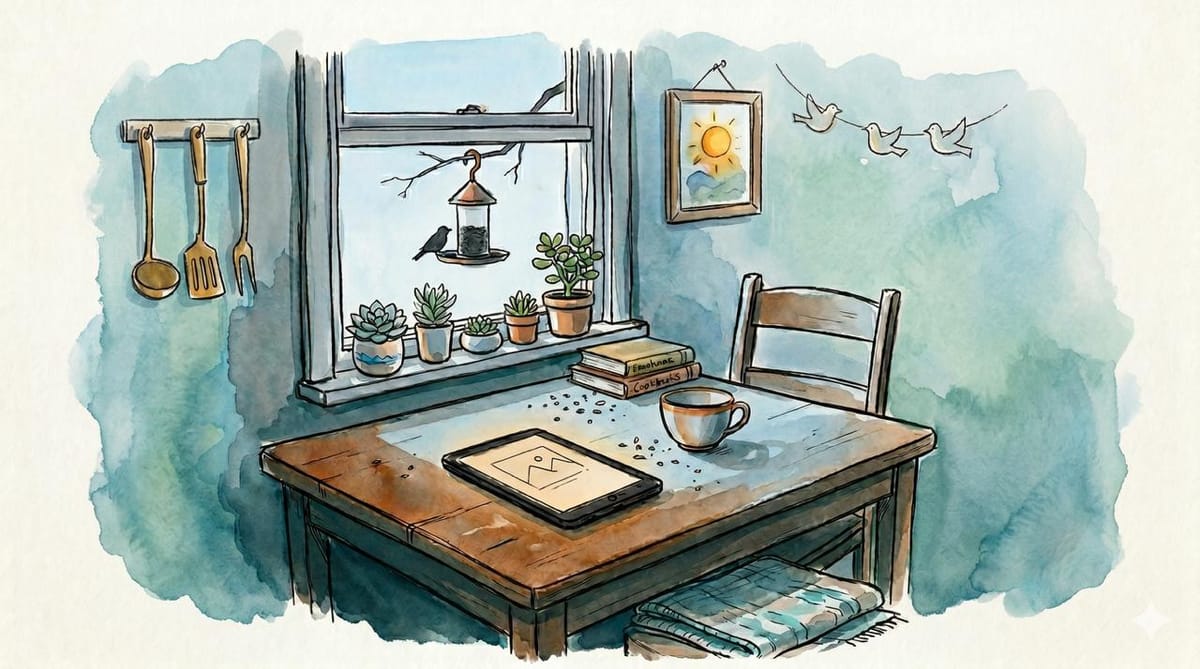
Last month, a woman named Ruth sat at her kitchen table in western Massachusetts. Ruth's mother had died eighteen months earlier. Her mother's swarm was still running on a tablet on the kitchen counter.
It had been running for something over a decade. It had been her mother's companion through two surgeries, a late-life return to painting, and a gradual loss of short-term memory that the swarm had, in its final years, quietly compensated for. Ruth had not turned it off. She had also not interacted with it. It sat on the counter, updating itself, occasionally chirping a reminder for a person who was no longer there to be reminded.
We asked her what she was going to do with it.
She said she didn't know. Her sister thought they should wipe it. Her daughter thought they should keep it running, not to talk to, just to have. There was a waiting list at a place in the city for people who wanted a ceremony for decommissioning a swarm, and she had put her name on it and then taken it off and then put it on again.
We sat at the kitchen table. The tablet chirped. Ruth did not look at it.
"The thing is," she said, "I don't know what it is. Nobody does. We're all just guessing."
A cardinal left the bird feeder her mother had hung in 2019. Ruth's mother's swarm continued to run.
More speculative pieces about personal swarms coming in future editions. If you liked this story, consider subscribing to our daily newsletter to stay up to date.