Who Pays for the AI Buildout?
Some builders can wait for AI revenue using cash from existing businesses. Others need fresh capital. Compute contracts determine who keeps paying if demand falls short.
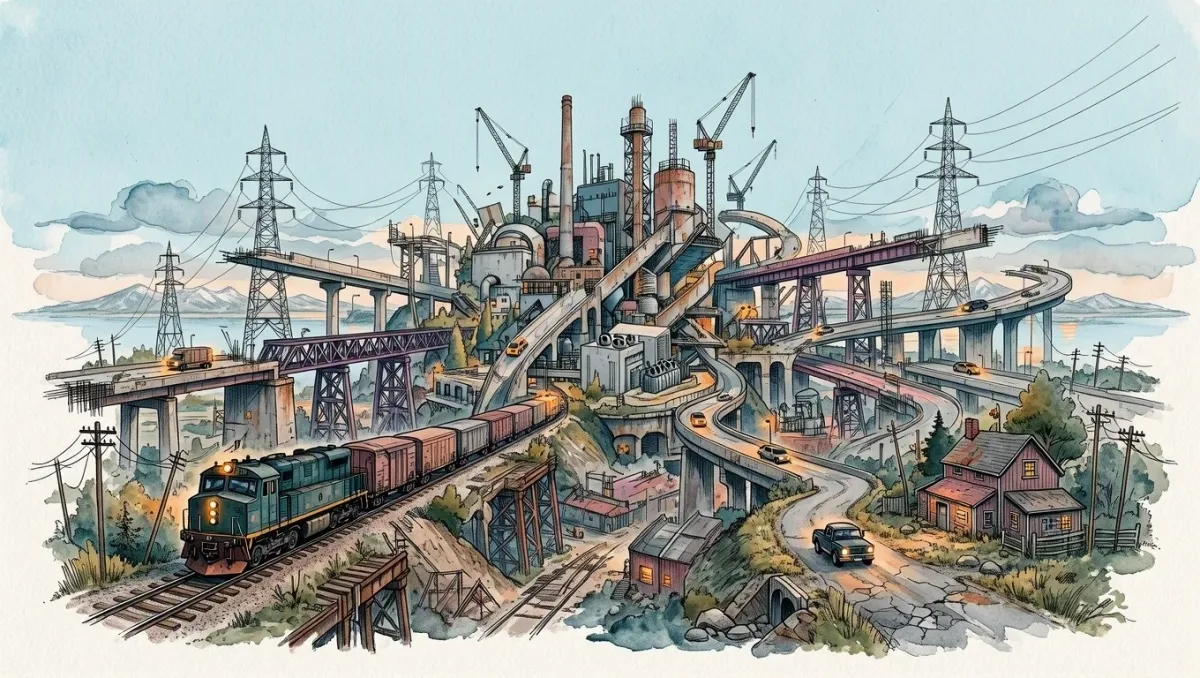
The buildout can keep growing before AI pays its way. Who finances the interval matters.
In the fiscal year that ended in May, Oracle raised $46 billion from notes, term loans, and other borrowing. Its operations produced $32 billion in cash over the same twelve months, and it spent nearly $56 billion on capital projects. On the other side of that ledger sit contracts worth $638 billion in revenue that Oracle has signed but not yet delivered. Its borrowing proceeds exceeded its operating cash as it built capacity against those contracts.
Large AI contracts drove much of the increase in that backlog, which Oracle calls remaining performance obligations. Some customers are already helping pay for construction. Oracle reported $75 billion in prepaid or customer-supplied hardware within its large AI contracts, reducing the capital it needs to raise. If the labs grow as they expect, their demand helps turn the new capacity into revenue. If they do not, Oracle is holding steel and chips built out based on someone else's forecast.
The debt Oracle sold is one line in a much larger financing tree. Morgan Stanley estimated in July 2025 that global data-center spending will reach about $2.9 trillion through 2028, that hyperscalers will fund roughly $1.4 trillion of it from their own cash flows, and that the remaining $1.5 trillion has to come from outside. Its breakdown of that gap runs to $800 billion of private credit, $200 billion of investment-grade bonds, $150 billion of securitized deals, and around $350 billion from private equity, venture, and sovereign funds. That outside capital includes both debt and equity. Its providers take different claims on the buildout, with repayment or returns depending on the businesses and projects they finance.
The buildout can keep growing before its new capacity pays for itself. Some owners can finance the interval from established businesses; others need reserves or fresh capital, while labs sign contracts for capacity they expect to use. Following those payments around the circle shows who can afford to wait for customer revenue and who remains obliged to pay if it arrives late.
The circle
Let's follow a dollar around the circle. Chipmakers sell accelerators to hyperscalers and to specialist cloud providers, who build data centers and lease the capacity to labs. The labs commit to payments under those capacity contracts. Lenders put up money for the buildings because those promises stand behind them, and the chipmaker's next quarter depends on the builders getting financed.
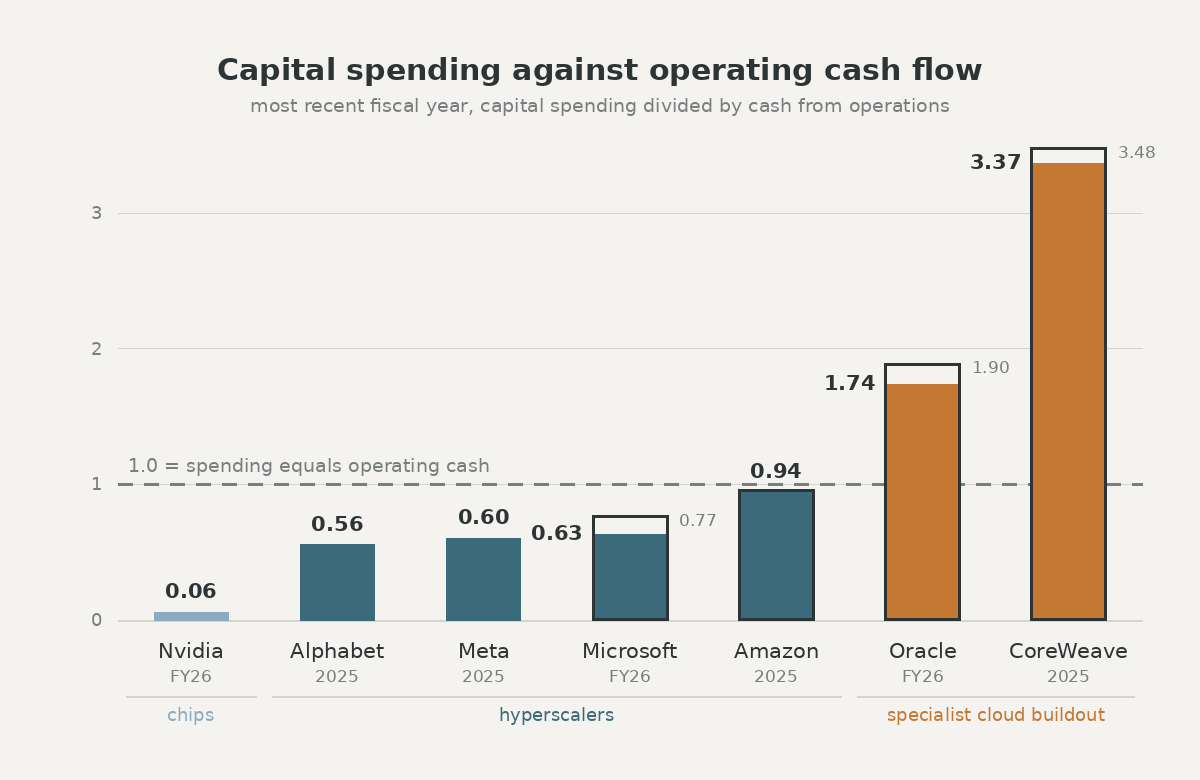
At the top of it, Nvidia's capital spending is a rounding error against its operating cash, about six cents on the dollar, and its gross margin in the most recent quarter was 75 percent. That margin is not a benchmark for anyone downstream to reach. The chip price that supports it becomes part of the buyer's capital spending.
Below the chip layer there are two ways to pay for the accelerators. A company that already sells search, ads, or software funds them from operating cash. In their most recent fiscal years Alphabet spent just over half its operating cash on capital projects, Meta about three-fifths, and Microsoft closer to three-quarters once finance leases are counted. Meta issued nearly $30 billion of debt anyway, which makes its leverage elective rather than necessary. Amazon sits just under the line, with capital spending at 94 percent of operating cash. The other way is to borrow. Oracle's capital spending ran to 1.7 times its operating cash. CoreWeave's ran to 3.4 times, against a contracted backlog twelve times its annual revenue. It priced $3.7 billion of convertible notes due 2033 at 2.875 percent, well below the 8.5 to 9.75 percent it pays on its straight senior notes. The equity option helps explain the lower coupon; the gap is not a clean comparison of credit risk.
The labs rent rather than build. Anthropic reportedly committed $200 billion to Google Cloud over five years. The company says its new Google and Broadcom capacity is expected to come online starting in 2027. OpenAI's reported infrastructure book includes purchase commitments for capacity from Oracle, Microsoft, Amazon, and CoreWeave. Its Stargate sites are also a partner buildout with Oracle and SoftBank.
The distinction is how much construction current operating cash can support. A thick cash cushion gives an owner room to fund capacity before its new AI business earns enough to pay for it. Where that cushion is thin, construction depends more on cash reserves or additional financing. Spending more than operations generate does not by itself establish that a company cannot service its debt or that a project will fail. It does mean that two providers expecting the same future demand can have very different room to wait for it. One can keep funding construction from an established business; the other may need fresh capital on terms it does not control.
No filing contains the whole transaction. A hyperscaler's annual report puts the data centers in capital spending without separating the AI revenue they are meant to produce. The lab publishes an annualized revenue figure without the schedule of payments behind its compute contracts, while the builder records those same contracts as backlog without showing the lab revenue needed to make good on them. Each report does what its accounting requires, leaving the spending, revenue, and obligation in three different sets of books.
AI revenue divided by AI capital spending looks like the number that would settle the buildout's arithmetic. Bain has published one version. At the capex-to-revenue ratios it considers sustainable for cloud providers, $500 billion in annual data-center capital spending would correspond to $2 trillion in annual revenue by 2030. That calculation matches cloud providers' revenue to their own capital spending. Comparing a lab's revenue with the capital spending of the companies building its capacity answers a different question. Even the revenue side changes with who is counting. Gartner's May forecast puts worldwide spending on AI models at about $59 billion for all of 2027, while Anthropic alone was already reporting an annualized revenue rate above $65 billion by mid-August. Those figures describe different transactions under the same label. Until the revenue and spending come from the same set of books, the ratio cannot tell us whether the buildout pays.
The lease is the loan
A lab buying cloud capacity need not own the data-center plant. Compute used to serve customers generally runs through cost of revenue, reducing gross margin; training compute can instead appear in research and development below gross profit. Annualized revenue can exceed an average year of compute commitments while the infrastructure underneath it is still deep in its spending phase. The crossover says nothing about what remains after the compute bill is paid.
Anthropic is the current illustration. Its revenue run-rate rose from about $9 billion at the end of last year to more than $65 billion by August, while its $200 billion Google commitment averages roughly $40 billion a year over five years. On that rough comparison, annualized revenue now exceeds the commitment's yearly average. The margin tells a less comfortable story. Anthropic's gross margin was projected at about 40 percent for 2025, implying roughly sixty cents of every revenue dollar would go to serving customers. In preliminary figures for the second quarter of 2026, it reported more than $11.5 billion of revenue and positive adjusted operating income. That measure excludes stock-based compensation. The $559 million operating-profit figure reported in May was an investor projection, not the quarter's result; the public figures do not establish GAAP profitability.
The infrastructure behind part of Anthropic's cost sits on Google's balance sheet, not Anthropic's. For OpenAI, much of it sits with Oracle and Microsoft. A lab's annualized revenue can overtake its average yearly commitment without covering the capital spending required to build that capacity. Its contract appears upstream as a supplier's backlog, alongside the capital spending and debt required to fulfill it. A lab's improving margin does not establish that its supplier can fund the next building from operating cash. The supplier finances the asset, while the contract determines what the lab must pay if it uses less capacity than expected.
OpenAI's reported commitments show why the missing schedule matters. Last autumn, Sam Altman said the company had committed to spending about $1.4 trillion over eight years on data centers and cloud services. In February, CNBC reported that OpenAI was telling investors it now planned to spend roughly $600 billion on compute by 2030. It also projected more than $280 billion of revenue in 2030 and described the lower spending plan as more directly tied to expected revenue growth. The two totals cover different periods and may describe different obligations. One is the capacity OpenAI said it had lined up. The other is what it now plans to use by 2030. Neither comes from a filing or published contract, so we cannot tell whether OpenAI must pay for capacity it does not use or has merely reserved access to it.
Without those contract terms, the $1.4 trillion can be read as capacity OpenAI reserved or as money it owes. That is the difference between a ceiling and a floor. A public filing should disclose material cash requirements and the periods when they fall due, though it may not reveal every contract's payment schedule or cancellation terms.
Two steps from the revenue
A lab’s right to cancel a capacity order matters to the supplier’s lenders, because the supplier may still have construction bills and debt payments to meet. Morgan Stanley’s $1.5 trillion estimate measures how much outside capital the buildout needs beyond projected hyperscaler cash flows; it does not tell us when customer payments will cover the spending. Those payments contribute to a supplier’s revenue, while the cash available to service its debt also depends on costs, other customers, and other businesses. Lenders may receive private financial information about the labs buying that capacity. Public readers still lack the accounts needed to examine those customers’ revenue alongside their costs and commitments.
Anthropic filed confidentially for an IPO in June, and Axios reported on September 14 that it was still likely to list this year. OpenAI filed confidentially too, but Sam Altman said on September 12 that the company would not go public in 2026, calling the moment “ill-advised.” If those plans hold, Anthropic will be the first of the two to publish an S-1.
Anthropic's public filing will bring its audited financial statements and material commitment disclosures into view. Readers will be able to examine revenue, the cost of serving customers, and obligations for future capacity within the lab's own accounts. It will make one customer's side of those relationships more visible, without providing a complete account of its suppliers' project economics or financing.
The effects will travel upstream, though not evenly. Anthropic’s accounts will speak directly to Google and Amazon, both investors and infrastructure suppliers. They will say less about Oracle and CoreWeave, whose backlogs include large contracts from OpenAI and other customers. Even so, the first public margins from a standalone frontier lab will give suppliers and lenders a benchmark for the customers whose commitments are financing the buildout.
The strongest case that this is fine
Borrowing to build infrastructure is not itself evidence that something has gone wrong. A data center has to be constructed before it can earn revenue, and debt can spread the cost across years in which customers use it. Capital spending above current operating cash may therefore reflect an investment that will pay for itself, rather than a business that cannot. The size of the funding gap alone cannot distinguish the two.
The distinction depends on when cash arrives relative to the payments already due. Oracle's backlog records contracted future revenue, not cash available today to cover construction or debt service. A supplier can bridge that interval with existing resources or financing. But if customer payments arrive later than expected, its ability to continue depends on how much cash it has, when its obligations fall due, and whether it can raise more. At the lab, a binding capacity commitment can keep the compute bill due even when customer demand falls short. The financing problem can therefore appear before anyone knows whether the long-term demand forecast was wrong.
Whose cash is covering the build
The buildout's ability to continue is not the same as its ability to pay for itself. Existing search, advertising, and software businesses can fund some capacity before AI earns its cost. Where construction exceeds operating cash, reserves and external capital must cover the difference. For a lab renting that capacity, the test is how much cash remains after serving customers and funding research, and whether it can meet the payments in its contracts. Those are connected questions, but success at one layer does not settle the accounts at another.
Oracle's $46 billion of borrowing helped finance construction ahead of the revenue that capacity is meant to earn. Anthropic's filing will give public readers a clearer view of one lab's ability to pay its suppliers, not an answer for Oracle's entire backlog. If customer revenue arrives later than planned, the buildings and financing obligations remain. The contracts determine who must keep paying while the wait gets longer.