AI and the Meaning Crisis at Work
AI is changing which jobs survive, which tasks disappear, and which parts of work still feel like ours.
This is the fourth article in "The Shape of the Next Decade," a series mapping what the next ten years of AI actually look like when you follow the dependencies instead of the headlines. Part one: The Half-and-Half. Part two: The Three Tiers. Part three: The Machine That Learned the Meeting.
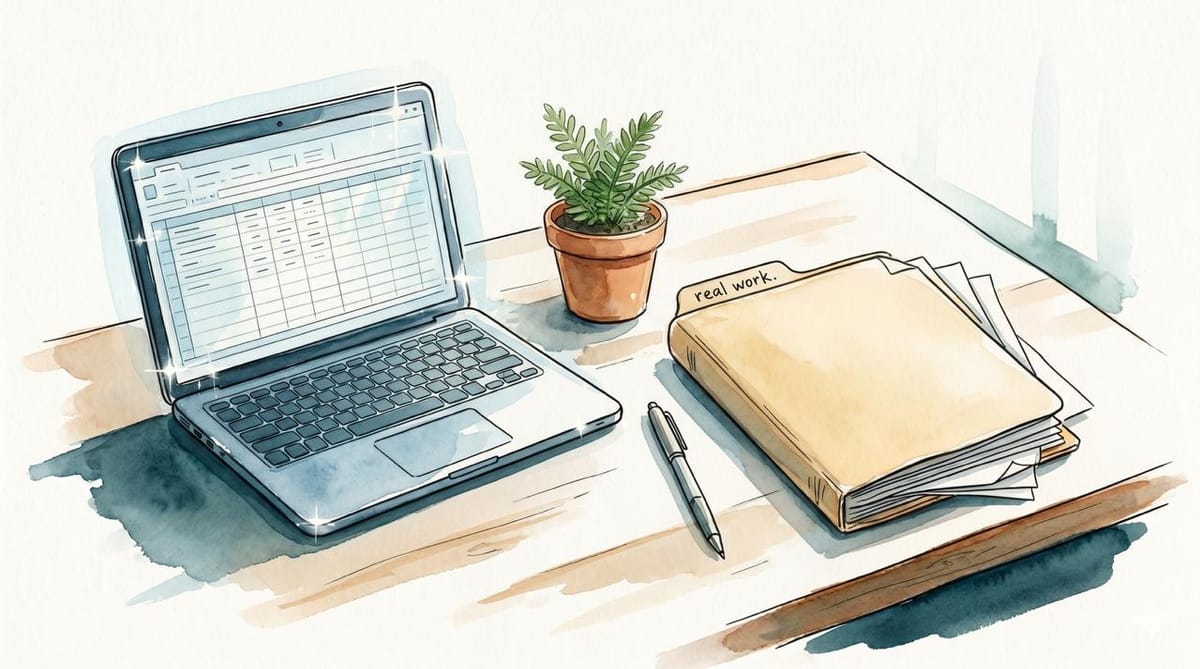
Maya kept the old version of the report in a folder called real work, which had started as a joke and slowly stopped feeling like one.
The new workflow was better by almost every visible measure. The model pulled the source files, built the table, drafted the summary, checked the inconsistencies, and gave her a version she could mark up before lunch. Her manager liked it. The client liked it. The team shipped more work with fewer late nights, and nobody had to pretend the old process had been efficient.
But a year earlier, the report had taken two days, and those two days were where Maya had learned to see the job. She knew which tables lied by omission, which old client preference still mattered, which appendix needed a quiet caveat because someone in procurement would read it like scripture. The new report was good enough that the old proof of her competence had become a review task.
Earlier in this series, I called this the split between artifact work and consequence work. AI is making the visible output easier to produce, while pushing more pressure onto the people deciding whether the output should exist, where it should go, and who owns the mess if it fails.
Professional identity does not split cleanly in two. Most jobs mix craft, execution, translation, coordination, and trust, and people move through those modes during the week. The same tool can feel like rescue to one person, theft to another, and background noise to a third. The difference is the part of the work that made the person feel like themselves.
The executor
For a software developer, it might be the code. For a translator, the sentence that finally carried the right meaning across languages. For an illustrator, the image that did not exist until their hand made it. For an analyst, paralegal, technical writer, or junior consultant, it might be the clean memo, the table that caught the problem, the document that proved they had seen what others missed.
In 2023, the writer and programmer James Somers described the anxiety with unusual precision in The New Yorker. The pleasure, he wrote, was in the process rather than the product. Somers' fear was that if the process collapsed into a three-minute exchange with ChatGPT, the product might survive while the thing that made the work satisfying disappeared.
Jon Christensen, a programmer with two decades in fintech, put it more bluntly in Every: "Code as craft was my religion, my identity." The line sounds melodramatic until you watch a competent person lose the center of a craft without losing the paycheck attached to it.
Economic charts do not catch this kind of injury very well. The job and title may still exist, and the output may even improve, while a large portion of the work stops feeling like something the person did.
Translators have been living a harsher version of the same shift. In Blood in the Machine, Brian Merchant’s reporting is anecdotal rather than a labor-market census, but the stories are stark. Julian Pintat, a technical translator with fifteen years of experience, said most of his requests had become post-editing machine output. Katherine Kirby, a translator in Rome, told Merchant she had received no work requests in June 2025 and was considering cleaning houses at 44. Laura Schultz, a Quebec translator with more than fifteen years in the field, said her income had fallen sharply as the work changed from translation to correction.
These are income stories, but they are also recognition stories. Translation did not vanish because demand for language disappeared. The market decided a rough machine version plus a human cleanup pass was enough for many jobs. The human moved from creator to supervisor, from writer to error-catcher, from the person who carried meaning to the person making sure the conveyor belt had not dropped any parts.
Artists describe the same narrowing. Merchant's reporting on illustrators and artists is full of people who can still make art, still know how to see, still have the skills they spent years building, and are watching clients decide, in some cases, that an approximate image is close enough. The wound comes partly from cheaper work and partly from the market exposing how little some buyers cared about the difference.
That is the executor's problem. The thing that once proved you were good becomes easy to produce, and it turns out abundance feels different when the abundant thing is also the work you were proud of.
The orchestrator
Across the hall, someone else is having the best professional year of their life and feeling faintly guilty about it.
One version is easy to imagine because it is already happening in pieces: a product manager joining a growing software company does what people have always done when they enter an unfamiliar codebase and an established team. She reads the wiki, watches old sprint retros, searches Slack history, asks awkward questions in standups, and builds a private map of why certain features exist and others keep getting deferred.
By February, an AI assistant is open in a second tab. It helps with competitive research, user interview summaries, and drafting PRDs that would have taken a full afternoon. She is still doing the work, or at least it feels that way. The model is a research intern with better formatting.
By April, the threshold has moved. Anything that looks like a twenty-minute task becomes a candidate for delegation: a feature spec, a first draft of release notes, a stakeholder update, a script to pull usage metrics from the analytics dashboard. She spends less time assembling documents and more time asking whether the thing on the screen actually solves the problem customers described.
By May, the unit of delegation has changed again. An agent pulls the latest support tickets, cross-references them with the product roadmap, drafts a prioritization memo with usage data attached, and posts it to the team channel for review. The handoff has moved from a task to a workflow. The leash lengthened because the last few pulls had not gone badly, and that was all the authorization anyone needed.
For some workers, this feels less like hollowing out than oxygen.
The person who always wanted to think in systems, sequencing, tradeoffs, and judgment suddenly gets more hours there. The artifact grind does not disappear, but it stops eating the day. The blank-page tax shrinks. The annoying glue work gets less annoying. For once, the tool is roughly the same size as the problem in their head.
That liberation is real. Some people are better at deciding what should happen than producing every artifact by hand, and AI gives those people more surface area.
The catch is that orchestration quality shows up faster now. Slow execution used to hide mediocre direction. A bad plan could take weeks to reveal itself because the team needed weeks to build the first artifact. When the artifact arrives in an afternoon, the quality of the ask is obvious by dinner. Good orchestrators compound while bad ones lose the fog that used to hide weak direction.
The other shadow is across the hall. The orchestrator's leverage comes partly from the compression of the executor's work. The same workflow that gives one person more altitude gives another person less authorship. Both experiences can be true in the same organization, on the same day, using the same model.
The next decade will contain a lot of people who feel guilty about thriving.
The translator
Some work happens in the messy space between worlds, where the job is neither making the artifact nor deciding all of its consequences.
A clinical informaticist sits between nurses and software vendors. A sales engineer sits between a customer's actual problem and a product team's formal roadmap. A project manager sits between legal, finance, engineering, and the executive who has decided the whole thing should be simple by Friday. Their value is the ability to move between domains without losing the thread.
AI should be good news for these people. In many cases, it is. A model can summarize the technical document before the meeting, turn the meeting into a brief afterward, and translate the executive's vague anxiety into three questions the engineering team can answer. The translator gets more reach.
But translation work has a quieter identity problem. The rare skill was never just understanding both sides. It was being the person in the room who could make both sides feel understood, which is harder to put in a ticket. AI can now do a passable version of the first part for almost anyone. It can simplify a technical note, draft a customer-facing explanation, turn a policy document into a checklist, and make a specialist sound less alien to everyone else.
The hard cases remain human: the angry customer, the frightened patient, the executive who says the system is broken when the real problem is that no one wants to own the decision. Models are useful in the room, but they do not carry social risk for the room.
The change is scarcity. If everyone can produce a decent cross-domain summary, the translator's routine magic becomes less rare. The work that remains is more delicate and more important, but also harder to explain in a performance review. "I prevented three groups from misunderstanding each other" is valuable. It is also hard to count.
Nursing offers a useful glimpse of the pattern. Ambient AI documentation systems listen to patient conversations and draft clinical notes. In a piece for Emerging Nurse Leader, Rose O. Sherman wrote that nurses may spend 25 to 35 percent of a shift on documentation and argued that ambient listening may favor nurses who communicate clearly with patients while revealing gaps in novices' verbal assessments. The AI documents the work and reveals who can translate a clinical encounter into usable information.
That is what makes this position slippery. AI can strengthen the translator by removing rote documentation and prep, while also diluting the translator by making ordinary translation available to everyone. The person whose identity was "I understand both sides" has to move toward a harder claim: "I know which misunderstanding will matter before anyone else can see it."
The discourse barely has language for that. There are lament essays for coders, lawsuits from artists, and dashboards for productivity gains. There is less space for the person who still has a job, still matters, and can feel their scarcity premium thinning in real time.
The craftsperson
The physical therapist is not losing sleep over ChatGPT mobilizing a shoulder.
Bodies are stubborn. They have pain thresholds, scar tissue, fear, compensation patterns, and tiny changes in movement that do not fit neatly into a form field. A model can help with notes, billing codes, and patient education. It cannot put a hand on a joint and feel the difference between guarding and damage.
For embodied workers, the first wave of AI often looks genuinely positive. In a Confluent Health case study, Rudy Marin, a physical therapist with thirty-five years of experience, said he used to eat dinner with his wife and then type evaluation and treatment notes until 10:30 or 11 at night. After ambient documentation, he said, he hardly takes work home.
That sounds less like a crisis than the machine giving him his evenings back.
Electricians are living another version of the paradox. They are among the harder workers to substitute away in the AI buildout and among the most necessary to it. Data centers need power, wiring, cooling systems, and maintenance. The Bureau of Labor Statistics projects electrician employment to grow 9 percent from 2024 to 2034, with about 81,000 openings each year on average, and Wired reported that Google is funding electrician training efforts aimed at upskilling 100,000 existing electricians and training 30,000 new apprentices by 2030. The chatbot revolution still needs people who can safely work around voltage.
The embodied craftsperson gets a longer runway because the value lives partly in the body. Surgeons, field engineers, nurses, electricians, machinists, chefs, and physical therapists know things through timing, pressure, and presence. Language models can advise the work before and after the moment. They do not yet inhabit the moment itself.
Physical craft has been deskilled before. Harry Braverman, a coppersmith and steelworker before he became a labor theorist, argued in Labor and Monopoly Capital that industrial systems often separate conception from execution, leaving workers with less control over the work even when they remain employed. A 2025 New Labor Forum essay revisiting Braverman describes his larger point this way: capitalism can splinter the worker, pulling craft knowledge away from the person doing the work.
Machining shows the ambiguity. In a 2024 essay on computer numerical control machines, economist David Deming argues that CNC shifted machinists toward more computer-assisted, planning-heavy, problem-solving work, even as the wage and employment story became rougher. The work did not simply disappear. It changed who had leverage inside it.
That is the craftsperson's unease. AI may give them their evenings back first. Later, robotics, sensors, scheduling systems, and automated planning may start compressing the larger arc of the job. For now, the machine takes the paperwork and leaves the hands. Later, the institution may decide the hands are the only part it still needs.
The anchor
There is also the person everyone calls when the official process has stopped helping.
She is the senior account manager whose clients call her personal phone before they call the firm. He is the project lead who remembers why the last vendor failed even though the official postmortem says something polite about integration risk. They are the sourcing coordinator from the last piece in this series, the person who knew which factory owner answered at midnight when customs held a container and which one cut corners when cash got tight.
AI has a hard time replacing that kind of trust. It can summarize the emails, rank the vendors, surface the prior contracts, and generate the call brief. It cannot be the person who picked up the phone during the last crisis and fixed the thing quietly enough that nobody upstream ever learned how close it came to breaking.
The anchor looks safe. In some organizations, AI may make them more central. If one trusted person can now produce the artifacts that once required a team, the relationship holder becomes even more valuable. The client does not care who built the deck; the client cares who will answer when the deck is wrong.
Most anchors become trusted by doing years of less glamorous work first: drafting, checking, translating, fixing, visiting, calling, apologizing, remembering. They build relationships by delivering, and they learn which details matter because they handle the details before they have the authority to delegate them.
If AI compresses the apprenticeship layer, the current anchors may be fine while the next generation loses the path into becoming them. Susan Pickford, a senior lecturer at the University of Geneva, told Merchant in the translator piece that there is likely a talent gap coming at the top of the profession as people retire. Translation is only one field, but the shape is broader. If fewer people spend years doing the work that builds judgment, fewer people become the elders whose judgment everyone trusts.
The anchor's crisis arrives late. It may not even arrive for the current anchor. That is why organizations miss it. The dashboard works until it needs a relationship. The junior layer shrinks until the senior layer retires. The institution keeps its trusted people long enough to forget how trusted people are made.
The same office
These five stories overlap. Most people live inside more than one of them.
A nurse may be part embodied craftsperson, part translator, part cognitive executor. A software engineer may be mostly executor on Monday, mostly orchestrator by Thursday, and a reluctant relational anchor when the production system fails because only one person still remembers the old migration. A product manager may feel liberated by AI in the morning and quietly displaced by it in the afternoon, when the model writes the kind of synthesis that used to make them feel rare.
The standard AI-and-jobs debate feels too flat because employment, wages, and skill demand each catch only part of the story. Underneath all three is a quieter question: which part of the work made the day feel like yours, and what happens when that part becomes cheaper, thinner, or less visible?
The answer changes by person, and sometimes multiple times per day. For some people, AI removes the least meaningful part of the job and gives them more room for the work they came to do. For others, it removes the activity that carried dignity, even if the title survives. For many, it does both.
Management language keeps missing the thing. "Reskilling," "productivity," "morale," and "change management" each catch part of the change and miss the injury underneath. A person can be upskilled and diminished. A team can be more productive and less sure where its judgment lives. A company can preserve headcount while quietly breaking the apprenticeship paths that made its senior people senior.
The org chart stays put, the titles stay put, and the work still gets done. What changes is more intimate — which parts of the day still feel like yours.