Sovereignty Is Not a Model You Can Download
Open weights can cross a border overnight. The power to run, adapt, govern, and keep what they learn cannot.
This is the eleventh article in "The Shape of the Next Decade," a series on how AI reshapes work, institutions, and ordinary life. It follows The Grid Under the Cloud.
In February 2026, India announced that one of its most-used pieces of public software had moved home.
Bhashini is the government's national language platform, built so that an Indian citizen can speak to a state service in Tamil or Marathi and be understood. It initially ran on a global cloud provider. The government moved the serving system onto domestic infrastructure, keeping its language data, models, and interaction records inside Indian jurisdiction.
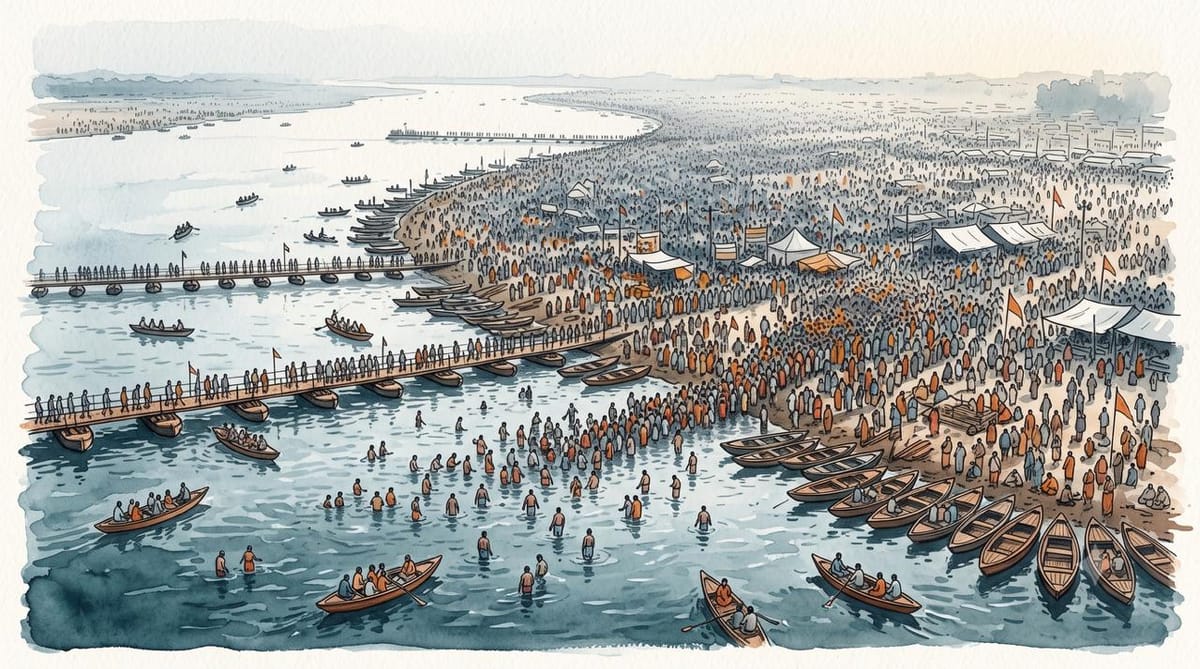
During the 2025 Maha Kumbh, a six-week Hindu pilgrimage and festival in Prayagraj, tens of millions of people gathered to bathe at the confluence of the Ganges and Yamuna rivers. Bhashini delivered real-time voice translation during the event. The domestic system had to carry a public service through exceptional demand, not merely satisfy the terms of a procurement announcement. India had not created every component underneath it, but it had taken responsibility for keeping the service running.
On July 16, the Chinese lab Moonshot AI announced Kimi K3, a 2.8-trillion-parameter model, and said it would release the full weights eleven days later.
K3 has a million-token context window and built-in vision, and it is already available through Moonshot's apps and API. The company says the full weights will arrive on July 27, making it technically possible for governments, research labs, and companies to host and adapt the model. Moonshot has not yet named the license that will govern those uses.
Moonshot recommends running K3 on "supernode" configurations with at least 64 accelerators. The weights may be free; the hardware, electricity, and engineering staff required to operate them are not.
What "leapfrogging" actually skipped
Leapfrogging has real history behind it. Kenya built mobile money before many richer countries, and the UN estimates that mobile payments moved roughly two trillion dollars across the Global South in 2025. India built a digital identity system that now underpins much of its economy; Rwanda and Ghana deployed national drone networks for medical supplies early. Each country built a useful service without first reproducing every layer of the older infrastructure.
K3 appears to offer the same shortcut. A country that never trained a frontier model can begin with a capable open one, just as countries that never laid extensive copper networks moved directly to mobile.
The shortcut ends once the model enters an institution. A mobile user can receive a finished service through a handset. A hospital or ministry running K3 has to decide where inference happens, who can alter the system, how local-language failures are corrected, and where the resulting evaluations and records will live. Open weights remove the need to train the original model. They do not remove the work of turning that model into a service an institution can operate and answer for.
Access, application, and institutional capacity therefore develop at different speeds. People can already use capable models, and open weights widen that access. Local organizations are beginning to build useful services on top of them. Durable sovereignty arrives later, when local institutions also control enough infrastructure, expertise, accumulated learning, and decision-making authority to shape those services themselves.
Mobile phones have spread everywhere, but much of the cloud infrastructure, app-store control, and advertising revenue remains concentrated in a handful of foreign companies. Countries gained access to the service without gaining equal control over the system underneath it.
Two ways to borrow strength
Few countries can build every layer of the AI stack alone. India and the African Union are filling the gaps in different ways.
India is building shared national capacity. The IndiaAI Mission pools compute and rents it to startups and researchers at subsidized rates; the government said more than 38,000 GPUs were available in February 2026 and announced another 20,000. The same mission funds a national datasets platform, several homegrown language models, and an AI Safety Institute. The GPU figures come from the government, and announced capacity may take time to become usable. Still, a university lab or ministry can gain reliable access to compute without owning a frontier cluster or depending entirely on one vendor's commercial priorities.
India's shared capacity still depends on imported chips, foreign supply chains, private cloud operators, and global capital. Moving Bhashini secured Indian jurisdiction over its data and serving infrastructure; it left the accelerator supply chain largely outside India's control. A system can therefore be sovereign under domestic law while remaining exposed to foreign suppliers.
The African Union is building capacity through partnership. Its Continental AI Strategy, adopted in 2024, calls for an Africa-centric, cooperative approach. In February 2026 the AU Commission signed a memorandum with Google explicitly framed as advancing Africa's "sovereign AI and digital capacity": public-sector training, education, local-language support, digital public infrastructure, and access to Google's products. Google described the goal as moving the continent "from digital access to digital agency."
The partnership can transfer skills, widen access, and build capacity faster than the AU's members could manage alone. Its announcement does not specify which infrastructure African institutions will control, whether evaluations and workflow history will be portable, or what happens if Google's terms change. Those details will determine whether the partnership leaves institutions more capable or simply better served by Google.
India and the AU both rely on outside suppliers, but they are trying to make different dependencies visible and replaceable. The practical measure is whether local institutions become more capable over time and can preserve public priorities when a supplier changes its prices or rules. The UN's foresight work proposes regional compute pools, common data standards, and joint procurement as one way for smaller countries to gain bargaining power without each maintaining a full national stack.
GPUs and contracts are easier to count than the learning an institution creates after deployment. As public employees correct outputs, define exceptions, and connect decisions to later outcomes, that working knowledge may accumulate inside the supplier's tools even when the servers and raw data remain within national borders.
The learning can leave even when the data stays
In a hospital, a clinician may correct a model's recommendation. If the correction stays attached to the case, the hospital can later compare it with the patient's outcome. Repeated corrections may become a new escalation rule; repeated outcomes may change what the hospital counts as a good answer. The value comes from the chain connecting model output, human decision, and consequence over time.
A ministry develops the same kind of working knowledge around its own rules. Staff learn which cases need review, where automated decisions fail, and which exceptions should become policy. Those judgments accumulate even when the underlying model changes.
The chain is easy to fragment. A correction may sit in a vendor dashboard while the outcome remains in a clinical or administrative system and the escalation rule survives in an employee's head. Every file can stay inside the country while the institution lacks a portable account of why its system works.
The provider may never train on the protected data. The institution can still keep its files without building a usable memory of what worked.
Satya Nadella has urged companies to keep their workflows and institutional learning portable as models improve. The national version carries higher stakes. If a public institution loses the connection between decisions and outcomes, it becomes harder to govern benefits, medical triage, disaster response, or language access. Citizens cannot switch to a competing ministry, and appeals become hollow if the state can no longer reconstruct how its own system reached a decision.
The server location does not answer the portability question. If the model or provider vanished tomorrow, would the institution retain the evaluations, policies, workflow knowledge, and outcome history that made the system work? A system that preserves those materials can replace its model. One that does not has left part of its institutional competence with the supplier.
Keeping that learning local does not guarantee good decisions. It preserves the evidence and authority that a country's laws, oversight bodies, and public institutions need to inspect and change the system.
Sovereignty without autarky
Only 32 countries host a specialized AI data center, according to Oxford University research, and Africa and Latin America together hold about three percent of global AI compute. Most countries will assemble their AI systems from a mixture of imported chips, rented compute, foreign models, domestic data, and local rules. Their sovereignty will be partial and negotiated.
That mixture can still leave an institution with meaningful control. A ministry might rent compute from a public pool and use a foreign model while keeping its evaluations exportable, its authorization rules local, and its interfaces documented. If those pieces can move with the workflow, changing providers is disruptive without erasing the institution's accumulated knowledge.
Regional compute pools and joint procurement are attempts to make that exit more credible for smaller countries. They provide another place to run a workload and more leverage when a supplier changes its prices or policies. The arrangement still depends on outside hardware and capital, but fewer decisions rest with a single provider.
If Moonshot keeps its July 27 deadline, ministries and startups around the world will be able to download one of the largest open models released so far. Bhashini offers the useful comparison. India arranged domestic compute, moved the serving system and its records into Indian jurisdiction, and tested the service during a gathering of tens of millions of people. Once the files are available, moving them is measured in hours or days. Building the institution around them is measured in years.