Bright Signals — April 21, 2026
A wearable that reads unspoken words from neck muscles, and the people with brain implants who are organizing to shape the technology. Two paths, same destination.
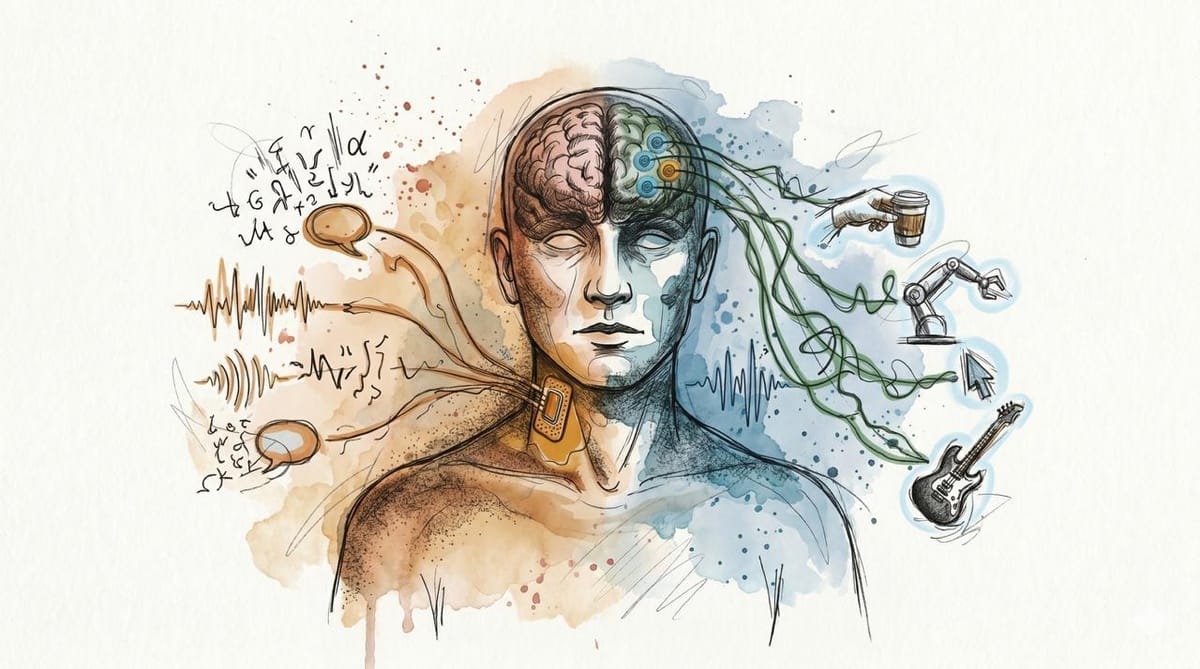
Two stories this week about AI restoring things that disease and injury took away. One uses a thin sensor against the skin. The other uses electrodes implanted inside the brain. They arrive at the same destination from opposite directions, and both are starting to work for real people.
A neck-worn sensor that reads unspoken words
Researchers at Pohang University of Science and Technology (POSTECH) in South Korea have built a wearable device that sits against the neck and reads the subtle muscle movements that happen when you intend to speak, even if no sound comes out. A paper describing the work appeared last week on EurekAlert, a science press release service, with coverage in Neuroscience News and Digital Trends.
The device uses a multiaxial strain sensor, a flexible element that measures skin deformation in multiple directions at once, to detect the tiny contractions in throat muscles that accompany subvocalization. An AI model decodes those muscle signals and converts them into synthesized speech.
People who've lost their larynx to cancer, those with amyotrophic lateral sclerosis (ALS), a progressive disease that destroys the nerve cells controlling muscles — these are the users. The POSTECH device is lightweight, sits against the skin, and does not require surgery. Most current solutions for speech restoration either require invasive procedures or produce the kind of robotic monotone that makes conversations exhausting for both parties.
The usable quality comes from the AI layer. Subvocalized muscle signals are faint and individually ambiguous. The same muscle twitch could correspond to several different phonemes — the distinct sound units that make up words. The model has to learn each user's specific movement patterns and disambiguate in real time. The POSTECH team reports that their system can reconstruct natural-sounding speech from these signals with enough accuracy to be practically useful, though the paper does not yet show independent testing at scale.
Previous silent speech systems required bulky electrode arrays strapped to the face or, in Neuralink's case, a chip implanted in the brain. A thin, flexible sensor that reads through the skin is something you could wear daily without drawing attention.
The people living with brain implants are organizing
IEEE Spectrum, the flagship publication of the Institute of Electrical and Electronics Engineers (IEEE), published a piece on April 20 about the BCI Pioneers Coalition, a group of people who have received brain-computer interfaces and are now advocating for their own interests as the technology moves from labs toward clinical use. The article, by Eliza Strickland, a senior editor at the publication, profiles several of these participants directly.
Scott Imbrie broke his neck in a car accident in 1985. A doctor told him he would never use his hands or legs again. Decades later, he was accepted into a University of Chicago clinical trial where surgeons implanted electrode arrays that let him control a robotic arm and receive tactile sensations back through the implant. "I still get goosebumps when I think about that initial contact," he told IEEE Spectrum. "It's just unexplainable."
Ian Burkhart was paralyzed from the chest down in a diving accident in 2010. He became the first quadriplegic to regain hand movement through a brain implant, in a trial run by Battelle Memorial Institute, a nonprofit R&D organization, and Ohio State University from 2014 to 2021. His implant recorded signals from his motor cortex, the brain region responsible for directing voluntary movement, and relayed them to electrodes in his arm that stimulated the muscles controlling his fingers. He eventually learned to swipe a credit card, pour from a bottle, and play Guitar Hero.
Casey Harrell lost the ability to speak after an ALS diagnosis. In 2023, surgeons implanted four electrode arrays in brain regions that coordinate speech muscles, and he can communicate again.
Burkhart founded the BCI Pioneers Coalition in 2018 after his own experience convinced him that the technology would only make the leap from lab to real-world use if the people actually using it had a voice in its development. The group now serves as both an advocacy organization, pushing companies and regulators to hear from trial participants, and a peer-support network for people going through the same experience.
More people have gone to space than have received advanced brain-computer interfaces. The surgical risks are real, including bleeding and infection in the brain. The psychological toll can be severe if the implant works during a trial and then has to be removed when the study ends. John Downey, the University of Chicago neurosurgery professor who led Imbrie's trial, estimates that the number of people he talks to about getting an implant is probably 10 to 20 times the number who actually go through with it.
The companies involved include Blackrock Neurotech, Neuralink, and Synchron, each taking different approaches to the same problem. Blackrock and Neuralink use intracortical arrays implanted directly into brain tissue. Synchron uses a stent-like device inserted through the blood vessels, avoiding open brain surgery entirely. All of them are being tested for restoring movement, controlling computers, and recovering speech.
The coalition now connects participants across trials run by different companies at different hospitals, pooling experience on what daily life with a BCI actually involves — charging routines, software updates, the anxiety of not knowing whether your device will be supported in five years.