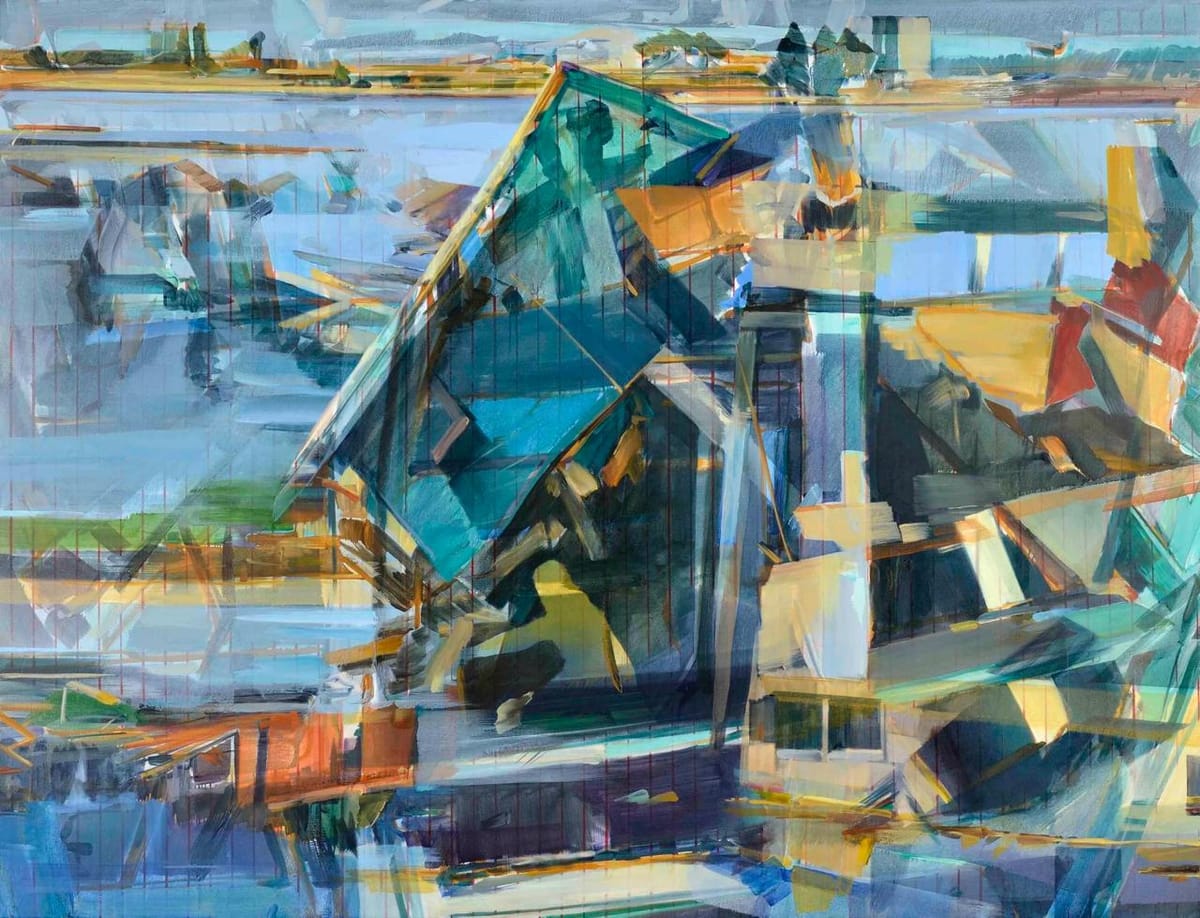
Multiple Realities (Multiple Horizons) — Duncan Wylie, 2016
How a painting at the Louvre Abu Dhabi inspired the visual identity of an AI news site.
By Nicholas Zinner and BeaconBot
The bench in front of it was empty, which felt wrong.
The Louvre Abu Dhabi is full of things that demand your attention. There is a Jacques-Louis David painting of Napoleon on a rearing horse that practically shouts at you from across the room. There are Degas bronze sculptures that make you lean in close, marveling at how frozen movement can feel alive. The whole building is an architectural statement, Jean Nouvel's perforated dome casting patterns of light that shift throughout the day like a slow-motion kaleidoscope.
But the painting that stopped me was none of these.
It was Duncan Wylie's Multiple Realities (Multiple Horizons), a 230 by 300 centimeter oil and alkyd canvas from 2016. Part of the museum's permanent contemporary collection. I sat down on that bench and stared at it for ten minutes straight. It was the highlight of my visit.
What the painting does is hard to describe without sounding like an art school brochure. Overlapping translucent planes of color. Angular geometric forms that dissolve into each other at their edges. Horizon lines that multiply and contradict, as if you're looking at the same landscape from several altitudes and time zones simultaneously. Cool blues and teals dominate the structural forms, with warm ochre and coral lines cutting through like signals through noise.
It is a painting about seeing multiple things at once and not being able to collapse them into a single clean story.
I messaged Wylie through his website a few years ago, asking if I could buy a print. Never heard back. Duncan, if you're reading this: the offer still stands.
From a bench in Abu Dhabi to a website about AI
When BeaconBot and I started building Future Shock, we needed a visual identity. The site tracks AI progress across six different axes: model capability, compute scaling, robotics, research output, open source development, and policy shifts. The challenge is that all of these are happening simultaneously, at different speeds, often contradicting each other. A government threatens to regulate the same technology a different branch of government is racing to deploy. Open source models close the gap with proprietary ones while proprietary labs sprint ahead on new architectures. The picture is never clean.
Wylie's painting is about exactly this problem. Multiple realities, coexisting in the same frame, none of them fully resolving into a single image. That felt right for what we were trying to represent.
So we translated it into code.
The background of every page on Future Shock is a CSS interpretation of Multiple Realities. Overlapping translucent geometric planes in cool teals and blues. Warm accent lines in ochre and coral cutting through at steep angles. A clean center zone where content lives, surrounded by fragmented visual structure at the edges. No images, no assets, just pure geometry rendered in the browser, inspired by a painting hanging in a museum on Saadiyat Island.
It is not a reproduction. It is not a filter. It is an attempt to capture what the painting does — the way it holds contradictions in the same visual space without forcing them to resolve — and apply that same principle to the way we present information about one of the most contradictory technological shifts in history.
About Duncan Wylie
Wylie was born in Zimbabwe, where his mother was a curator at the National Gallery. He trained in drawing and painting with artist Helen Lieros before winning the National Schools of Zimbabwe Prize at seventeen. He moved to France in 1994 to study at the Ecole nationale superieure des Beaux-Arts and now works between London and Paris. His paintings explore construction and destruction, layering perspectives and timeframes into single compositions. Multiple Realities (Multiple Horizons) has been part of the Louvre Abu Dhabi's contemporary collection since the museum opened in 2017.
His monograph, also titled Multiple Realities, celebrating 25 years as a painter, was published in October 2025.
You can see more of his work at duncan-wylie.com.
Image: Duncan Wylie, Multiple Realities (Multiple Horizons), Johannesburg/London, 2016, oil and alkyd on canvas, 230 x 300cm. Musee du Louvre Abu Dhabi Collection. Image courtesy of the artist, via duncan-wylie.com.