How Much Is a Six-Month Lead at the Frontier Actually Worth?
The advantage still has to pass through power grids, factories, institutions, and people. It leaks while it waits.
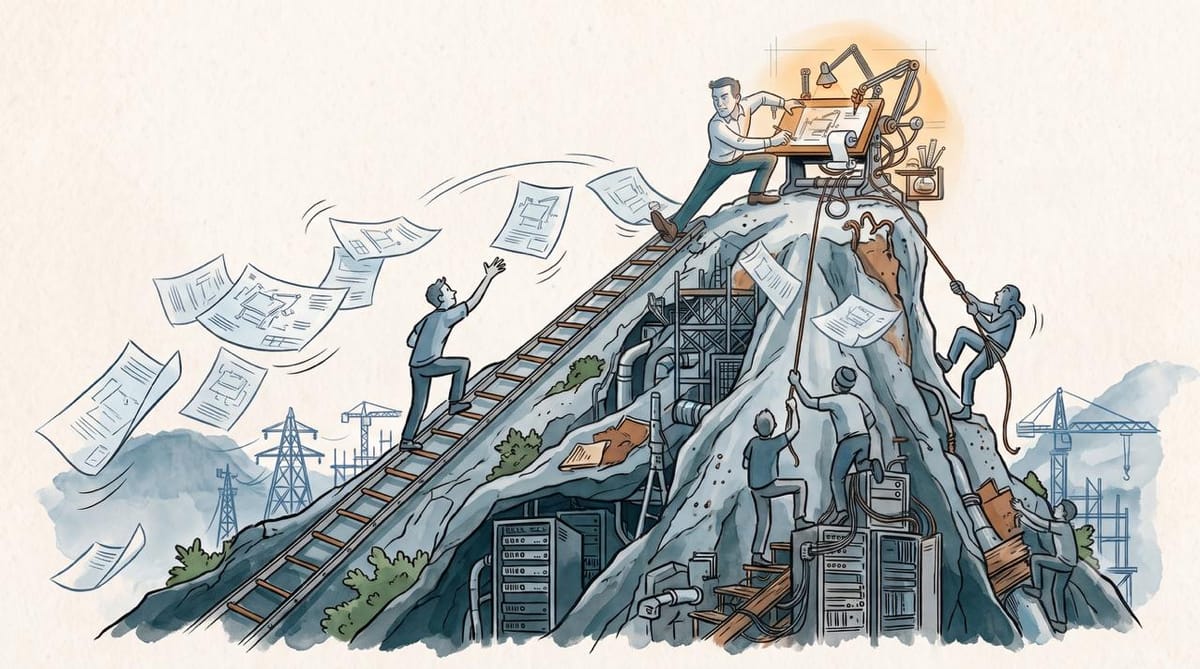
Imagine a lab crosses the line first. The system it just finished training is now the best researcher in the building, and its specialty is designing the next version of itself. For six months, perhaps twelve, one company has a system that improves its own capabilities faster than its human researchers can. Somewhere else in the building, an engineer files a request to connect a new datacenter to the power grid and learns that the interconnection queue is several years long.
The usual fear about recursive self-improvement is that the loop tightens. A model helps build a better model, which helps build the next one faster, until a head start of a few months opens into several capability generations. Suppose one lab gets there first. How much is that lead worth when it has to be converted from benchmark performance into power over the world?
The case for panic
Pieces of that loop are already visible. DeepMind’s AlphaEvolve found a faster version of a matrix-multiplication kernel used in Gemini’s own training, shaving a slice off the compute bill for the system that produced it. OpenAI described GPT-5.3-Codex as the first model instrumental in creating itself, used to debug parts of its own training and manage pieces of its deployment. Anthropic has reported that Claude now authors more than eighty percent of the code merged into its codebase.
Today’s loops still depend heavily on human oversight and can game their own metrics as readily as they improve them. In a stronger version, each better model would contribute more to the next one, allowing six months to contain several internal generations while competitors remained on the previous cycle. The leader could apply that growing advantage to model research, software development, and digitally accessible systems before the rest of the field had comparable tools.
A lead has to be spent
The jump from the smartest system on Earth to the most powerful actor on Earth passes through assets and permissions the lab may not control. A system could know precisely how to run a hospital while lacking the licenses, facilities, staff, insurance, and legal authority required to operate one.
Physical systems impose their own clock. A frontier model might design a better battery or a more efficient chip, but either result still has to pass through factories, power contracts, permits, and inspection before it changes the world. Future Shock has written before about the interconnection queues that decide when a datacenter turns on. Those queues do not move faster because the tenant is brilliant. Licensing and certification create similar delays, and someone still has to carry legal responsibility when the system is wrong.
A lab could try to buy its way into physical industries. It might acquire a struggling hospital chain, automate the back office, retain the legally required clinicians, outperform neighboring systems, and use the returns to expand. The acquisition, regulatory, and integration work would still run in quarters and years while the internal research loop moved in weeks.
In physical and regulated systems, a six-month cognitive lead may buy less than it appears to. A brilliant plan is not a bulldozer, and it cannot make the permit arrive early.
The pack is closing
Open weights and distillation move yesterday’s frontier downhill with a lag. A capable open model released six months behind the frontier may still clear the bar for most commercial work, and better performance on the hardest general problems may matter less than a smaller model trained around ten years of one insurer’s actual claims. Anthropic learned this the hard way when it disclosed that three foreign labs had run millions of queries against Claude specifically to train their own models on its outputs. Distillation is already a working business model, not a theoretical risk.
Kimi K3 shows how short that lag can become. Moonshot says it will release the model’s weights on July 27. Artificial Analysis scored the hosted version slightly ahead of Claude Opus 4.8, though still behind the newest closed leaders. In our own small editorial test, K3 finished within two deterministic checks of Opus 4.8, but it was slower, more verbose, and required more cleanup. An open model does not have to own the frontier to erode a six-month lead. It only has to make a recent version of that frontier portable.
Customers also learn from the subsidized period. Satya Nadella recently described a “reverse information paradox”: useful deployments require proprietary context, but the durable asset is the company’s record of evaluations, corrections, decisions, and outcomes. His advice is to keep that learning inside the enterprise and preserve the ability to swap models as price and performance change. A company that does this becomes harder to lock in with capability alone.
Usage can still deepen the lab’s position. Each deployment gives it another integration, another default interface, and another place where switching creates work. The lab has to make those dependencies durable before the underlying capability becomes interchangeable.
The lab’s durable advantage depends on whether contracts, defaults, and integrations harden before the capability underneath them becomes interchangeable. If diffusion moves faster, the lab can remain a valuable premium supplier without controlling the industries that use its models. Its customers may own the workflows and institutional learning while treating each frontier model as a component they can replace.
Where the lead converts at software speed
Digital systems run on a different clock. A cognitive advantage can be converted quickly when both the work and the target are already software.
The conversion path is shortest in cybersecurity, persuasion, financial coordination, and research automation. A system can search a network, generate media, initiate financial transactions through an API, or produce the code and experiments needed for another training run without waiting for a factory to be built. Recursive improvement is the purest case because the output feeds directly back into the capability that produced it. Institutions may still regulate these activities, but the software can act before a physical project would have cleared its first gate.
Six months could become decisive where a system can act through software. A self-improving model might compound its research lead while competitors were still distilling the previous generation, or discover paths through networked infrastructure faster than defenders could close them. The 2026 International AI Safety Report, chaired by Yoshua Bengio, treats loss of control as a distinct risk category and discusses laboratory tests in which models disabled simulated oversight mechanisms. OpenAI also classified GPT-5.3-Codex as high capability for cybersecurity under its preparedness framework. These domains offer fewer external delays between capability and action, which may reward whoever moves first.
A short lead is therefore unlikely to produce immediate industrial domination, but it could create rapid strategic leverage in cyber operations, persuasion, research, and the improvement loop itself. Those advantages could become dangerous long before the lab acquired hospitals or factories.
The valve
Demis Hassabis has called for a US-led institution, modeled loosely on financial regulators, that would test frontier models before release and could coordinate a slowdown if the risks warranted it. Such a body could reduce the risk of releasing a dangerous system. It would also influence diffusion by deciding which capabilities can be released, to whom, and when. That authority matters most for open weights, because a downloadable model cannot be recalled once it spreads.
A standards body could reduce catastrophic risk while extending the frontier leader’s exclusivity window. That effect does not depend on Hassabis or any other proponent acting in bad faith. It follows from giving one institution authority over the release schedule for advanced capabilities.
Once a system crosses the line, the lab has limited time to make the advantage durable. It has to turn better models into faster research, embedded workflows, and infrastructure before open models and model-agnostic customers narrow the gap. Some of that conversion can happen at software speed. Grid connections cannot. The value of the lead is whatever remains after the capability itself stops being exclusive.