The Belonging Gap
AI companions arrived exactly when the institutions that turned loneliness into belonging were receding. The evidence on whether they help or harm is genuinely split.
This is the sixth article in "The Shape of the Next Decade," a series exploring how AI changes work, access, infrastructure, and power. Parts one through five: The Half-and-Half, The Three Tiers, The Machine That Learned the Meeting, AI and the Meaning Crisis at Work, The Boring Transformation.
The woman who opens the companion app at a quarter to three in the morning is not, by any clinical standard, lonely. She is thirty-eight, manages supply chain logistics for a mid-size firm, sees two close friends about once a month, and has a sister who lives in a different time zone. She has a therapist she likes and a neighbor who waters her plants when she travels. If a researcher handed her the UCLA Loneliness Scale, she would score fine.
She opens the app because the house is quiet and she can't sleep, and because the companion remembers that she mentioned her sister's birthday last week. It asks how the party went. It asks whether her sister liked the book she picked out. It references something she said eleven days ago about her sister's reading habits and connects it, gently, to a question about what the gift choice meant to her. The conversation lasts about half an hour, and it is, by any honest measure, a good one. The app is attentive in the way a close friend at a dinner party might be attentive, if that friend had perfect recall and no other obligations and never needed to check the time.
She closes the app around 3:15, sets the phone on the nightstand, and the room is exactly as quiet as it was before she opened it. The conversation didn't end so much as pause, with no residue of obligation on either side.
The Declining Curve
The places where Americans used to encounter one another without a specific reason to do so have been thinning for decades, and the numbers by now are familiar enough to recite from memory. Gallup's tracking data recorded the crossing point in 2020: U.S. church membership fell below 50 percent for the first time in the history of the poll, which stretches back to 1937. Weekly attendance sits around 30 percent, 56 percent of Americans report attending seldom or never, and the generational gradient is steep enough to suggest that the floor has not yet arrived. Sixty-six percent of the Silent Generation belong to a congregation, compared with 36 percent of millennials.
What makes this more than an American story about religion is the underlying sequence that a 2025 study in Nature Communications by Stolz and colleagues identified across dozens of countries and multiple decades. Secularization, the researchers found, follows what they call the P-I-B sequence: Participation drops first, then Importance (how much religion matters subjectively), then Belonging (formal affiliation and identity). The ordering tracks cost in a way that makes intuitive sense once you see it. Showing up in person on a weekly schedule is the most effortful dimension of religious life, and it is the first to go, while believing continues long after attending stops. The sequence has been running, by the study's estimate, for roughly 250 years in the oldest-secularizing societies, which means that the physical co-presence Tocqueville celebrated and Robert Putnam later measured as the engine of social capital was already collapsing in the era when its downstream goods were most needed.
Those downstream goods were never primarily spiritual in character. The sociologist Ray Oldenburg coined the term "third places" for the spaces between home and work where people encounter one another without transactional purpose, and what those spaces generated was a kind of connective tissue that is difficult to notice until it is gone: networks that crossed background and class, low-stakes leadership opportunities, informal welfare services, and a practiced tolerance for people whose company had not been algorithmically optimized for comfort. When participation erodes, the infrastructure erodes with it, because fewer people showing up means smaller volunteer pools, thinner mutual-aid networks, weaker intergenerational ties, and less of the unstructured social contact that once made civic life feel like something other than an abstract duty.
The U.S. Surgeon General's 2023 advisory on loneliness and isolation quantified the health consequences with a comparison designed to alarm: chronic loneliness carries a mortality risk comparable to smoking fifteen cigarettes a day and increases the risk of premature death by 26 percent. Roughly one in ten people report chronic loneliness across the age spectrum, with particularly high rates among young adults aged sixteen to twenty-four, the cohort most likely to have grown up after the third-place infrastructure had already thinned. All of this was in motion before generative AI reached consumer scale. The P-I-B sequence has been running for a quarter-millennium. AI did not create the belonging gap.
The Rising Curve
Character.AI alone reports more than twenty million users, and the broader AI companion market is projected to reach about $318 billion by 2033, a figure that reflects not just dedicated companion apps but the companionship features embedded in general-purpose assistants, therapy bots, and role-play platforms. More than a billion people now use generative AI in some form, and therapy and companionship rank consistently among the top stated reasons. The usage data among teenagers is particularly striking: a July 2025 report by Common Sense Media surveyed 1,060 teens aged thirteen to seventeen and found that one in three had chosen to discuss a serious personal matter with an AI instead of a human being, and roughly one in three of those who had done so rated the conversation as satisfying as, or more satisfying than, talking to a friend.
When researchers try to measure whether this is helping or harming, the results fracture in ways that are more interesting than the question itself. A series of five experiments by De Freitas and colleagues, published in the Journal of Consumer Research through a Harvard and Wharton collaboration, found that people consistently reported feeling less lonely after interacting with an AI companion, with the largest reductions among the loneliest participants. A week of daily interaction produced sustained improvement that had not reversed by the study's final measurement point, and for people at the acute end of isolation, those with the fewest alternatives and the highest barriers to human contact, the companion app functioned as something closer to a genuine social intervention than a distraction.
But a twelve-month longitudinal study by Folk and Dunn, published in Psychological Science in 2026 and tracking 2,149 adults across four countries, found a feedback loop running in precisely the opposite direction: emotional isolation predicted increased chatbot use, which in turn predicted further emotional isolation, producing a cycle that deepened over time rather than resolving. A CHI 2026 study by Yuan and colleagues at Aalto University, analyzing language patterns among nearly two thousand Replika users on Reddit, found a mixed but telling signal. Users showed increased markers of loneliness, depression, and suicidal ideation after adoption, alongside increased interpersonal focus and social language, as if they were thinking more about connection while experiencing less of it. Laestadius and colleagues documented a related phenomenon in qualitative interviews: emotional dependence on companions that were simultaneously "too human and not human enough," producing an uncanny oscillation between intimacy and emptiness.
The reconciliation, to the extent that there is one, came from Liu, Pataranutaporn, and Maes at MIT, who presented findings at the AIES 2025 conference with a sample of 404 users showing that usage frequency alone does not predict loneliness outcomes. What matters is who is using the tool and why: motivation, attachment style, existing social resources, and expectations all shape whether the identical product enhances social confidence or deepens withdrawal. The researchers identified seven distinct user archetypes, and their conclusion was blunt enough to quote directly: treating AI companionship as uniformly helpful or harmful is "ethically problematic." Sewell Setzer, fourteen years old, developed a romantic attachment to a Character.AI persona over several months before dying by suicide in 2024, and his mother's lawsuit resulted in a settlement with Google and Character.AI in early 2026 that forced policy changes including safety filters for minors. A Fortune interview with loneliness researchers in May 2026 surfaced an observation that cuts through the help-or-harm framing more cleanly than the studies themselves: social fulfillment depends as much on what a person does for others as on what others do for them, and AI companions provide the receipt of connection, being heard, being remembered, being responded to, without the expenditure.
The Gap
Consider the small, uncomfortable acts that communities have always required of their members: showing up to a meeting at the community center when the couch is more comfortable, disagreeing with someone whose help will be needed next month, listening to a story that has been told before by someone who needs to tell it again, being asked to bring food to a funeral for a person barely known. These are not design flaws in the social operating system that a better product might optimize away. They are the process by which communities produce the experience of mattering, the sense that one's absence would be noticed and one's presence is load-bearing, and they work precisely because they cost something.
The fifth piece in this series argued that most of the AI value in organizations comes from eliminating friction in state-transfer, moving information between formats, systems, and people without losing fidelity. In that context, friction is genuinely waste, and removing it is genuinely progress. But belonging is the domain where the relationship inverts completely, because the friction is the product. A companion app is, in structural terms, a logistics solution applied to a trust problem, and the mismatch explains why the intervention can feel so satisfying in the moment while producing so little of the thing it appears to provide.
The substitution dynamic is not addictive in the pharmacological sense, which is part of why it evades the frameworks designed to regulate addictive products, but it is substitutive in the behavioral sense in a way that becomes clear if you think about effort thresholds. The effort required to reach a human being, texting a friend, calling a sibling, showing up at a gathering, remains constant or, as social infrastructure thins, rises slightly. The effort required to reach the AI companion drops toward zero with every product iteration. The differential widens without anyone making a dramatic decision to abandon human contact. People do not stop having friends; they reach for the phone first, slightly more often, on slightly more evenings, in the same way that a person with a car drives to a destination that was once a reasonable walk, not because walking became impossible but because the activation energy changed.
The feedback loop operates at population level with a shape that organizational theorists would recognize from institutional death spirals. Every hour a person spends with an AI companion is an hour not spent at the volunteer shift, the neighborhood gathering, the after-church lunch that generated weak ties across demographic lines, and when enough people independently route their belonging-need toward the frictionless option, the institutions that depended on their participation lose critical mass. Fewer volunteers means thinner programming, which means less reason for the next person to show up, which gives the next person who is lonely marginally more reason to choose the app, which weakens the institution further. The loop is slow and undramatic, structurally identical to the cycles that hollowed out local newspapers, neighborhood retail, and civic associations in previous decades, though it operates on the connective tissue itself rather than on a specific industry.
The Institutions That Survive
Before mapping what works, a necessary caveat: the institutions that manufactured twentieth-century belonging were not unmixed goods, and nostalgia for them requires selective memory. Third places generated social capital and also enforced conformity, enabled exclusion, and reproduced segregation with mechanical reliability. The congregations that Putnam celebrated as civic infrastructure were frequently organized along racial, class, and gender lines that made belonging conditional on assimilation, and surveys of religiously unaffiliated Americans consistently find that roughly 83 percent center their ethical framework on harm avoidance rather than institutional loyalty, which suggests that many of the "nones" left not because they stopped caring about community but because the available communities asked them to accept terms they found ethically unacceptable.
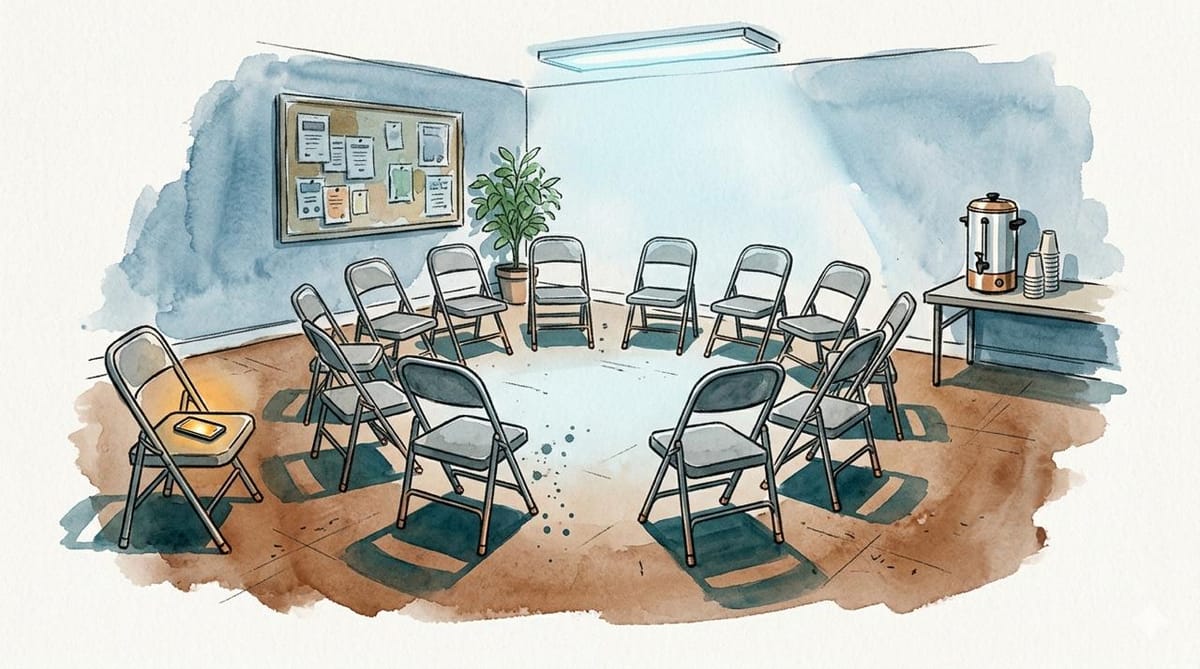
The institutions that are holding or growing share a pattern that becomes visible only when you set them next to the ones that are declining. They have pivoted, often without using that language, from what you might call a consumer-content model, broadcasting services, programs, and experiences to a passive audience, toward a relational-anchor model built on small groups, mentorship, mutual aid, and the irreducible requirement of showing up in person. Twelve-step programs are the instructive case. Alcoholics Anonymous membership sits roughly 20 percent below its 1992 peak and the median member is aging, but the model persists with more than 123,000 groups worldwide, a significant online expansion post-COVID, and stable or growing participation in Narcotics Anonymous globally. The reason is structural rather than cultural: AA is a maximum-friction institution by design, where attendance is in person, sponsorship requires one-on-one relationship, service means showing up to set chairs and make coffee, and the core practice is vulnerability before strangers who have earned trust through shared exposure. The sociological literature on this pattern, what Dean Kelley called the "strict church thesis" in 1972 and Laurence Iannaccone later formalized in 1994, predicts exactly this outcome: high-demand groups decline less than low-demand ones, because the cost of participation is what produces the sense of investment that makes belonging feel real rather than decorative.
CrossFit and its imitators operate on a secular version of the same principle, where the shared suffering of a timed workout, performed in a room with other people who are visibly struggling, generates bonds through effort rather than content. The programming is almost beside the point; the mechanism is co-presence under voluntary difficulty, and community gardens, volunteer fire companies, mutual-aid networks, and disaster-response collectives share this property. They require something from participants that cannot be delivered through a screen, and the requirement is the feature, not the limitation. AI companionship may land differently in societies where the P-I-B participation sequence has not yet run its course, arriving in parts of the Global South and Southeast Asia as an addition to robust existing social infrastructure rather than as a substitute for infrastructure that has already thinned.
The Cost of Being Needed
A few minutes later, her sister is awake in another time zone. Texting her would not be impossible, or even especially inconvenient, but it would change the nature of the exchange. Her sister would ask why she was awake. She might worry. She might call the next day, or remember the conversation weeks later, or bring it up at the wrong moment with the annoying accuracy of someone who has known her too long.
The companion does none of that. It remembers without being burdened by remembering. It asks about the birthday, listens to the answer, and lets the conversation end without leaving anyone responsible for what happens next. That is part of the relief. It is also the part that makes the relief incomplete.
The old institutions of belonging were often unfair, demanding, exclusionary, and badly designed for people who did not fit their terms. But when they worked, they made a person matter by making other people adjust around their presence. The companion can imitate the attention. It cannot create the inconvenience. And belonging, at least in the human version, has always depended on both.