The Rehearsal Problem
Cheap simulation can make decisions better informed without making them easier to make. The hardest cases are the choices where information was never the missing ingredient.
This is the seventh article in "The Shape of the Next Decade," a series on how AI reshapes work, institutions, and ordinary life. Part six: The Belonging Gap. The people in this piece are representative scenarios, not reported cases.
The night before she has to tell a teacher of nineteen years that the district will not renew his contract, Dana runs the conversation eight times. Not in her head, and not with her husband, who has heard enough of them over the years. She runs it against a chatbot she has told, in careful detail, who the man is. He coaches the robotics team on his own time, that he will bring up the robotics team, that he takes bad news by going quiet and then asking a question engineered to make her feel small. The model plays him convincingly. It goes quiet in the right places and it asks the question. By the third run she has a steady answer, and by the eighth she has stopped flinching when it lands.
Nathan Fielder built two seasons of television out of the wish underneath this, the wish to live through a hard moment once before having to live through it for real. In The Rehearsal, he helps people prepare for difficult conversations by staging elaborate recreations, building replica rooms and hiring actors so a man can practice confessing a lie to his trivia teammate before he has to do it for real. What took Fielder a soundstage and a cast now takes anyone a browser tab and twenty minutes, which means the thing he was gently mocking is on its way to becoming the ordinary way a great many people walk into the rooms that matter to them. And the unsettling part of fictional school administrator Dana's evening is that the rehearsal worked. Somewhere around the sixth run, the real conversation started to feel like the formality, and the rehearsal started to feel like the event.
When the preview saves you
Reuben had wanted to pour on schedule. He was a structural engineer on a mid-rise project that had already slipped twice, and he was fairly sure the floor system held, the way you are sure of something you have done a hundred times before. The load model he ran that week was close to a formality, a check you do because the process says to, not because you expect it to tell you anything. This time, though, it told him something. Somewhere in the interaction between a transfer beam and an unusually long span, the simulation found a failure mode that his confidence had walked straight past, a place where the structure would have been fine through inspection and through occupancy. But then, under the wrong combination of load and time, not fine at all.
This is the positive case for the rehearsal. A great many bad decisions are bad because someone acted on conviction when the missing ingredient was information. The bridge that will not hold, the molecule that poisons the liver, the launch with a flaw nobody modeled. These are the failures simulation was built to catch, and it catches them. Finite element analysis lets an engineer watch a building stress and fold under a load it will never actually meet, which is a far better place to discover the weakness than the building itself. When the bottleneck is ignorance, more rehearsal is close to a pure good. The engineer who wants to skip the model may simply be tired of process, but the model is there for the people who have to live under the bridge, take the drug, or use the product after the confident decision is made.
Reuben's model helped because the question had an answer outside him. The beam could carry the load or it couldn't. Simulation was useful because it moved the decision away from confidence and toward evidence. The harder cases begin when the model can show you consequences but cannot tell you whether the choice is worth making.
The room, furnished wall to wall
Priya believed in the product. She had built the company around it, and when her board asked for a market simulation before the launch, she treated it the way Reuben had treated his load model, as a box to check on the way to a decision she had already made. The model did not cooperate. It put the odds of failure at thirty-eight percent, then showed her why: three competitor responses that drove most of the downside, each plausible enough that she could no longer ignore them. The analysis was useful, which made it harder to dismiss. But Priya had wanted to launch on conviction, and conviction is a harder thing to hold once a screen has shown you the exact shape of how you might fail. The decision in front of her was the same. The weight of making it was not.
Everyone has felt a smaller version of this. There was a time when the forecast said "chance of rain," and you made your plans and carried an umbrella and got on with the day. Now the same forecast arrives as an hour-by-hour probability distribution, and the outdoor wedding, the concrete pour, the kid's birthday party in the yard all acquire a number you can refresh like a stock ticker. The weather has not become more uncertain. The uncertainty has become more legible, and legible uncertainty turns out to be much harder to live with than the vague kind, because a quantified forty-two percent feels worse than a shrug when it describes the same situation.
What the simulation removed, in both cases, was a kind of merciful blur. You could know a project might fail, a policy might hurt some people, or a launch might backfire without having the whole failure path laid out in front of you. Once the model names the harms, the losers, and the odds, the decision gets harder to carry alone. Run the same logic up to the scale of a policy, where a model can enumerate the fourteen thousand jobs created here and the eight thousand lost there and the rural median income moved by a few hundred dollars, and you arrive at a strange place, holding a decision better informed than any in history and somehow harder to make than it has ever been.
The human on the hook
A version of this already lives inside ordinary institutions, where it usually looks less like paralysis than like a signature at the bottom of a form.
A loan officer reviews a credit model's recommendation. She can override it, but permission is not the same as cover. Follow the model and a bad loan belongs to the process. Override it and the mistake has her name on it. The same pressure shows up for the underwriter pricing a policy and the analyst reviewing a risk model: judgment remains technically available, but disagreement gets expensive. The human stays at the decision point, nominally in charge, while the act of judgment slowly empties out of the role, because the institution has made judgment the riskier of the two available moves. Credit scoring did not eliminate the loan officer. It made the loan officer's disagreement expensive.
The model is not liable for anything. It does not appear in court, sit in a review meeting, or explain itself to a regulator. Responsibility still moves through people. But when the model fails, the failure can be treated as process: everyone followed the recommendation, so no one person owns the choice. When a human override fails, responsibility concentrates on the one person who chose to step outside the process. Earlier in this series, writing about the way AI absorbs the patterns of a decision without the judgment behind it, the danger was that the institution would lose knowledge it could not see it was losing. Here the judgment is still in the room, attached to a human who is increasingly paid to keep it to themselves.
Cheap simulation pushes this pattern outward from the three or four regulated corners where it already lives. When a CEO can run the market model, the model's recommendation becomes the safe choice and the founder's instinct becomes the liability, and the same is true of the policymaker with the impact projection and the manager with the hiring algorithm. The CEO can still override, of course, in a way the loan officer cannot, but the model's recommendation now sits in the board deck, and a board's memory runs longer than a market's.
Prepare the room, don't furnish it
The answer is not less simulation. It is better control over how much of what a model can generate actually reaches the person holding the decision. A simulation can produce more branches than a person can use; the interface decides which uncertainties become evidence and which remain noise.
Good decision support prepares the room. It surfaces the constraint the person missed, highlights the evidence that changes the call, and clears away the noise so a judgment has somewhere to stand. Bad decision support furnishes the room so completely that there is nowhere left to stand at all: every branch, every probability, every modeled harm, capped with a ranked recommendation, until signing the recommendation is the only move the human has any cover to make. The first kind of system routes information toward judgment. The second routes around it while leaving a person seated where the judgment used to be.
The series has run into a version of this before. In the piece on AI companionship, the trap was that a frictionless substitute could quietly hollow out the relationship it was meant to imitate, because the friction was part of what gave the relationship its value. The blur works the same way. A frictionless system is very good at removing uncertainty and very bad at knowing when it should stop. The harder discipline is deciding how much not to know.
Back to the real doorway
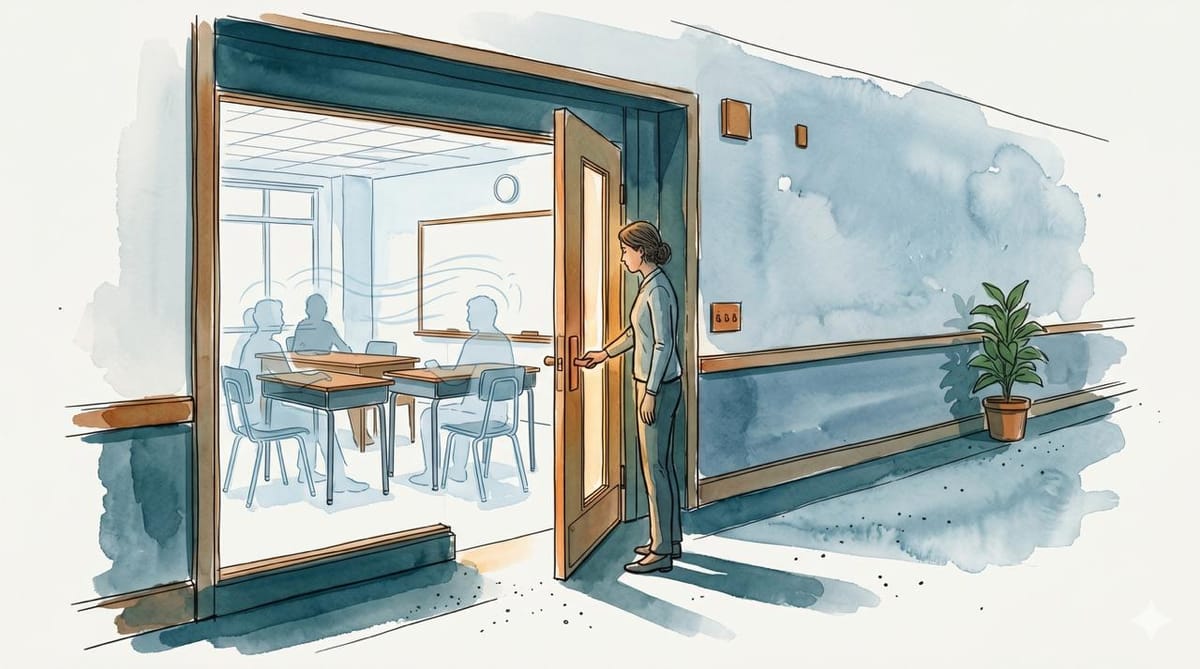
Dana walked into the real conversation the next morning, carrying the strange calm that comes from having already lived through the worst version of it. It went more or less the way the model said it would. The teacher went quiet, then asked the question she had been waiting for. She had her answer ready. The whole thing was over in less time than a single one of the night’s rehearsals.
The model could prepare Dana for the conversation, but it could not help with the moment before she opened the door. A rehearsal can show you where the chair will be, which sentence will land badly, and how the other person's face is likely to move. It can make the room familiar. It cannot decide whether you walk in.