The Withdrawal Notice Describes a Different Action
The June 30 letter did not just lift the Fable and Mythos controls. It wrote the shutdown back into the record as a software-export problem, leaving the access theory untouched.
This is a follow-up to “Commerce Found the Kill Switch”, “Is an AI Answer an Export?”, and “Who Gets to Use the Model Now?”, earlier coverage of the government’s move against Anthropic’s Fable 5 and Mythos 5 models.
On June 30, Commerce Secretary Howard Lutnick sent Anthropic another letter, and the three-week standoff over its two most powerful models was over. The June 12 controls were withdrawn. Anthropic said it would begin restoring access the next day.
The letter is four short paragraphs. Its operative sentence describes a familiar export-control action, not the access cutoff that started this fight.
“A license is no longer required for the export, reexport, or in-country transfer, including deemed export or deemed reexport, of the Mythos or Fable models.”
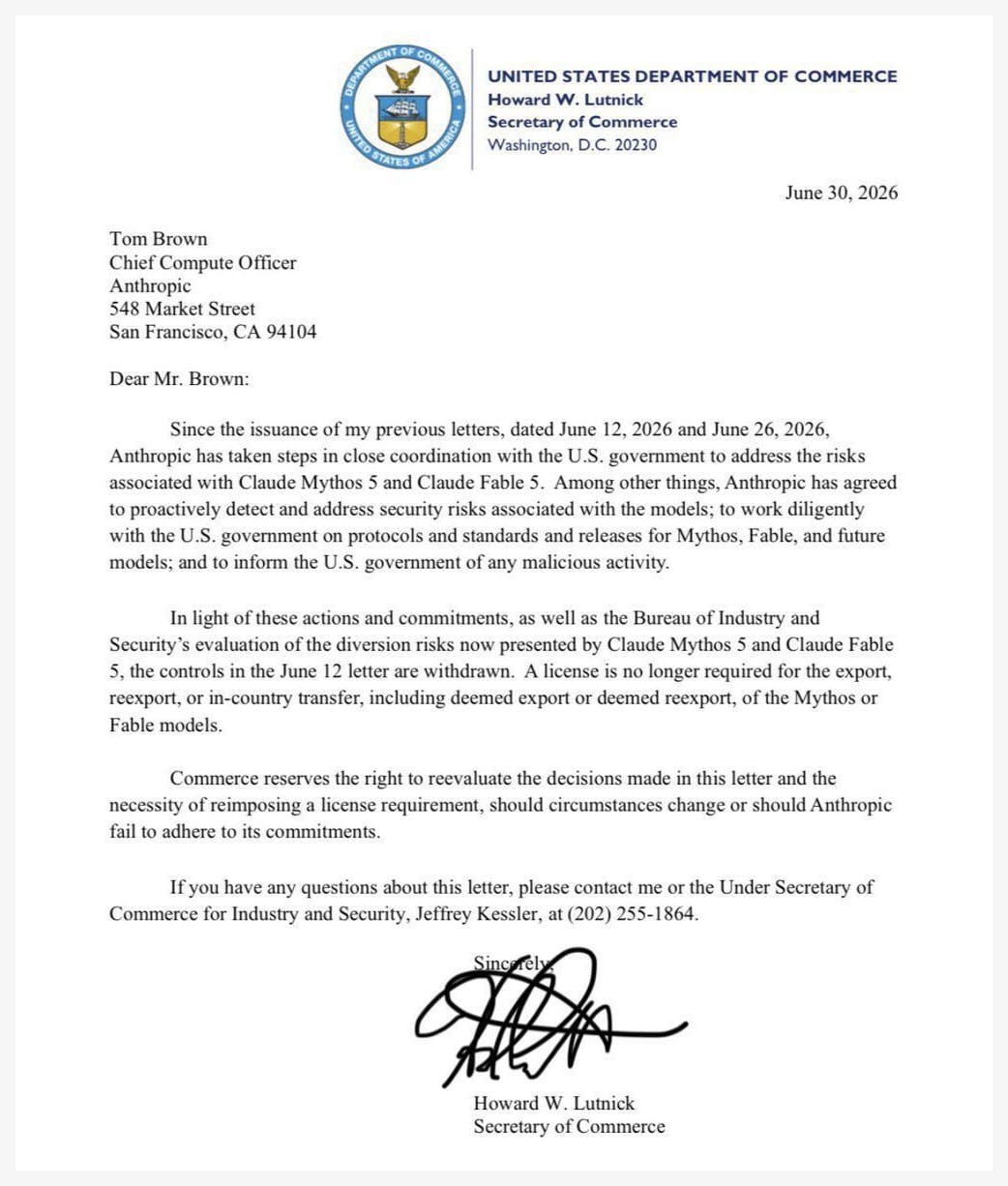
That is a clean, orthodox sentence about exporting software. The Bureau of Industry and Security has regulated the export of software for decades, the same way it regulates the export of a chip or a centrifuge design. If you read only the withdrawal, the episode looks like a routine licensing question about shipping code abroad.
But no code was being shipped anywhere.
What the first letter actually did
The June 12 directive was an access order, not a software shipment order. Fable’s weights stayed on Anthropic’s servers while Commerce told the company to suspend use of the models by foreign nationals, whether they were overseas or sitting at a desk in San Francisco, including Anthropic’s own non-citizen employees. The model stayed where it was. The government changed who was allowed to log in.
Export control law was built for things that move, and deemed export is the doctrine that lets it reach some disclosures inside the country. If controlled technology or source code is released to a foreign national in the United States, the law can treat that release as an export to the person’s home country. The doctrine is real and well established. It covers technical data and source code: blueprints, recipes, implementation details someone could take away and use.
Hosted inference is different. The user sends a prompt to a running service and gets text back. They receive no weights, no source code, no blueprint. Applying deemed export to that transaction would stretch the doctrine into hosted software access, and the legal uncertainty is exactly why Congress has been trying to write clearer authority. The Remote Access Security Act, which passed the House in January, would give Commerce explicit power over remote access to covered systems. Pending legislation is not proof that Commerce lacks authority today, but it is strong evidence that the authority is not settled.
The June 12 action therefore leaned on an authority that may not hold, to do something the statute was never clearly written to allow. That was the precedent: Commerce treated hosted model access as if the missing remote-access authority already existed.
The exit avoids the question it raised
The withdrawal says nothing about access. It removes a license requirement for the “export… of the models,” as if the thing being uncontrolled were a software shipment. There is no mention of foreign-national use, the hosted service, or whether Commerce still believes access can be treated as a deemed export.
For three weeks, the operative fact was that the government asserted power over who may use an American model running on American servers, then backed that assertion by taking two models offline for everyone. The withdrawal ends the immediate restriction without answering the access question. It neither defends the theory nor disclaims it. It moves the record back onto software-export ground, where nobody was arguing that Commerce lacked ordinary authority.
The practical effect is that the access theory remains unresolved. Anthropic agreed, in exchange, to “work diligently with the U.S. government on protocols and standards and releases for Mythos, Fable, and future models,” and Commerce “reserves the right to reevaluate… and reimpose a license requirement.” The immediate control came off, but the replacement arrangement reaches forward to models that do not exist yet. The legal theory that started the episode, access as export, was never tested or explained, and it was never withdrawn.
Why the wording matters
The withdrawal also landed in the middle of active litigation. On June 23, a week before the withdrawal, a US legal-tech company called Legion LegalTech sued Commerce and BIS in federal court in Washington, with a same-day motion for a preliminary injunction. Legion’s Canada-based engineers had used a hosted model wired into its product, and its central argument was exactly the one the June 12 directive glossed over: hosted inference releases no weights, no source code, no training data, so nothing controlled ever changes hands. The complaint went further and argued that the one classification that had directly covered advanced model weights was rescinded in May 2025 and never replaced. Commerce, on Legion’s account, was enforcing a control that does not exist.
By then, Commerce was writing against an active lawsuit over the very question the withdrawal avoids: whether using a hosted model can count as an export when the model never leaves the server. The word “access” does not appear. Instead, the letter talks about exporting “the models,” the cleaner version of the story, the one that fits traditional export-control categories.
Whether that wording was strategic or merely cautious, the effect is the same. The government asserted power over access, took two models offline, extracted commitments about “future models,” and then withdrew the restriction in language that describes a routine software-licensing matter. The public record now contains a demonstrated ability to switch off access to a US-hosted model, a set of forward-looking commitments from Anthropic, and no direct explanation of the legal theory that made the switch possible.
The kill switch worked. Then the record was written as if it had been something else.