What If a Wellness Cruise Could Offer What Your Doctor Can't?
In the fall of 2029, a motor yacht sat anchored twenty-eight miles offshore. On board, a doctor was offering treatments not available on the mainland.
This is part of our What If series, where we take real technologies and research trajectories and ask what happens if they converge. Everything that follows is conjecture and speculation, grounded in science that exists today but extrapolated into scenarios that do not. None of this has happened. Some of it could.
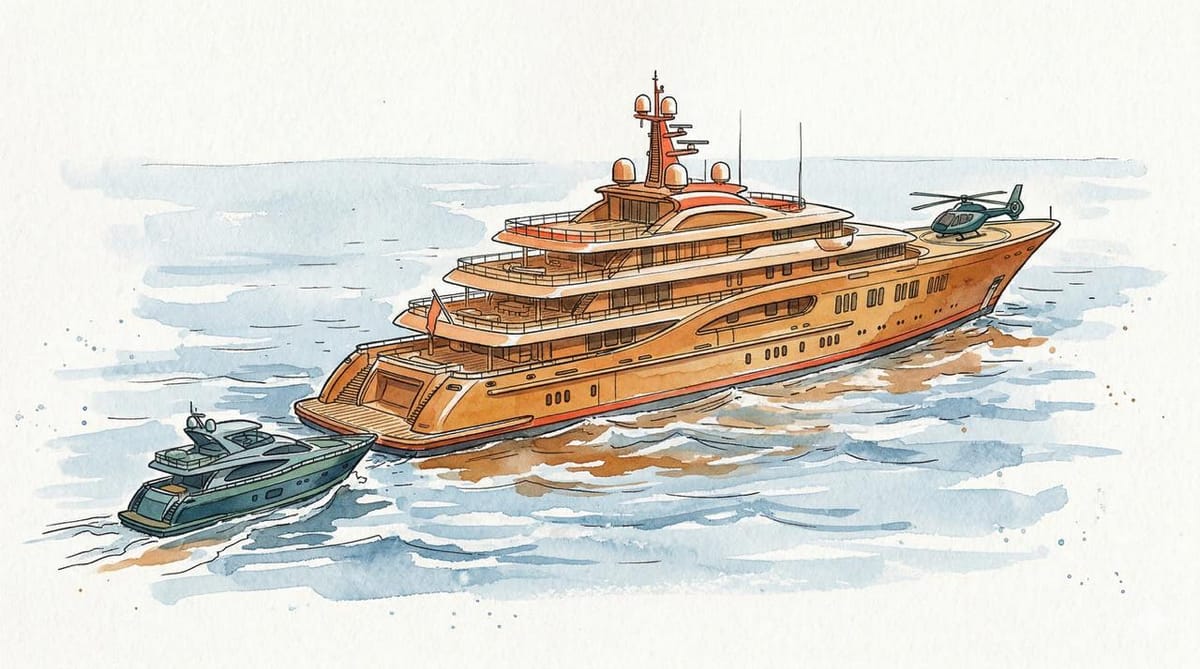
In the fall of 2029, a 180-foot motor yacht called the Meridian sat anchored twenty-eight nautical miles southeast of Ambrose Light, well beyond the contiguous zone where American law loses its grip. She flew a Tongan flag. From a distance she looked like any other charter yacht, white and clean and unremarkable. From the upper deck, there was nothing but open Atlantic in every direction.
The passengers who reached the Meridian that October morning had boarded a different yacht two hours earlier at Chelsea Piers. That vessel, a sleek boat flying Panamanian colors, offered champagne at embarkation and an itinerary listing "wellness consultations" with the specificity of a spa menu and the vagueness of a lawyer's draft. Eight passengers. A welcome packet in a linen envelope. The crew learned every name before the boat left the harbor. When they arrived at the Meridian, a helicopter sat on the foredeck, rotors still. Two other yachts were already tied off at the stern, running the same route from different ports.
Nobody discussed why they were there. Not over hors d’oeuvres, not on deck, not during the two hours it took to reach the rendezvous point. They talked about the water, whether the Atlantic is always this calm in October. A woman in her forties mentioned, over a glass of champagne, that her daughter had cystic fibrosis. She said it once, quietly, and changed the subject. The room caught it. Everyone heard. Nobody asked a follow-up.
The yacht pulled alongside the Meridian and the crew tied off at the stern platform. Passengers stepped from one deck to another, helped by crew in pressed whites, and in that crossing moved from one flag state to another.
The Meridian smelled different. Under the leather and the teak, something antiseptic. A steward led each passenger to a private suite on the lower deck: a robe folded on the exam chair, sparkling water and a cocktail on a side table, ocean sliding past the porthole. Five physicians ran consultations in parallel, one patient at a time, each suite soundproofed and separated by a corridor lined with teak paneling. The effect was more luxury spa than clinic, which was the point.
Dr. Okafor, according to the lanyard clipped to her lab coat pocket, carried herself with the brisk competence of someone who once saw forty patients a day at a Manhattan teaching hospital. She arrived in the suite, closed the door, and the consultation began with a technology that does not exist in any American clinic. A CRISPR-based diagnostic array, descended from the SHERLOCK platform that Broad Institute researchers had first demonstrated years earlier, read the patient's blood like source code. Not a standard draw sent to Quest Diagnostics and returned in three days. A handheld device, small enough to sit on the consultation room table, that Dr. Okafor held against the inside of his arm while she explained what it was looking for. In thirty minutes, she had mapped inflammatory pathways, immune profiles, epigenetic age, and hereditary risk factors that a hospital workup would take weeks to surface. The patient watched the results populate a screen mounted on the wall, numbers and pathway diagrams she could not read but Dr. Okafor could. Diagnosis to custom compound in under twenty-four hours.
Then Dr. Okafor opened the menu — not a generic catalog but a filtered list, narrowed by the diagnostic results still glowing on the screen behind her.
The peptides were table stakes. BPC-157, TB-500, semaglutide variants. The same molecules that had been flowing through Chinese gray-market suppliers and American bodybuilding forums for years, synthesized in Shenzhen with better purity testing. Dr. Okafor dispensed them the way a bartender pours a well drink. The real list was on the next screen.
She pulled up a custom anti-inflammatory compound, flagged by the diagnostic as relevant to this patient's elevated IL-6 markers. Designed by a protein-folding model descended from AlphaFold and RFdiffusion, the tools that earned David Baker a Nobel Prize in 2024. The molecule had not existed ten weeks earlier. A lab in Incheon designed it. A facility in Hyderabad synthesized it. Dr. Okafor showed the patient binding affinity predictions, computational toxicity screens, organoid test results. For patients with autoimmune conditions, the same protein-design pipeline could generate custom monoclonal antibodies: targeted immune suppression calibrated to a specific disease profile, not the broad immunosuppressive sledgehammer of conventional treatment.
Next was an epigenetic reprogramming protocol. Partial Yamanaka factors to reverse cells' epigenetic age by five to seven years per session. "Results are not guaranteed," Dr. Okafor told him. "The research is promising. But it is also nascent."
She scrolled past it to a gene-washing panel. Not one CRISPR edit but a stack: clear an APOE4 variant to reduce Alzheimer's risk, knock down PCSK9 to permanently lower cholesterol, tweak FOXO3 toward the longevity variant that centenarians carry, clear any hereditary cancer mutations flagged by the diagnostic array. A genetic tune-up. The same base-editing platform that underpinned Casgevy, the sickle-cell treatment that had been approved six years earlier at $2.2 million per patient. The Meridian's version stacked edits that each existed individually in research. The combination had been tested in primates at a Korean university lab, published in a journal most passengers had never heard of. Price: $480,000. Nobody flinched.
For cancers with zero FDA-approved options, something more aggressive: an AI-designed cocktail combining a custom oncolytic virus, an mRNA vaccine, and a CRISPR edit, all three targeting a specific tumor's genetic signature. Personalized to a resolution that mass-market oncology cannot achieve and regulatory timelines will not permit for years.
Further down, an AI-optimized gut biome reconstruction: custom probiotics calibrated to his bloodwork, engineered to produce specific metabolites, neurotransmitter precursors, anti-inflammatory compounds.
At the bottom of the pamphlet, listed with clinical detachment: neurogenesis compounds. AI-designed molecules promoting new neuron growth in adults. For traumatic brain injuries, early cognitive decline, stroke recovery. The animal data was "encouraging." That word again.
"I'm not going to tell you this is safe," she said. She left a pause where a hospital physician might have offered reassurance. "I'm going to tell you what we know and what we don't, and you'll decide."
The Meridian was a clinic, not a factory. The compounds administered on its decks were manufactured onshore, in facilities across Shenzhen, Hyderabad, and Incheon, staffed by scientists who could not get domestic regulatory approval but whose credentials were genuine. Cold-chain containers arrived by tender. The supply chain ran through four countries before reaching a consultation room with ocean views. It mirrored the existing peptide gray market precisely: Chinese factories to middlemen to American consumers.
The quality-control question did not disappear with the luxury upgrade. Dr. Okafor, for all her competence, did not oversee manufacturing in Hyderabad. She trusted the batch certificates the way her patients trusted her. The experience felt safe because it was expensive and beautiful. The supply chain underneath operated on the same trust architecture as a Reddit bodybuilder reconstituting powder in his kitchen.
Two suites down, another physician was running a different kind of consultation. The woman from Connecticut sat across from him with her fourteen-year-old daughter beside her. The girl was quiet, watching the diagnostic array read her blood the same way it had read every other patient's that morning. She had cystic fibrosis. Her mother had brought her here for the diagnostic.
The results would go to one of the Meridian's partner labs in Incheon. Within weeks, they would design a combined mRNA and CRISPR therapy targeting her specific CFTR mutations. Mother and daughter would come back for a second visit to receive the treatment. Same yacht, same route, same two-hour ride from Chelsea Piers. The first trip was the scan. The second trip was the fix.
"Her pulmonologist knows," the mother said later, on the ride back. "He can't recommend it. He can't tell me not to." She paused. "He gave me the Signal group link."
A physician who spent thirty years inside the system, handing a patient's mother the coordinates to get outside it.
On the ride back, a younger passenger who had recently sold a fintech company explained the legal architecture over whisky. He enjoyed it the way certain people enjoy explaining watch movements.
The yacht flew a Panamanian flag. The Meridian flew Tongan. The operating company was incorporated in Abu Dhabi. Payments ran through stablecoins on Coinbase's L2 chain. The physicians were licensed in the flag state and in Singapore. He ticked through each layer with his glass in hand, and the picture that emerged was a jurisdiction shell game where no single country's law applied to the whole operation. Nothing touched U.S. jurisdiction until the passengers stepped onto the pier at Chelsea Piers, at which point they were citizens returning from a vacation with nothing to declare but whatever was already in their bloodstream.
"Same play as Polymarket," the fintech founder said. The crypto industry spent $130 million on the 2024 election cycle, and prediction markets went from offshore gambling to CFTC-approved within a few years. "You don't stay offshore. You stay offshore until you can afford to come onshore."
The Women on Waves ships anchored outside territorial waters to provide abortions where they were banned. That was activism. This was commerce. The water does not care about the difference.
Medical tourism is already a hundred-billion-dollar market. Americans fly to India for heart surgery, to Mexico for dental work, to the Bahamas for stem-cell injections their insurance won't cover. The Meridian compressed that impulse into a boat ride. No adverse event database will track what happens to passengers in five years. No Phase IV monitoring. No pharmacovigilance. The data disappears into the American healthcare system, one more unexplained anomaly in a chart no one thinks to connect to a yacht in the Atlantic.
By late afternoon, the yacht was sliding back toward Manhattan through low haze. Passengers checked phones, texted spouses, scrolled through whatever they had missed. The mother and her daughter sat together near the stern, the girl asleep against her shoulder.
A new message appeared in the Signal group where the trip had first been advertised. A new member, asking if anyone could vouch. Two replies. Both vague.
The customs booth at the end of the Chelsea Piers gangway was staffed by a single CBP officer who checked passports and waved people through. Nobody asked what the passengers did on vacation. Nobody knew what was in their blood. The pier was thirty feet away, and the distance between what American medicine is and what it could be was twenty-eight nautical miles of open ocean, a Tongan flag, and a Signal group you had to know someone to join.