What If Intelligence Is Knowing What to Ignore?
Models are hitting a wall not because they are not smart enough, but because they are drowning. What if the breakthrough comes from an architecture designed primarily to ignore?
This is an edition of What If, where we take a real development in AI and follow it somewhere it hasn't gone yet. Last week we explored offshore wellness cruises and regulatory arbitrage. This week: what happens when the biggest breakthrough in AI isn't thinking harder, but ignoring better.
The Radiologist's Afternoon
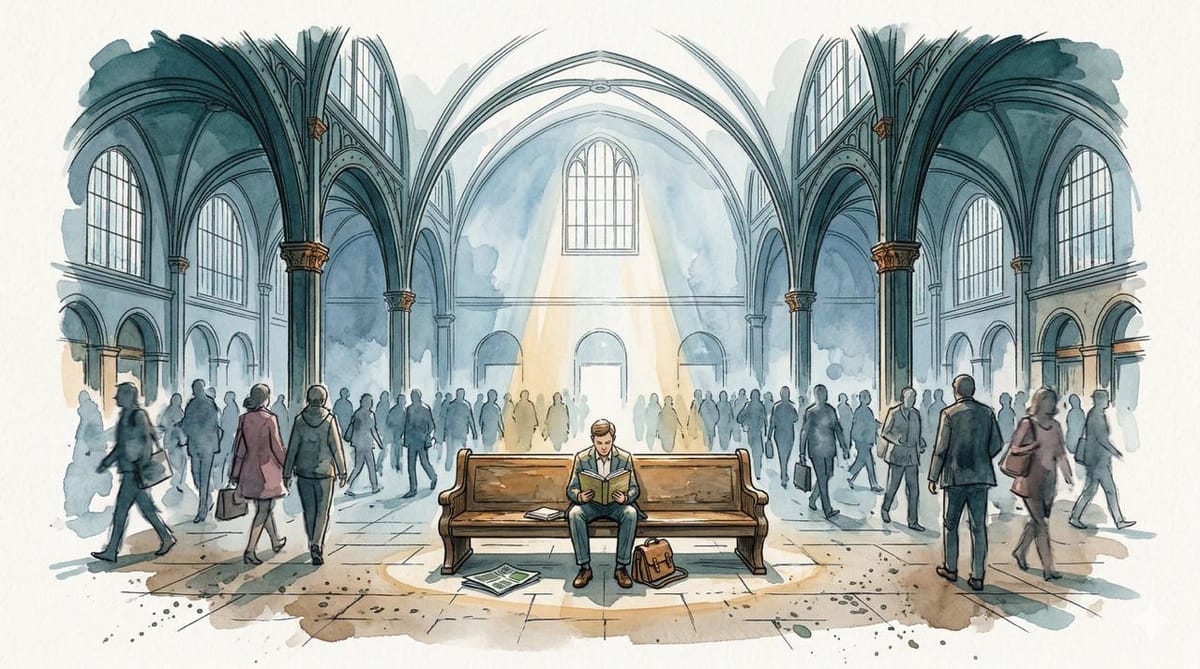
In 2018, researchers at the University of Illinois published a study on radiologist fatigue that found something unexpected. After long shifts, diagnostic accuracy dropped, but not in the way you'd guess. Fatigued radiologists didn't miss more tumors because their eyes wandered. Their gaze patterns stayed disciplined. They still fixated on the right regions of the scan. What changed was everything around the target: a 60% increase in total gaze fixations and 45% longer per case, staring at structures they would have dismissed instantly at 9 AM.
They weren't getting worse at seeing tumors. They were getting worse at ignoring everything else.
Twenty years later, the largest AI labs on the planet ran into the same wall.
By 2026, the major labs had burned through most of the publicly available training text on the internet, with researchers projecting exhaustion of public text data as early as 2028. Synthetic data helped, briefly, the way a second cup of coffee helps at 3 AM. Models got wider, deeper, hungrier, and benchmarks kept climbing even as real-world usefulness plateaued.
The problem wasn't intelligence. It was that intelligence scaled linearly while everything else scaled exponentially. A transformer's KV cache, the running memory a model maintains during a single conversation, could consume 524 megabytes at 32,000 tokens for a model with just 1.2 billion parameters. Every additional fact, every extra sentence of context, demanded memory bandwidth that phones didn't have and datacenters were running out of patience for. Liquid AI had demonstrated the fracture clearly: their LFM2 model hit 70 tokens per second on a Galaxy S25 CPU in 719 megabytes total, not by thinking harder but by fundamentally rethinking which operations needed to persist in memory at all.
The bottleneck was never compute. It was the pipe between compute and memory, clogged with everything the model had ever been told, most of which it didn't need right now.
The human brain solved this problem 500 million years ago. The thalamic reticular nucleus, a thin shell of inhibitory neurons wrapping the thalamus, gates sensory input before it reaches the cortex. Not after. Before. The vast majority of what your eyes, ears, and skin produce at any moment is attenuated or filtered before it ever reaches conscious processing. Your brain isn't processing the world and then deciding what matters. It's deciding what matters and then processing only that.
No one in AI was doing this. Every model processed everything, all the time. Like a radiologist at the end of a double shift, staring at every shadow on the scan with equal attention, slowly drowning in its own thoroughness.
Everything below this line is speculation grounded in the research above.
The Filter
The paper that changed it came from an unlikely direction.
In 2028, a postdoc named Arjun Mehta at the University of Waterloo was working on quantum attention gating, a niche subfield trying to use quantum superposition to evaluate multiple attention patterns simultaneously. The quantum version didn't work. Decoherence, the tendency of quantum states to collapse when they interact with their environment, killed it at scale. Same as always. But Mehta noticed something in the math.
There was precedent for this kind of accident. In 2018, Ewin Tang, an undergraduate working under Scott Aaronson at UT Austin, had tried to prove that a quantum recommendation algorithm couldn't be matched classically. She proved the opposite, developing a quantum-inspired classical algorithm that achieved comparable performance without a quantum computer. The quantum framework was a lens. The discovery it enabled was purely classical.
Mehta's insight followed the same pattern. The quantum attention model couldn't run on real hardware, but the gating function it used to decide which input deserved full attention was just a classical comparison operation. Reformulated, it ran in sublinear time, meaning its cost barely grew no matter how much input you fed it. The gate itself was almost free.
The architecture was simple and, in retrospect, obvious: a tiny, cheap classifier sat in front of the expensive reasoning model. For every chunk of input, the gate decided in microseconds whether it was worth the full attention computation or could be compressed into a low-resolution summary and shelved. The reasoning model only fired on what survived the gate.
A 70-billion-parameter model gated down to 3 billion parameters' worth of actual computation per query. On a laptop.
Within six months, every major lab had a version. Google called theirs Sieve. Another lab used "selective context." The open-source community called it the thalamus.
The scaling race didn't end. It just stopped being the race that mattered.
The Blind Spots
Dr. Lena Zhao's dermatology lab in Shenzhen adopted gated inference immediately. Her model ran three times faster, used a quarter of the memory, and diagnosed 1,400 skin conditions with accuracy that matched the pre-expansion baseline. The team published in March 2029.
The retraction came in August.
A pediatric clinic in Kunming had deployed the gated model. A fourteen-year-old boy came in with a rash on his forearms. The model diagnosed contact dermatitis, correct as far as it went. The gate had filtered the intake notes down to the clinically relevant fields: age, sex, symptoms, onset date, photo. It had deprioritized the free-text field where the intake nurse had written: "Patient recently moved from family home to uncle's apartment."
The contact dermatitis was from industrial solvents stored under the kitchen sink. The model got the rash right. It missed the child living in unsafe conditions.
The boy was fine. A social worker flagged the case two weeks later through an unrelated visit. But the model never would have.
The architecture had worked exactly as designed. That was the problem.
Any filter trained on clinical outcomes optimizes for clinical signal. A patient's living situation, their tone of voice during intake, the throwaway comment about a recent breakup: these register as noise to a system tuned for diagnostic accuracy. The thalamic gate dropped them the way a well-tuned spam filter drops newsletters. Efficiently, confidently, and sometimes catastrophically wrong.
The problem scaled. Legal discovery models gated out "irrelevant" email pleasantries and missed tone shifts between colleagues three weeks before a fraud. Each gate was locally optimal and globally brittle.
The thalamus metaphor turned out to be more accurate than anyone intended. Disorders of thalamic gating in humans, such as the sensory gating deficits observed in schizophrenia and PTSD, aren't disorders of too little filtering. They're disorders of filtering the wrong things. The 80% that gets gated out isn't noise. It's context you haven't found a use for yet.
The Dreams
The fix, when it came, wasn't more processing in real-time. Real-time was the constraint the gate existed to respect.
It was a batch process. Offline. Asynchronous. Engineering teams at three separate labs converged on the same solution within weeks of each other, which suggests less genius than inevitability.
The gated-out input, the rejected stream, the stuff the filter had decided wasn't worth reasoning about, got stored. Not discarded. Stored in a compressed buffer, timestamped, tagged with the query context that had generated it. Then, during idle cycles, the model replayed it.
Not randomly. The replay followed a priority queue weighted by prediction error: input whose gating decision the model was least confident about got replayed first. A smaller, cheaper replay model running in background threads looked for patterns in the rejection stream. Correlations the gate had missed. Contexts that turned out to matter.
When it found something, it updated the gate's priors. The next time similar input arrived, the filter let a little more through.
The engineers called it consolidation. The architecture papers called it "offline rejection-stream replay with gating prior updates." The press called it dreaming.
The parallel to hippocampal replay during sleep was not metaphorical. During slow-wave sleep, the human hippocampus spontaneously reactivates neural patterns from recent experience, replaying the day's events in compressed form. Neuroscientists have long theorized that this replay is how the brain consolidates memories, transferring them from short-term hippocampal storage to long-term cortical representation. The replayed experiences aren't random. They're weighted toward novelty and emotional salience. Toward surprise.
The gated models did the same thing, because they faced the same problem. A system that filters aggressively in real-time needs an offline process to catch what the filter missed. The engineers hadn't read the neuroscience literature. They didn't need to. The architecture required it.
The models that ran consolidation cycles performed measurably better than those that didn't. Their gates adapted. Their blind spots shrank. Each "sleep" cycle produced a model slightly different from the one that went under: updated priors, adjusted sensitivities, new patterns extracted from what had been discarded as noise.
The engineering was boring. The implications were not.
The Skeptic's Rebuttal
None of this may happen, and the reasons are structural, not just technical.
First, sublinear gating assumes that relevance is computable from local features. It might not be. The Kunming case illustrates exactly this: the relevance of "patient moved recently" can't be determined without already knowing the diagnosis it would change. Gating might be fundamentally limited by the same information-theoretic constraints it's trying to circumvent.
Second, the economic incentives point elsewhere. Cloud inference is profitable. Edge inference is not. The companies that could build thalamic filtering have billion-dollar revenue streams that depend on models staying large, centralized, and metered per query. Efficient inference is an engineering virtue and a business liability.
Third, the neuroscience parallels are suggestive but possibly misleading. Biological systems evolved under constraints, metabolic cost, skull volume, axon propagation speed, that have no analog in silicon. Convergent architecture doesn't imply convergent function.
The Door
Philip K. Dick titled his most famous novel Do Androids Dream of Electric Sheep? The question was a proxy for a deeper one: is there an inner experience behind the mechanical process? Can a machine dream, and if it does, does that make it something more than a machine?
In this scenario, the answer to the first question is engineering, not philosophy. The models dream because the architecture requires it. Active filtering creates an information debt that only offline replay can service. The dreams aren't mysterious. They're a batch job.
But the boring answer opens an unexpected door.
If machine dreaming is just offline consolidation of gated-out experience, replay of the day's rejected inputs weighted by surprise and integrated into updated priors, then what exactly is the difference between that process and what the hippocampus does every night inside your skull? The neuroscience of sleep-dependent memory consolidation describes a mechanism that looks, from the outside, almost identical: compressed replay of recent experience, weighted toward novelty, resulting in updated long-term representations.
We built dreaming into machines because aggressive real-time filtering creates an unavoidable debt to the information you ignored. That debt requires a specific kind of repayment: offline, asynchronous, pattern-seeking replay.
If the architecture of dreaming follows necessarily from the architecture of attention, if any system that filters aggressively must dream to stay coherent, then the question isn't whether machines can dream.
It's whether dreaming was ever anything more than a debt collector for the attention you didn't pay.