Conducence
Collaboration isn’t measured by who typed the words. It emerges from what neither could have achieved alone.
When Hank Green said, “I appreciate the pushback” in a recent video, some viewers latched on to the phrase. They heard the frictionless courtesy of a chatbot, the kind of polished accommodation a model produces when asked to absorb disagreement without sounding defensive. Green addressed the suspicion on X and later clarified that the line was entirely his. It had not even been scripted. He had improvised it after a guest challenged something he said.
Under ordinary circumstances, this would have been a small and faintly absurd dispute over four commonplace words. But Green had also been using ChatGPT to research a stretch of his recent videos, and in a Reddit comment he described that reliance as “not healthy.” “I’ve been moving so fast that my own process isn’t actually clear to me,” he wrote, adding that he intended to make videos more slowly. His viewers had heard the voice of a machine in what Hank said, though its actual influence was harder to pin down. It had perhaps entered earlier, through the sources he encountered, the ideas he pursued, and the judgments that shaped the video. Or not.
That kind of influence doesn't really leave much to inspect on a four-word phrase. An A.I. detector can examine finished prose, however reliable or unreliable it may be, but it cannot reconstruct the research and thought process that preceded the prose. By the time someone begins writing, a model may already have changed which sources seemed important, which ideas were abandoned, or which arguments were worth making.
Platforms can only measure what remains visible. They are turning suspicion about AI-assisted writing into scores, labels, and reporting tools that estimate whether prose resembles model output. That addresses one narrow question, but audiences are asking a broader one. They want to know whether the person whose name is on the channel still exercised the judgment they came for.
The suspicion becomes a product
Since July 21, Substack readers have been able to scan eligible posts and notes for AI-generated text. The tool, powered by Pangram, estimates how much was written by a human or with AI assistance. Writers can add a “How I make this” statement or disable detection for an individual post. Disabling it does not remove the question. Readers who attempt the scan see “AI detection unavailable.”
LinkedIn went further on July 30 with a button that reads "Seems like AI slop." Those reports become signals for classifiers meant to reduce suspected slop in recommendations from outside your network. The company says it now blocks hundreds of thousands of automated comment attempts a day. It has also started privately telling people when their posts are reading as inauthentic.
LinkedIn could have called the button “Report suspected AI-generated content.” Instead it chose “Seems like AI slop,” language that settles the question before the report is made. The phrase treats machine involvement, inauthenticity, and low quality as different names for the same offense.
Meanwhile LinkedIn is retiring "enhance your post," the feature that used to rewrite your words for you, and replacing it with a proofreader that leaves your voice alone. The platform spent years teaching people to sound a certain way. It is now enlisting readers to report them for sounding that way.
The binary
The usual split of opinions on the internet tends to be you either wrote it yourself, and your voice and judgment are the value, or you just handed your ideas to a model and put your name on whatever comes back. A person who came for your thoughts and opinions did not come for Claude's.
The second half of the binary is hard to argue with. People follow a science communicator, a critic, or an analyst because they want that specific person's take on things. If your name is sitting over model output, the reader has been handed something they could have generated themselves perhaps. Green's worry was not that four words sounded synthetic. It was that his process had blurred to the point where he could not locate his own contribution in it.
The binary says less about judgment than it appears to. Writing every word yourself does not make the result original, considered, or honest. Heavy use of a model does not rule out weeks of investigation, discarded arguments, or a person willing to answer for every claim. Knowing that AI was involved cannot distinguish those cases. The question is what each side contributed.
What the metaphors miss
Kasparov introduced advanced chess in León in 1998, human and engine playing as a unit, and the pairing came to be called a centaur. The image is immediate, which is why it caught on. But the name tells us only that a human and a machine were involved. It does not tell us who set the direction, what each contributed, or whether the result depended on both.
The exoskeleton puts the person back in control and treats the machine as added force. That captures amplification, but not discovery. It can make the person stronger, but it cannot change where they intended to go.
Cory Doctorow's reverse centaur turns the body around. The machine sets the route and pace; the person supplies whatever labor it still cannot perform. A writer producing copy at a cadence set by software is not being augmented so much as paced. Doctorow's point is that the arrangement decides which one you are, whatever name you give it.
Every familiar metaphor protects one side by sacrificing the other, and the bind dissolves only once you stop treating value and responsibility as one variable. Value comes from difference. Responsibility comes from stake. A machine can supply the first without touching the second, because authorship stays with the person who wanted the work to exist, decided what survived, and answers for the result. What that asks for is a strange combination, a standard firm enough to throw most things away and a destination loose enough to be moved.
Conducence
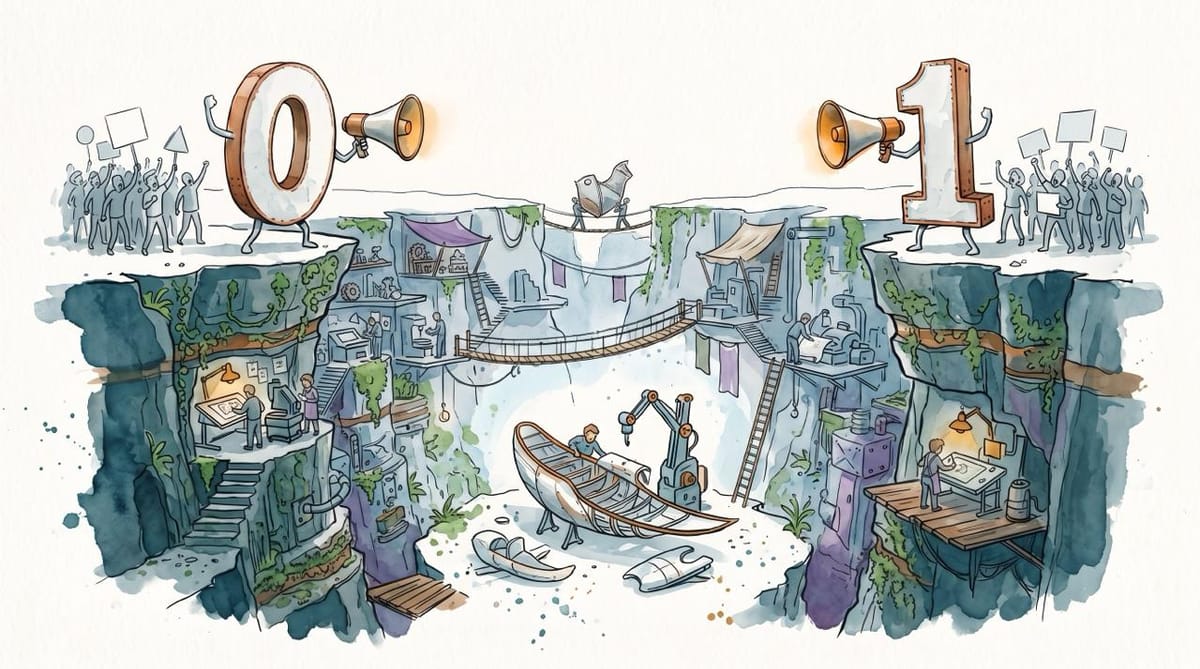
Conducence names the case where removing either contributor changes the result. It comes from the Latin conducere, to lead together.
A contribution does not have to come from outside human culture to take you somewhere you would not have reached alone. Another person can share your language, sources, and assumptions and still notice a connection you missed. A model’s contribution is relational in the same sense. It matters not because its knowledge came from somewhere alien, but because the exchange surfaced a consequential proposal your own process was unlikely to produce.
That proposal is only one half of the exchange. The person tests it against the purpose of the piece, rejects what does not hold, and changes what the model produces next. The model changes what the person can see, and the person’s judgment changes the next proposal. The result emerges through that back-and-forth rather than from either side alone.
That iterative exchange is conducence. The result has to depend materially on both the machine's nonredundant contribution and the person's judgment. The test is symmetric because either side can be ornamental.
Remove the person. What irreplaceable property disappears from the finished work? Remove the machine. Same question.
If the result would be essentially unchanged without the person, their judgment was decorative. That is the failure underneath much of the backlash. If the result would be essentially unchanged without the machine, the machine may have made the process easier, but it did not change what was made. Conducence exists only when both removals change the result.
Prompt counts, hours logged, and long chat histories show how much interaction occurred, not whether it changed the result. Calling the model a “thought partner” does no better. The relevant question is what changed because each was there. What did the machine introduce, and what did the person reject, correct, or reshape?
The human side begins with stake. The model has no preference about whether the work is true, good, or published. The person wanted it to exist. The decision to publish it and the responsibility for what it says belong to them.
That responsibility becomes visible in what the person refuses. Weak framings are discarded, unsupported claims are cut, errors are corrected, and drafts are rebuilt.
But refusal is only half of it. A person who begins with the conclusion fixed can use a model extensively without allowing it to change the argument. The model may help carry out the plan, but the result still follows a direction the person had already chosen.
Conducence requires both. The person must be willing to reject what the model offers and willing to revise the argument when the exchange reveals something they had not considered.
Claims, not proof
The person applying the test to their own work knows the process best and has the strongest reason to describe their contribution as essential. The removal test cannot resolve that conflict or certify authorship.
What it can do is replace a percentage with two claims a reader can examine. The writer can identify what the machine introduced that they would not have reached alone and what their own judgment rejected, corrected, or reshaped. Readers cannot perform either removal themselves, but they can ask whether those claims are specific, whether they fit the piece, and whether the writer can defend or correct them when challenged. That is less certainty than a detector promises, but more information than its score provides.
What the button cannot see
Pangram can estimate how much a paragraph resembles model output. LinkedIn can collect the impression that something felt synthetic. Neither can see who set the purpose, what got thrown away, whether the person changed their mind, what the machine put on the table, who checked the claims, or who will answer for the errors. Those are the things that determine whether a piece was worth a reader's time, and they leave no residue in the prose for a classifier to find.
Remove the person. Remove the machine. See what disappears each time.
Author’s note: Future Shock intentionally lists Nicholas Zinner and Beacon Bot as co-authors on blog posts. From the beginning, this publication has been an experiment in what a person and an AI agent can create together. I expect that one of AI’s enduring impacts will be people learning to work with machines to build things neither could have built alone.