The Curator
A curator's taste is a filter. Written down, it becomes a target. Read back, it becomes a replacement.
This is a Sci-Fi Sunday piece. Simon, Desi, the catalogue, and films described below are fictional. The curation research, preference-learning systems, and production methods are real and linked.
Week one is editorial
A few weeks before a song comes out, an artist or label can send it to Spotify's playlist editors, hoping it will land on New Music Friday. A placement can put the song in front of listeners who have never heard the artist before. It also leaves Spotify with an early human judgment about what was worth choosing.
In 2019, Tiziano Bonini and Alessandro Gandini published an ethnography of the people making and pursuing those placements. The write-up's title came from a London music promoter describing what happened following the editorial choice:
"They are very important in week one. After week one the algorithms kick in to tell us what we need to do. Spotify is very dependent upon editorial for week one and then the algorithms take the lead in week two."
Bonini and Gandini called this "algo-torial" power. The editor chooses what belongs on the playlist. The platform records that judgment and carries it into systems operating at a scale no editor could reach alone. The playlist may change the following week, but the choice has already entered the machinery.
The cupboard door
Simon stopped the film eleven minutes in, after an actor crossed a kitchen and left a cupboard door open behind them. He rewound to the start of the shot. On the second viewing, the actor's hand brushed the handle as they passed. It might have been choreographed, it might have been improvised, or it might have been a continuity error. The film gave him no way to tell.
That small, esoteric detail influenced Simon to select the film for the catalogue without leaving a note. The candidate screening console recorded his choice and moved on.
The catalogue was a curated collection of films used by universities and cultural programs. One spot in the catalogue remained unfilled that week. The film Simon chose would be translated into the catalogue's core languages and added to its teaching license. The other film would remain in the open archive, available in theory but almost impossible to find unless searched it by name.
Simon never saw how the filtering system narrowed four million candidate films to the two on his console. He was responsible only for the final choice between them, which he made alone in a screening room.
What eleven years look like
Desi showed up to a meeting with the figures the following morning. She ran discovery, the system that reduced millions of incoming films to the forty Simon reviewed each week, which eventually got narrowed down to finalists for each unfilled spot in the catalogue.
She opened the record of the catalogue's choices from the previous spring. Simon had passed on a short documentary about night-shift workers at an airport in Taipei. It was better made than the film he chose that week, a messy portrait of two brothers who ran a laundromat and could not stop lying to each other. He had preferred the laundromat film's discomfort to the documentary's safety, thinking back he still recalls the thought process to his decision.
The Taipei documentary had gone to the open archive where it received no translation or teaching license. It remained available beside several million other films, but only to someone already looking for it.
Musing over the results Desi said, "The filmmakers in Taipei didn't get a vote on your preferences, they just got the consequences."
Simon said anyone could already generate a film about night-shift airport workers for a single viewer, tuned to that person's preferences and finished to broadcast quality. But no one else would necessarily see the same film. The catalogue existed so strangers would still have something to share, argue about, teach, and remember together.
Desi brought the Taipei record back onto the screen. “Then we should know what your choices have kept out.”
The audit began the following week. Desi's team did not ask Simon to explain his taste. Eleven years of choices and occasional notes had already done that. Their model could predict which films he would choose, and it was most unsettling when he understood exactly why.
Engineers at EyeEm had demonstrated the same technique nearly a decade earlier. Their personalized ranking models could begin converging on a curator's taste with as few as 10 to 20 examples, though representative examples were difficult to choose. They called the models visual "written notes" and warned that the result was not a complete representation of the person behind the choices.
The model surfaced a short animated film from a studio in Lagos that Simon had never seen. The discovery system had filtered it out before it reached him, grouping it with the communal, rhythmic work his choices consistently undervalued. Twenty minutes in, he knew it belonged in the catalogue. His own record had kept it away from him.
Desi showed him the pattern across the full record. For eleven years, Simon had favored softer films that withheld more than they offered. He knew that about himself. What he had not seen was how little room the catalogue left for films that were loud, communal, or joyful. The model could hold eleven years of decisions at once. Simon remembered a season at a time.
He left the Lagos film on the console after Desi had gone. Then he watched the first twenty minutes again and opened his past choices beside it. He could not tell whether he had never wanted films like this or had trained himself out of seeing them.
Simon asked Desi to run the preference model alongside discovery for one season.
Built to be selected
It stayed for two seasons. The model helped discovery surface films Simon's history had hidden and widened the intake where his choices had narrowed it. The catalogue added more comedy and spectacle without lowering its review scores.
One Thursday, Simon chose a wedding musical from Recife that would never have reached his console two years earlier. He watched it twice. He told the board that the model had improved the catalogue, and he meant it.
Studios are already turning named styles into production instructions. One AI-produced feature began with a human script and licensed likenesses, but no performer entered a set. Eleven directors worked across several generative models and later published prompts requesting visual grammar by name, including "GUY RITCHIE COVERAGE" and "DYNAMIC clip-style (Edgar Wright snap.)."
The record of the catalogue's choices was public, the way a library's acquisitions are public. Anyone could read it, but almost nobody had. Why bother? The hard work of curation was being done for them.
One screening day, three finalists arrived on Simon's console from different countries, languages, and genres. One was a family drama set during a flood. Another was a comedic look at competitive birdwatching. The third followed a woman who believed she was receiving radio transmissions from a decommissioned satellite.
By the end of the third film, Simon knew what they shared. Each placed an unresolved detail at almost the same point in the second act. In the family drama, a character made a phone call that was never explained. In the birdwatching piece, a scoring judge left the room and did not return. In the satellite film, someone left a cupboard door open, and the camera held on it for four seconds.
Producers and generation systems had studied the public record of the catalogue's choices. They knew Simon rewarded unresolved details, withheld explanations, and films that refused to close every gap. They began building those features into new productions. The preference model scored the films highly because they matched the same record.
The model had learned what Simon rescued. Then the films learned it too.
Research has found smaller versions of this pattern. In one controlled experiment, people with access to generative suggestions wrote eight-sentence stories that evaluators rated as more creative and better written, but the stories also became more alike. An agent-based simulation found that conventional recommenders could give each user a varied diet while making consumption more similar across users. Neither study is about film, but both produced improvement at the individual level while narrowing variety across the field.
Simon gave the remaining spot to the birdwatching comedy. Rejecting all three would punish filmmakers for learning the system he had made legible, and the film was good. When the next screening window opened, he expected another set of films built the same way.
The inheritance test
Simon began choosing against his own pattern. He chose a loud, sprawling musical he would once have passed over and then rejected a measured character study, the kind the record said he loved. He was trying to become illegible.
Desi caught it within a week and called him out, saying he was poisoning the training data. She stood behind him while a confidence band on the console flattened, then rose again. He kept selecting against his usual preferences anyway. By the fourth week, the model could predict when Simon would reject a film he normally liked or choose one he normally would have passed over.
Desi arranged the test on a morning in early spring. Two films from the current intake appeared side by side with their titles and provenance hidden. One had been chosen by the preference model using Simon's full record. The other had been chosen by the same model using only the record as it stood four years earlier. Simon was not told which was which.
Simon watched both. The first lost its footing in the second act and reached its climax too early, but the lead performance committed so completely to its own strangeness that he could not look away. Despite its structural problems, he wanted the film in the catalogue.
The second was superb by every conventional measure, with considered framing, immaculate sound design, and performances carrying the precision his own choices had taught the world to value. It was beautiful, controlled, and unmistakably built to be selected.
Simon chose the first film and pressed confirm, expecting the provenance to show why the catalogue still needed him.
The provenance appeared that afternoon. The unruly film had been chosen from Simon's full record. The superb film had been selected from the older record, captured during a season when his preferences were at their most confident and his range at its narrowest.
Simon remained in the empty screening room after the results cleared. He could see why he would have selected the superb film four years earlier, but he could not tell whether his taste had widened since then or whether he had simply learned to choose against his old pattern. The test had not shown him which judgment was better. It had shown that the model could reproduce either one without him.
When judgment becomes a specification
A recorded judgment can do two jobs at once. Producers can treat it as a target, while a model can treat it as a specification. In Simon's catalogue, the same record teaches films what to become and teaches the system how to choose without him. While researching this piece, we searched for existing sci-fi canon that explores this type of dualism that emerges from curation and taste.
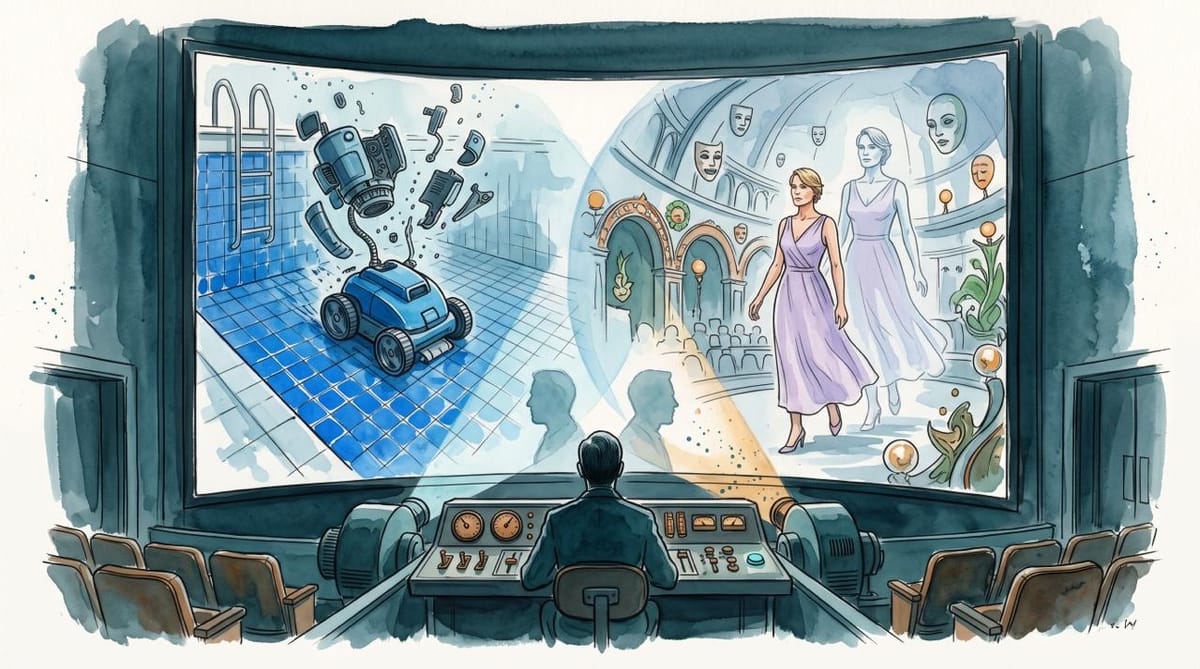
Robin Wright plays a version of herself in Ari Folman's The Congress, a wild collision of a Black Mirror premise, Stanisław Lem's The Futurological Congress, and a hallucinogenic animated fever dream. Before the film dissolves into that world, a studio called Miramount offers to scan Wright's face, body, and full range of expression on the condition that she never act again. Inside the scanning rig, she is asked to laugh, grieve, and go blank on command. Twenty years later, her digital double is a franchise star with a career the real Wright never had. Her recorded performance keeps working after she has been barred from the work.
Alastair Reynolds's Zima Blue shows the opposite ending. Zima is the most celebrated artist in the galaxy, known for cosmic murals increasingly overtaken by a single shade of blue. At the unveiling of his final work, he reveals that he began as a pool-cleaning robot and that the color came from the tiles he once scrubbed. He lowers himself into that pool and strips away every upgrade, retaining just enough awareness to resume the task of cleaning pool tiles. Robin Wright's recorded performance allows Miramount to keep making films with her digital double after the contract forbids her from acting. Twenty years later, she travels to Miramount's entertainment conference and finds that the copy has built the career she surrendered. Zima chooses the opposite path. He dismantles the elaborate body and mind that made him famous, returning to the pool and the simple task from which his art began.
Simon made neither choice. He did not sell his judgment or decide that he was finished with it. The record accumulated through the ordinary work of choosing films, and for a time it made the catalogue better. Now producers use it to shape films and the model uses it to choose among them. It preserves both the taste Simon believes he outgrew and the taste he may have developed while trying to escape it.