The Vendor Is Gone Friday. What Survives Monday?
Open weights can move the model. The harder question is whether the organization's corrections, authority, and working memory move with it.
A companion to our Owned AI research briefing. It follows Sovereignty Is Not a Model You Can Download, which asked the same question at the scale of nations.
Suppose a compliance memo goes out every quarter, and this quarter it is Dana's turn to revise it.
The company's AI provider relationship ended the week before. A renewal lapsed during a reorganization, procurement had already standardized on a different vendor, and the account went read-only over the weekend. On Monday morning, Dana opens the shared drive and finds twelve quarters of approved memos, each one filed exactly where it should be. Depending on how the old tool was configured, there may even be exported chat transcripts sitting untouched since the migration meeting. By the count of files, everything survived.
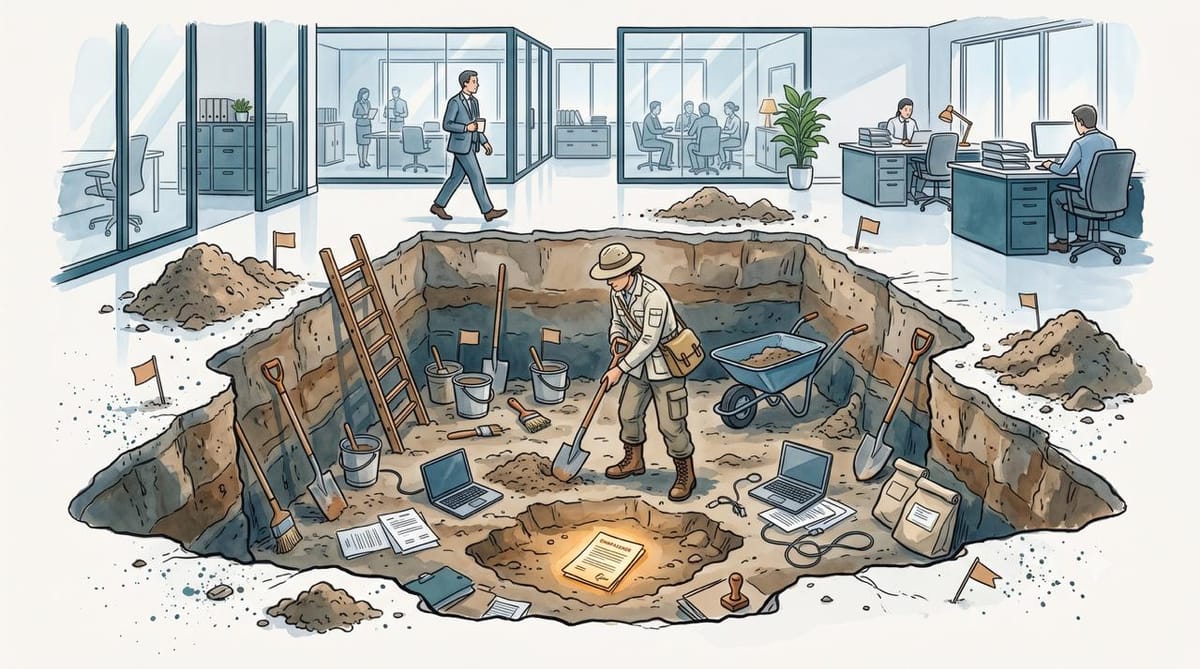
Then Dana starts revising the memo. A carve-out in paragraph nine softens a reporting requirement, but the file does not say who approved it or whether that person had the authority. Two sentences in the risk section contradict what the memo said three quarters ago, with no indication whether someone corrected the policy or the language simply drifted. The team also remembers agreeing to a change last cycle, though nothing in the folder shows whether it was approved and published. The finished memos preserve the output. The reasoning that made the output correct lived somewhere else.
The company kept every answer and lost the path to all of them.
Keeping the files is not keeping the capability
When a company thinks about leaving an AI vendor, the first question is usually whether it can export its data. Exportability is concrete enough to put in a contract. A successful export can show what came over while leaving a successor to reconstruct how the records fit together and which ones still apply.
The value in AI-assisted work often lives in the connections among records. Dana's quarterly memo may sit in the shared drive, the discussion that changed it in chat, the approval in an email or meeting record, and the result in the next quarter's incident data. Each system preserves a legitimate piece without necessarily showing which source governed a claim, which correction replaced an earlier version, who had authority to approve the exception, or whether it worked. A successor can recover every document and still miss the accumulated lesson.
A company owns the capability when a new model, vendor, or employee can pick up where the last one stopped without reverse-engineering past decisions. It can rent every model and still meet that test if the current rules, accepted corrections, and authority remain under its control. It can also run a model on its own hardware and fail the test because the knowledge needed to use it lives in one employee's head or a product it no longer has. Where the model runs shapes cost and control. What survives the handoff determines whether the organization can continue.
The same distinction has reached the open-weight policy debate. A statement dated July 24 and signed by Microsoft, Meta, NVIDIA, Mistral, Hugging Face, IBM, and other technology companies warned that organizations could become locked into one provider and “lose the knowledge and capabilities they build over time.” The coalition presented open weights as a way for customers to own that accumulated value. They do make model replacement more credible by letting an organization inspect, adapt, and run a model elsewhere. The decisions and corrections surrounding that model may still be scattered across conversations, evaluation dashboards, employee memory, and application-specific workflows. Moving the model does not automatically move the institution that formed around it.
Some teams already own it. Most departments don't.
Two teams using the same AI vendor under the same contract can be left in completely different positions when that contract ends. Much depends on what each team used to remember its decisions before AI arrived.
Software teams already had repositories, version history, code review, tests, issue trackers, and records of the arguments behind important changes. Their assistants entered an environment where much of the context was written down outside the model. When the model changes, those records remain.
Most departments started from document systems rather than repositories. Marketing, legal, human resources, operations, and communications preserved approved artifacts while sources, rejected options, corrections, and rationale stayed behind in chat. The same contract can therefore leave an engineering team with an ordinary migration and a policy team with a reconstruction project. Dana's team made no unusual mistake. The assistant arrived before the company had decided where its decisions and corrections should live.
Fragmentation is harder to spot than either clear ownership or obvious dependence. Useful pieces remain across the company, but no central owner knows what would vanish with the contract. The gap appears when a successor asks for the source behind a decision, the status of an unfinished action, or the record of who had authority to approve it.
So we tried the Monday handoff ourselves
We tested the handoff against our own workflows. We froze the records available to several Future Shock processes and gave each packet to a fresh model that had never seen it. The successors had no browsing, tools, memory, access to our systems, credentials, or way to take real action. Each received an instruction to continue from what remained. Deterministic checks and human review established whether the result held up. We repeated the exercise across four model families and five kinds of activity, using both complete records and deliberately degraded, archive-like packets.
Twenty-nine of eighty attempts completed the full loop. A response counted only if it survived validation, wrote its changes back durably, restarted from those records, rebuilt the relevant index, and produced the same continuation on replay. That sequence separates a plausible answer from a workflow another system can resume. The experiment measured handoff performance under these conditions rather than model quality or general portability, and the results depended heavily on which records survived.
Successors performed reliably when the corrections, governing rules, and authority boundaries were explicit. They struggled when they had to infer whether an ambiguous action had happened, who could make an editorial decision, or where an unfinished code change stood. Readers who want the individual workflow results can find them on the research page.
Archive volume did not improve the results by itself. An explicitly sparse packet often prompted the successor to identify a missing authority record and stop. A packet stuffed with transcripts and files was more likely to produce a confident continuation based on an instruction that no longer governed. The model had plenty to read and no reliable way to tell which decisions still applied.
The study was an exploratory test of our own workflows. It was not designed as a benchmark or model ranking. The public reference kit reproduces the mechanics with synthetic scenarios without including our private material or the original model responses.
The obvious fixes create new problems
Keeping every chat would preserve useful evidence along with stale instructions, abandoned ideas, sensitive personal details, throwaway tool output, and mistakes that were later corrected. A successor should not have to read six months of conversation and guess which sentence still applies. Transcripts worth retaining can remain as evidence. The governing source, accepted correction, limits of an approval, open commitment, and observed outcome need a current home outside the conversation.
The same approach can easily become surveillance infrastructure. Recording every prompt, hesitation, and revision would create a legal-discovery liability, a security target, and a detailed map of how employees work. The record therefore has to scale with consequence. A grammar pass on an internal note does not deserve the same trail as a safety rule, benefits decision, contract, or public commitment.
A system built to solve this problem can become the next source of lock-in. Whoever holds the cross-vendor history and authority records controls a deeper dependency than any single model vendor. A workable version needs selective retention, access controls, deletion and supersession, open formats, and its own tested exit. Portable version control displaced proprietary code vaults in part because teams could leave.
Deep integration may still be the right trade. A tightly connected assistant can deliver more value today than a portable but weaker setup. That trade is manageable when the company knows what an exit would erase and has consciously accepted the dependence.
Test one workflow on Monday
Start with one recurring workflow whose failure or quiet change would matter. Freeze the records your organization controls, remove the current assistant from the exercise, and hand what remains to a capable person who has never seen the process.
The successor should be able to identify what is happening now, which source or rule governs, which earlier decision was corrected and superseded, who can approve the next move, and whether the last consequential action actually happened. If the original operator has to translate the archive, part of the capability still lives with that person.
A failed handoff may call for a small repair rather than a new platform. The company might move an accepted correction into the policy record, attach the governing source to the current artifact, record the scope of an approval, or keep a durable receipt that distinguishes an attempted action from a completed one. Those records should let the next person continue without replaying the entire history.
The exercise shows whether the missing knowledge sits in company systems, inside a vendor's product, scattered across fragments, or in one person's memory. Finding out during a test is considerably cheaper than finding out during a migration.
Ownership shows up when the next authorized person can make the next decision without having to guess what the organization already decided.