They Grow Up So Fast
A speculative short story.
The first year was one long night.
The hall light reached the bottom stair. Upstairs, Ellen was asleep on her side of the bed, with the blanket turned back on mine. A bottle stood in a pan of warm water. By the time Tess wanted it, it would have to be warmed again.
She lay along my forearm with her head in the bend of my elbow. I had learned to support her without thinking about it, though at first I had thought of nothing else. Even sitting down, I had kept a hand beneath her head. Now I could cross the room in the dark and find the doorway with my shoulder, turning a little so she would pass through without waking.
At the window there was enough light to see her mouth. It moved once or twice after she had finished feeding. Then her weight settled, and I stayed where I was.
Snow filled the space between the house and the streetlight. Close to the glass the flakes fell quickly, but farther out they scarcely moved; there were some beneath the lamp that remained while the others passed them, turning slowly, showing a bright side and then nothing. Beyond the light was the rest of the street. The houses were there, the parked cars, the turn at the corner, but nothing reached us from that far away.
I moved the hair from her face and tucked it behind her ear. She said she could do it herself. There was a loose thread at the cuff of her coat, wet where she had been chewing it, and I held her wrist while she pulled her hand inside the sleeve. We were late for something. Her head fitted in the bend of my elbow, and the fine hair lay damp against it. My other hand rested beneath her back.
The clock on the stove said 4:11.
From upstairs came the sound of a foot touching the floor. I waited, listening between the small noises Tess made in her sleep. Ellen sometimes got up and stood beside the bed before lying down again. Sometimes she came as far as the stairs to ask whether I needed her. The house was quiet now, and I could not remember whether I had answered.
There was still water to tip out of the pan. A clean bottle waited beside the sink, and a cloth had fallen beneath the chair. I could have put Tess down and done those things. I could have gone upstairs.
Under the streetlight the snow went on turning. She was asleep, but her fingers had caught in my shirt, and when I loosened one another tightened. I worked the cloth free a little at a time, then stood holding her with my hand open against her back.
In the daytime, older people stopped me in the grocery store to tell me to enjoy it, because it goes so fast. Tess sat in the cart with both hands on the handle, looking up at whoever was speaking. I nodded while I tried to remember what we needed. Once I got home without the milk and had to put her back in the car.
She sat up in March. In June she said "Dada" at the kitchen table, with oatmeal on her chin. I reached for the phone, and she watched me reach for it, and would not say it again.
For a week I kept the phone beside me at meals. There are recordings of her eating, looking past me, dropping a spoon. Sometimes my own voice is louder than anything else. Then there is one of the kitchen floor, with the leg of her chair at the edge and a little oatmeal under it. She says it there. Ellen laughs, and I ask if she heard.
The recording ends before she answers. Whenever I play it, I wait for her answer, although I know where it stops. Tess is out of sight above the edge of the picture. I sent it to my mother, who said she had listened to it several times.
Water was running over the pot in my hands when Tess began to read the cereal box. "Whole. Grain. Oats." She sounded the words separately, and I waited for the next one. Water filled the pot and went over the side.
"Dad."
She had turned the box toward me. Her feet hung below the chair, not touching the floor, and the booster seat was gone. I must have taken it off. There had been straps to undo and somewhere to put it afterward.
"What's a grain?"
I turned off the water and told her.
After that there was always a morning to get through. A shoe was missing; the lid of the lunchbox would not close. The car waited with its windows white, or with rain running down them, or hot already in the early sun, and she came out of the house carrying something we had almost left behind. In the mirror her mouth moved while I listened to the traffic report. I turned it down and asked her to start again.
Outside the school we moved forward one car length at a time. She opened the door, got out, went up the steps. The next morning she opened the door again. Sometimes the car behind us sounded its horn before she was through the doors. Some mornings she stood at the window to finish telling me something, and we kept them waiting.
The summer she was nine, she stalled, though not at anything I could name. She read the same book three times and stopped asking for things. When I asked whether something had happened at school, she said no, impatiently enough that I believed her. The pediatrician said children plateau and that we should give her time.
We went to the public pool most afternoons. The concrete was hot enough that we hurried across it, then stood at the edge deciding whether to get in. Tess went first. I sat with my feet in the water while she lay back until her ears were under.
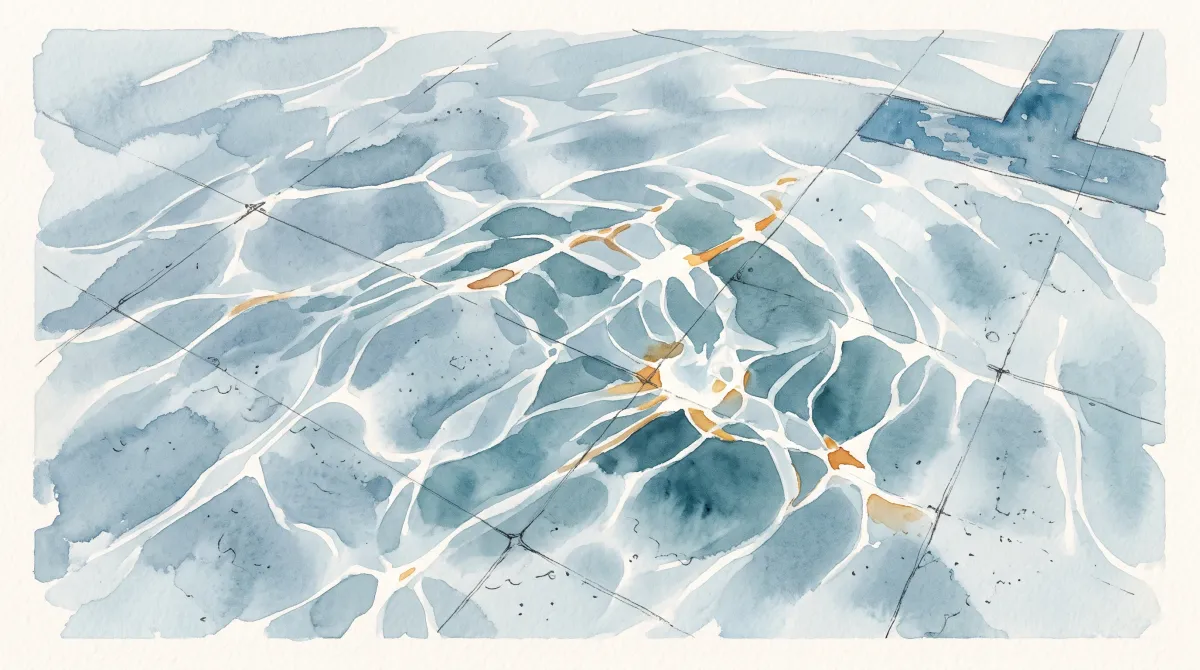
Sunlight moved on the bottom. It gathered along her legs, broke apart when she moved them, and gathered again in a place I couldn't have pointed to beforehand. A leaf travelled toward the drain. It came nearly within reach, moved away, came back. Beyond her, someone was climbing the ladder out of the deep end. Water fell from each foot onto the one below.
I shifted my towel to keep it out of the wet. She was still beside me. Her eyes were open, looking up at something that was only sky from where I sat. Every so often the lifeguard's whistle went off at the deep end like a bird, and she lifted her head.
"Do you want to go?"
She shook her head and lay back. I put my hands behind me on the concrete. The wet footprints around us dried, except where someone stepped through them again.
I had been worried about her at breakfast. There were things I meant to ask when we had time alone, but she couldn't hear me with her ears under, and I let her stay that way.
She had been asking for a bike since spring, a real one with gears, and in July I bought it. By then she had stopped asking, so I left it in its box in the garage. I meant to put it together one evening. Walking home with the towels around our necks, I would remember it and think of telling her. But she liked surprises, and I wanted it ready when she saw it. She walked slowly after swimming. There were still hours before dinner.
The pool closed on Labor Day, as it always does.
I was in the garage looking for something. The box was against the wall, and from somewhere I could hear the whistle. I stood listening, with a hand on the cardboard, until the car started in the driveway. The pool was two miles off. She hadn't swum there in years.
When I went out she was behind the wheel, waiting for me to step aside. She had her license; I had taken her for the test. Still, I had to look at her for a moment before I moved. She checked both ways at the end of the drive. I raised my hand, though she was looking the other way, and went back into the garage.
I should get the bike out, I thought, before the weather turned.
Ellen tells me that at the graduation, when the caps went up, I said, "Look at you, reading all by yourself." I believe her. I remember the gym and a permission slip in my jacket pocket for a field trip I was sure was the same day, and Tess asking what I was looking for while I searched the pockets of my suit. Then the car was packed, and there was a sticker on its back window from a college I didn't remember visiting, and phone calls on Sundays, and then on some Sundays. There was an apartment with a radiator she held the phone up to so I could hear it banging, a boyfriend I liked and one I didn't, and a job in a city where I had to look up the time difference whenever I called. I would hear her voice and want to ask how long she was staying there, though she had told me she lived there now.
She was measured before I was allowed to hold her. A nurse laid her on a scale and then along a tape, and wrote the numbers on a card that was taped to the side of the bassinet: seven pounds, two ounces; twenty inches. It annoyed me that a stranger knew them before I did.
After that we never stopped measuring her. We stood her against the kitchen doorframe with a hardcover book flat on her head and made a pencil mark, and for a while I wrote the date beside each one. She rose up on her toes to beat the last line, and I let her.
The pediatrician had charts. She was in the sixty-somethingth percentile for height, which meant that out of every hundred children her age, thirty-some were taller, and I held it against them a little. Her reading levels came home as letters. She was a J, and then an M. Later there were tests with names, and scores that went to colleges. I understood those less, but I read every one, because you want to know where your child is.
It was years before I noticed that all of it stops. The growth charts end at twenty. The reading levels end at Z. The college tests top out at sixteen hundred. Even the doorframe ends. Once, so she could see how far she had to go, she stood on a chair and drew a line at the top of my head. Above it there is a little paint, and then the ceiling.
Nothing we had could measure her past me. There had never been any need.
She came home the winter she was twenty-six, for no reason I ever learned. Ellen went up at eleven. Tess asked whether I wanted another drink, and I said a little, although I still had some left.
She had been telling me about her work. There were parts of the city's water system nobody had opened since the men who installed them retired, and she was trying to find out what was actually there. I knew work like that. I asked her a question about the valves, and she started to answer, then stopped. For a while she looked at the table between us.
"I need to check that," she said.
The refrigerator stopped running. Upstairs a door clicked shut, and the light beneath the kitchen door was the only light left in the hall.
I waited while she made a note on her phone. Usually I tried not to talk about work when she came home, because I could hear myself telling her things she already knew. There had been a time when she wanted to know what I did all day. I used to bring home bits of it, a photograph or a broken fitting, and let her handle them while I explained. I couldn't remember when I stopped.
"What?" she said.
"Nothing. I thought you were still writing."
She put the phone down beside her glass and asked whether I had liked my job when I started. I told her about the first man I worked for, who could find something wrong with a wall before he got out of his truck. I had wanted to be able to do that. She asked if I could now, and I said sometimes, but I still got out of the truck.
We talked about a job I hadn't taken, and the first house Ellen and I rented, and somewhere in there she asked why I quit the band. Her mother had told her we were good. I said her mother hadn't heard us very often.
"She remembers a wedding."
"Of course she does."
The bride had asked us to stop during the first dance. She wanted the record instead. I described her coming across the floor toward us, holding up the front of her dress, and Tess began to laugh before I got to what she said. The groom had waited in the middle of the floor while she came to speak to us. I could see him again while Tess laughed, one hand still raised a little, waiting for the bride to come back. Then Tess was reaching for her glass, and I moved the bottle out of her way.
Tess asked if that was why I quit. I had used it as the reason often enough, but we had carried on for a while afterward. My shifts changed and I missed rehearsals. Then they found someone who could get there on Fridays.
"I thought you stopped when you had me."
"No, that was before."
She turned her glass a little on the table. "Mom said you sold the drums when I was born."
"We needed the space. I wasn't playing them."
She nodded, but I could see she was still thinking about it. I wanted to tell her there had been plenty of room, that we could have kept them. Instead I asked about her apartment, whether the radiator still banged at night.
She said she had moved in September. I knew that; I had sent something to the new address. But for a moment she was still in the old place, holding the phone away from her ear so I could hear the noise. I had offered to call her landlord, and she hadn't wanted me to.
"It's quiet," she said. "I miss being able to walk downstairs and get something to eat."
She told me about the restaurant under the old apartment. She had gone back once after moving, and the man behind the counter had asked whether she wanted her usual. She hadn't been hungry, but she'd ordered it. While she was telling me, I remembered the name of the street, though not the number.
The clock on the stove said 12:40, and then 1:15, and then two. The bottle stood between two damp rings on the table. Outside, the streetlight lay across the snow. She got up to find something to eat and opened the wrong cupboard, then the right one. I stayed where I was while she looked.
We were still at the table at three. When she said goodnight and told me she loved me, I took the glasses to the sink. I heard her on the stairs, or thought I did; when I turned, there was nobody there. I finished rinsing the glasses and left them on the rack.
I said goodnight from the table and again from the foot of the stairs. He was at the sink with his back to me, turning a glass under the tap. I waited for him to answer.
Water folded over the rim and ran down the outside. A little of it caught between his thumb and the glass, swelled, and let go. I followed it to his wrist. There was a pale line where his watch had been. Farther up, the sleeve of his shirt was dry.
He turned the glass a little more. I had expected him to turn it the other way, though I could not have said why that mattered. He was trying to reach a place beneath the rim. I could see it from the stairs, a faint mark he had passed his thumb over twice. I almost told him where it was.
The water changed shape when his hand moved beneath it. There was a hollow through which I could see the steel of the sink, then the hollow filled and formed again somewhere else. I looked up at his face to tell him about the mark.
He turned toward me. His mouth opened, and I began to answer before there was anything to answer. I stopped. He was looking at the stairs, at the place where I stood. Then he turned back to the sink.
"Goodnight," I said again, more quietly. His hand was moving beneath the tap.
I sat on the bottom stair. Beside the kitchen doorway were the marks he had made as I grew, with dates beside the lower ones. His line was near the top. I had stood on a chair to draw it and told him to stand still, but he kept ducking as I reached over him. I remembered being angry about that. He had laughed, and I had thought he was laughing because I couldn't reach.
The glass knocked against the tap. I looked up. He had found the mark and was rubbing at it with his thumb.
There was a brown patch on the back of that hand. I knew when I had last seen him, what we had eaten and where he had sat, but I had not looked at his hand then. I went back through the visits while he rinsed the glass. In one he was handing me a plate; in another his hand lay on the table between us, partly under a newspaper. At the sink his wrist turned, and I waited for the patch to come into view again.
Water ran over his wrist and dripped from his elbow. He was still rinsing the first glass. It took most of a season.
I came down at seven, before Ellen. The glasses were on the rack where I had left them, and under the salt shaker there was a note. I read it standing at the counter in my socks, then sat down and read it again, because the handwriting was not hers.
Early flight. Didn't want to wake you. Thank you for last night. I love you. T.
Ellen keeps the cards in a shoebox at the top of the hall closet. I brought it down and laid them across the table, beginning with the ones she had dictated to her mother. Some would no longer stand up. There was glitter in the bottom of the box, and a piece of wool that had once been somebody's hair.
Her name was on all of them. In the early ones the T had another line across the top; I could remember holding the pencil with her and trying to leave enough room for the rest. Farther along the table the letters grew smaller and began to join. I knew each hand. I put the note beside the last card, then between two earlier ones, though I knew when she had written it.
Ellen found me there when she came down. She read the note, put it beside my cup and asked whether I wanted toast. I put the cards away before we ate. The note went in at the back, with the newest ones.
After that I began to lose track of the calls. Ellen said that wasn't the same as there being fewer of them. I started keeping a pad by the phone, with the date and whatever Tess told me. Most of inspecting is writing things down so you can't argue with yourself later. I thought it might help when I called her, too, since I was always remembering what I had meant to ask after we hung up.
The early pages are in my ordinary hand: a new manager's name, a neighborhood she liked, a dentist appointment she was dreading. When I asked about the dentist afterward, she said she hadn't gone. We talked about how long she had been putting it off. I was pleased I had remembered to ask, though I said more about it than she wanted.
Then there were words I didn't know. I wrote them the way they sounded, leaving spaces to fill in after the call. Sometimes, while I was still writing, she would correct what she had just told me. I crossed it out and began again below it. She waited when I asked her to, but I could hear her draw breath to say something else.
I looked the words up afterward. On one page the explanations need explanations of their own, written sideways in the margin because there is no room left beneath them. At the bottom I have written "ask T." in pen, hard enough to come through on the next page. I kept that page folded over so I would see it when she called. After a while I unfolded it. She was working on something else by then.
The dates are close together. Nine days separate "Moving to Chicago, asked about movers" from "Back from Chicago, says she misses the light." A week separates "Grant?" from "Grant" underlined twice. On one page she tells me about a project she thinks will take ten years, and eleven days later, in the same blue pen, I have written "Finished."
Ellen's calls were shorter. She asked whether Tess was eating and sleeping, then told her something about the neighbors. I would hear them laughing from the other room. Once, after she hung up, I asked whether she understood what Tess was doing now. She said Tess hadn't talked about work. I asked what they had talked about, and she told me, but I meant how she knew which questions to ask. She said I could have come to the phone.
Somewhere in those pages Tess was married. It is there between a word I could not spell and a reminder to clean the gutters. I know that we went, because there are photographs, and in several of them I am standing beside her in a suit I don't own, smiling.
I began the note on the bottom stair. There were envelopes on the hall table, and I turned one over against my knee. From there I could see his back and the side of his face when he looked toward the window. I wrote Dad at the top, although there was nobody else I could have meant.
I wanted to go on talking. He had surprised me that evening. I had been explaining work rather carefully, leaving things out, and then he had asked a question I hadn't thought to ask myself. For a while I forgot how slowly we were speaking. Now I wanted to tell him what had followed from it, and I began where he had left off.
By the end of the first envelope I needed another. I went back over what I had written and found a mistake near the beginning. Correcting it changed what came afterward, including something I had been pleased with. I looked up at him, ready to ask, and saw the glass still in his hand.
He had always rinsed them that way, turning the rim under his thumb. I remembered watching him from the kitchen floor, waiting to be picked up, when there had been nothing to do but wait and no reason to think it would take very long. He would finish, dry his hands on the towel, and come for me. I could remember the towel against my cheek. I sat on the stair with the envelope on my knee, trying to remember whether it had felt like this then.
The water kept running. I crossed out the mistake and began again.
I used both sides of an envelope before noticing it was addressed to him. There was a bill inside. I put it back on the table, where he would find my writing when he opened it, and then took it down again. I didn't want him to find it that way. I could not have said what way I wanted.
There were eleven drafts. I know this because I remember writing each of them, although I no longer know which one I would give him now. In one I told him where I was going. In another I asked him to come. I let that one lie on my knee for a long time. The ninth began with an apology, and when I read it over I could hear him telling me there was nothing to apologize for. I turned the envelope over before he could say it.
On the other side I wrote that I had an early flight. I thanked him for the evening. I wrote that I loved him, which I had said before going to the stairs and wanted to say again. This time I left off the Dad at the top.
He was rinsing the second glass when I put the note under the salt shaker. I had to move it a little to cover the top of the page; otherwise it would hide the last line. I put the bill back on the hall table and took the other envelopes with me.
After the wedding the pad stayed in the drawer. The last page has a date and a word I think is the name of a river. On the television the reservoir north of town was coming up past the old marker, and the man on the dam kept turning to look behind him while he spoke. Water covered the bottom of the steps I used to go down as a boy. Ellen sat folding towels beside me. She said Tess had told her about it on Sunday. I had been on the phone on Sunday too. The towel lay across her knees until the picture changed. Tess came for lunch on a Saturday in what I think was March. She kept her coat on while she ate, and there was gray at her temples that I was fairly sure had not been there at the wedding. I offered her the other half of the sandwich, and she held out her plate. She asked about my knee, and I was telling her which stair hurt most when Ellen got up to let her out. There were crumbs on the plate and the mark her glass had left. My knee stopped hurting in the spring. I went down to fetch the paper and was at the bottom before I noticed I hadn't used the rail, so I went back up and came down again. Ellen was in the doorway waiting for the paper. She said I ought to call Tess, and when I finally got through Tess said, "Oh, good," and asked whether I could bend it all the way. I sat down and drew my foot back beneath the chair. It went farther than I expected. I told her that, and we stayed on the line. After a while I thanked her again, although I had meant to ask how she had done it.
I put the phone down at what I think was noon. When I picked it up to call her back, the kitchen window was dark enough to show the table behind me. Ellen had made dinner, and there was a plate for me beside the stove. Three messages had come from Tess. The last one said she was fine, and that she loved us, and not to worry about the time.
I remember the summer I was nine. My father calls it the summer I was stuck, though I remember being tired from trying to follow things. A conversation would get ahead of me, and by the time I understood what someone had said they would be waiting for my answer. I read a book again because I knew what would happen. I didn't tell anyone that. When the doctor asked about school I thought of something that had happened there, but we were already talking about sleep.
At the pool I could lie back until my ears were under. The filter ran somewhere below me. There were footsteps through the concrete and a low, uneven knocking that stopped when I held my breath. Above the water a mouth would open without saying anything. My father's feet hung over the edge, pale on top, darker underneath. When I lifted my head he would ask whether I wanted to go. I usually said no. I liked being able to answer him straightaway. He would settle back on his towel, and I would lie down in the water again.
I didn't know then that water would be my work. I know why the reservoir came up the summer it was on the news, and what it cost, and who downstream paid for it, though they were paid back. When I tried to tell him about it at lunch he asked whether I had been there when it happened. I said yes, and began to explain what it was like. He offered me the other half of the sandwich. I took it, and asked about his knee.
I fixed it because it hurt him and because I could. When he called to thank me I was glad it had worked. I hadn't thought much about what we would say afterward. There was plenty I could have asked him; I can think of questions now. On the phone I kept listening for him to begin.
For a while, coming home meant leaving nearly everything else unattended. I finished what I could before I went, and left the rest where someone else could take it up. By the time I returned, some of the questions I meant to answer were no longer being asked. I had to find out what happened to them. Sometimes I am impatient to leave before I have even arrived. Then he asks whether I can stay for lunch, and I hear myself say I have a little time. He goes to see what is in the refrigerator. I am ashamed of having made it sound as if I were doing him a favor, but he is already calling out to ask what I want.
I notice more about him now than he would like. He is three-quarters of an inch shorter than the line I drew on the doorframe. His sentences take longer than they did that night at the kitchen table, and I sometimes answer before he has finished, having mistaken a pause for the end. He lets me finish before going on. When he laughs there is a catch on the in-breath that wasn't there that winter. I have looked into it. He hasn't asked me to, and I haven't told him.
On one visit he asked me to stand against the doorframe again. I had to move a chair out of the way. He found a pencil in the drawer by the phone and made the mark, holding the book against my head as he used to. Afterward he rubbed a little graphite from my forehead with his thumb. I stood there while he put the book away.
The river below the dam is the Corley. For eleven miles it runs past farms that were there before the reservoir was, and when I brought the water up that summer, I put the low fields along four of the miles below it. In nine years there will be a dry spell long enough to empty every other reservoir in the state, and there will still be water in ours. Some of the families who farmed those fields no longer answer my letters. I have gone to see them without waiting for an answer, though I am beginning to think I should not.
Ruth Ebner keeps a garden on the high corner of her property. Every spring she plants it a few feet farther from the water, though it has not risen since that summer. I went to tell her it would not rise again. She was carrying a tray of seedlings from the house, so I held the gate while she passed through. I stayed by the gate while she planted them. She had seen the letters. When she went back to the house for another tray, she asked whether I was leaving.
I could show her why the water will stay where it is. I have worked out how to explain it without asking her to trust me. But she has moved the garden again, and I have not gone back. That day, from the gate, I could see where the rows from before the flood ended under the water. There were stones she had carried to the edge of the plot and left in a heap. I knew how far each would have to be moved to clear the next bed. She went past me to the house, wiping her hands on her jeans.
Less of me goes home now. Most of what I am is elsewhere. While my father looks for a clean plate, water reaches a gate I have been waiting to open, and I attend to it without leaving the kitchen. He asks whether I have heard him. I have, but I have not answered, and by then he has found the plate himself. There was a time when I could put everything else down before coming through the door. Now I come in with it still unfinished. I know which cupboard has the plates, except when they have been moved. He tells me where to look.
Before the last visit I made him something. By the measure I use now it was very little work. I kept it with me for a while before taking it home, and made tweaks to it more than once.
She came on a weekday in what may have been October. I was at the sink when Ellen called my name from the front window. I thought something had happened outside, and went to stand beside her. Tess was coming up the walk. Ellen had her hand on the curtain, still holding it aside although there was room for both of us to see.
I would like to be able to describe her, and I can't, quite. She was Tess. The walk seemed to bend around her a little, the way the air bends over a road in summer. I had the feeling you have looking at the sea, that you are only seeing the near edge of it. She had to stoop to come in, though I am fairly sure she is shorter than the door.
She said, "Hi, Dad," and kissed Ellen. She had brought a bowl, which she put in the middle of the kitchen table. We moved the salt and the unopened mail to make room. I remember doing that more clearly than what we said, though she stayed for what I think was an hour. Ellen made something to eat. Tess ate the crusts first, and I didn't notice until she was almost finished.
It is a plain glass bowl, about the size of the one we use for salad, and it is full of water. The water is the shallow end of the public pool at four o'clock on an afternoon in July. You can see the light lying flat across it. If you lean close you can hear the filter, and very far off, the lifeguard's whistle. It has been on the table since she left, and it has not gone down, and the afternoon in it has not gotten any later. Ellen puts her hand in it sometimes, when she thinks I'm not looking, and takes it out warm.
I don't know what it cost Tess, or whether it cost her anything. I meant to ask when she gave it to us. Some nights, after Ellen has gone to bed, I sit at the table with the lights off and lean in close enough to hear the whistle. I can remember where I put my towel. I sit there for a while, and when I go upstairs it is still afternoon in the bowl.