What Does It Mean to Be Super?
From gods and heroes to computers and a larger order of fries, a history of the word now attached to intelligence.
In 1896, a translator named Alexander Tille reached the first speech in Nietzsche's Thus Spake Zarathustra and had to find a word for the figure Zarathustra was describing. He wrote "beyond-man." "I teach you beyond-man," his Zarathustra tells a crowd that has gathered to watch a tightrope walker. "Man is a something that shall be surpassed."
“Beyond-man” suggests someone who has surpassed humanity, with no cape and no comic book behind him, just a hyphen and a preposition. English already had “superman.” The Oxford English Dictionary finds it in print by 1894, and in 1903 George Bernard Shaw put it in the title of Man and Superman and made it something people said at dinner. When Thomas Common produced his translation in 1909, his Zarathustra announced, in capitals, “I TEACH YOU THE SUPERMAN.”
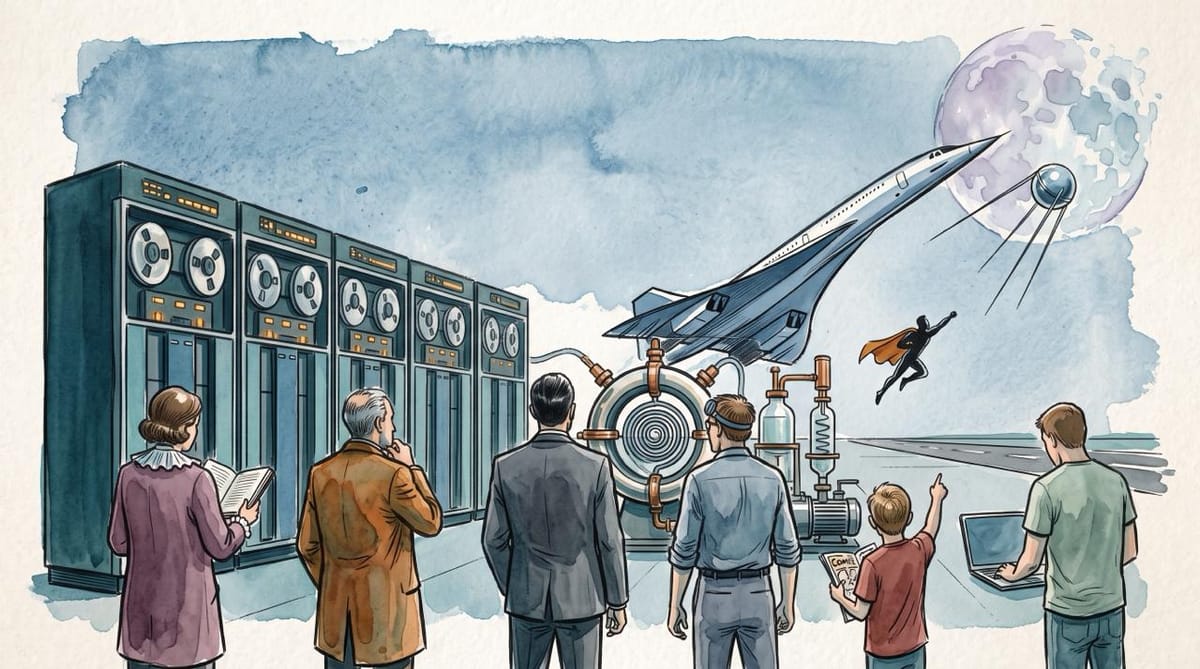
The word is back on the frontier. The labs building the most capable AI systems now describe their destination as superintelligence, a term with a technical definition from 2014 and a history that runs back through Cold War computers, comic books, a Leiden laboratory, and a Quaker's margin note from 1674. In each of those places, "super" marked whatever that era believed lay just past the human limit, and usually whatever it was anxious about. Following the word is a way of following what each generation thought was about to change everything.
The Latin super means “above.” Its related adjective, superus, has the comparative superior, “higher,” and the superlative supremus, “highest.” The vocabulary also carried an older anxiety. Trying to explain the origin of superstitio, or superstition, Cicero described people who spent whole days praying and sacrificing in the hope that their children would outlive them. He connected the name for those parents, superstitiosi, to superstites, the children who survived them. Modern scholars doubt his etymology, but it preserves an ancient anxiety associated with the word. These parents prayed and sacrificed without knowing whether any of it could keep their children safe. For the next two thousand years the prefix kept pointing up. By the fifteenth century English had “supernatural,” and by the sixteenth, “superhuman,” both naming what stood above the ordinary order of things and what people answered to.
The Superman Against the Supernatural
Zarathustra comes down from his mountain into the market square and tells the crowd the Superman is "the meaning of the earth." Then he warns them against anyone promising salvation above the earth. "I conjure you, my brethren, remain true to the earth, and believe not those who speak unto you of superearthly hopes! Poisoners are they, whether they know it or not."
Nietzsche was writing for readers whose heavens were emptying. A few pages earlier in the same prologue, Zarathustra meets an old hermit who still praises God and walks away marveling that the man “hath not yet heard of it, that God is dead.” The Superman is what Zarathustra offers the crowd in place of what they had lost: an ideal above the human that stays on the earth. Where religious hope had pointed at God and the heavens, he asked people to imagine what humanity itself might become.
Shaw's play carried the word into drawing rooms. For his characters it is both a philosophical ideal and a useful slogan. As one of them puts it, "Superman is a good cry; and a good cry is half the battle." The word traveled faster than the philosophy. Within a decade of Tille's hyphen it could be played for laughs in a London drawing room. The pattern would repeat as “super” found new uses, with people taking up the word before agreeing on what it meant.
Zero Resistance
In his Leiden laboratory in 1911, Heike Kamerlingh Onnes used liquid helium to cool a thread of mercury to about four degrees above absolute zero. Its electrical resistance fell to zero. In his first reports to the Dutch academy he called the new state "supraconductivity." By the time he delivered his Nobel lecture in 1913, the English text spoke of "the state of superconductivity."
Within two years, Onnes was imagining what he could build with it. In 1913 he proposed a superconducting coil just thirty centimetres across that could produce a magnetic field of 100,000 gauss. He thought the cooling equipment could be built in Leiden with relatively modest funding. “Since we may confidently expect an accelerated development of experimental science,” he wrote, “this future ought not to be far away.” A thread of frozen mercury had become the prospect of a powerful new machine. How quickly those possibilities could be realized was still anyone’s guess. Powerful superconducting magnets would have to wait until the 1960s and materials better suited to the task.
The Villain Who Became a Hero
In 1933 two teenagers in Cleveland, Jerry Siegel and Joe Shuster, published a story called "The Reign of the Super-Man" in their mimeographed science-fiction fanzine. A drifter named Bill Dunn is given an experimental drug, gains the power to read and control minds, and uses those abilities against the people around him. Asked about it decades later, Siegel said the idea was nothing new. "The superman theme has been one of the themes ever since Samson and Hercules; and I just sat down and wrote a story of that type—only in this story, the Superman was a villain," he said.
Five years later the same name appeared in Action Comics #1, now belonging to a hero who used his abilities to protect people. In February 1940, while war raged in Europe and the United States remained out of it, Siegel and Shuster showed readers of Look magazine how their hero could end it. In a two-page comic called “How Superman Would End the War,” Superman tears through the Siegfried Line, grabs Hitler, then flies to Moscow for Stalin. He delivers them both to the League of Nations, which pronounces them guilty of “unprovoked aggression against defenseless countries.” The war could be over in two pages if someone were strong enough to drag its leaders into court.
Nietzsche had asked what humanity might become. The superhero gave that question a character and a story, allowing writers and readers to imagine what someone with extraordinary abilities ought to do. Siegel and Shuster’s answer in 1940 was to stop a war that ordinary people could do little to end. In the pages of a comic, the desire for peace could become a person strong enough to bring it about.
Superpowers and the Sound Barrier
In 1944, with the war still underway, a political scientist named William T. R. Fox published The Super-Powers, about the United States, Britain, and the Soviet Union and their responsibility for the peace that would follow. “Super” had described what one man could do with his strength. Now it described what three governments could do with theirs, and the question of what they would do with it moved from the comics page to the negotiating table, where it stayed for half a century.
On October 14, 1947, Chuck Yeager flew the Bell X-1 past the speed of sound over the California desert. He had named the aircraft Glamorous Glennis after his wife. “Supersonic,” once a word for sound pitched above human hearing, now described a speed a person could travel. The experimental aircraft that followed would fly higher and faster, with the X-15 helping develop the knowledge needed for human spaceflight. Within the emerging Cold War, military competition and the ambition to explore space were drawing on much of the same engineering. A flight beyond the sound barrier was becoming part of a larger effort to discover how far machines could take people.
Super Computing
Those ambitions also demanded machines that could calculate faster. “Supercomputer” was in print by 1949, and in 1964 the CDC 6600, designed by Seymour Cray’s team in Chippewa Falls, Wisconsin, became the fastest computer in the world. Researchers wanted that speed to tackle problems whose complexity exceeded what they could otherwise compute. The National Center for Atmospheric Research acquired one to put that power to work studying the atmosphere.
In 1965, the British statistician I. J. Good, who had worked at Bletchley Park during the war, imagined a machine that could surpass any person at every intellectual activity. He called it “ultraintelligent,” and included designing machines among the things it would do better than its inventors. Such a machine could design a more intelligent successor, which could improve on its design in turn. What might become possible once invention could proceed beyond the limits of the people who had started it? Good described an “intelligence explosion” that would leave human intelligence far behind.
“Thus the first ultraintelligent machine is the last invention that man need ever make,” he wrote, “provided that the machine is docile enough to tell us how to keep it under control.” The prospect combined an extraordinary freedom from human limitations with the uncomfortable possibility of depending on the machine to explain how to govern it. Good wondered why an idea with such consequences was discussed so seldom outside science fiction. “It is sometimes worthwhile to take science fiction seriously,” he wrote.
Supersize
On January 21, 1976, British Airways flight BA300 left Heathrow for Bahrain. The sound barrier Yeager had crossed in an experimental aircraft was now something commercial passengers could cross on a scheduled flight. For the next twenty-seven years, supersonic flight was an expensive way to get somewhere quickly.
By the 1990s, “supersize” had turned the promise of something extraordinary into a mundane marketing pitch. In 2004, Super Size Me premiered at the Sundance Film Festival. That March, McDonald’s announced it would phase out Supersize fries and drinks. A spokesman described the change as “menu simplification” and denied any connection to the film.
The Word That Was Waiting
During the same years that “super” was becoming an unremarkable promise of more fries for your money, a small group of writers was considering what would happen if intelligence exceeded anything human beings could know. They were returning to the possibility Good had described, in which machines became capable of inventing their own successors. In 1993, the mathematician and novelist Vernor Vinge predicted that “within thirty years, we will have the technological means to create superhuman intelligence.” In 1995 the roboticist Hans Moravec wrote of "freely compounding superintelligence." In 2014 Nick Bostrom offered the definition that has stuck: "any intellect that greatly exceeds the cognitive performance of humans in virtually all domains of interest." In printed books, the word grew roughly eightfold in frequency over the 2010s.
By the time “super” was attached to machine intelligence, it had described human aspirations, scientific breakthroughs, extraordinary power, and ordinary purchases. Those associations gave readers plenty of ways to hear the new term, whatever its technical definition specified. But the idea of an intelligence above our own had an older place in the language, long before anyone imagined building one.
The Oxford English Dictionary’s earliest example of "superintelligent" comes from William Penn, years before the royal charter that gave him Pennsylvania, and the thing it described is close to what the word is being asked to mean again.
In 1674, Penn published a long defense of his faith called The Christian-Quaker, in which he argued that the Greek philosophers had glimpsed the truth about God without the benefit of scripture. On one page he quotes Anaxagoras, by way of Plato, on a divine mind that found all things “confusedly mingled together” and “came and reduced them to order.” In the margin beside the arguments that follow, Penn wrote of “a Divine Super-intelligent Being.” He gathered passages of scripture to describe it and summed up two verses from the Book of Wisdom as “orders all.”
Each era found something different to imagine beyond the ordinary, from humanity surpassing itself to flight beyond the sound barrier and machines that could invent their own successors. “Super” gave those possibilities a name before their implications were clear. Attached to intelligence, it now invites us to imagine which limits we might overcome next. To name an era we cannot yet comprehend, we have reached for the language Penn used to describe God.