Please Hold for Another Department
The staff left, the software stayed, and the town started paying extra to make its departments disagree with each other.
Future Shock recently tracked what happens when AI collapses the amount of organization inside a company in The Cambrian Explosion of Tiny Companies. This What-If follows the same thinning logic into a town hall that still needs to look like a government. Everything below is conjecture, grounded in staffing pressures and systems that already exist, then pushed into a scenario that does not.
For the third time that March, runoff overwhelmed the new culvert and poured through Navarro Equipment Repair's bay door, spreading across the floor toward the shop's air compressor. Celia Navarro shut off the power to the back half of the shop, called Public Works, and got a woman named Susan who sounded genuinely sorry about the whole thing.
Susan pulled up the drainage plan. The culvert, she said, was performing to the approved specification.
Celia asked who had approved it.
"Planning would have signed off on the design," Susan said. "Let me transfer you."
There was a pause with music, eight seconds of a looped guitar number that sounded licensed for waiting rooms or elevators, and then a man named David picked up. He introduced himself as Planning. His voice sat about a third lower than Susan's and moved at the same unhurried pace, and he told Celia that Planning had approved the drawings exactly as submitted. The installation method was a Public Works call.
"Public Works just said it's working as approved."
"That's consistent with their role," David said. "They install to the approved design. If the design is producing standing water, that's a question about the original survey, which Records would hold. Shall I transfer you?"
The music came back, the same non-offensive guitar song.
Maria answered for Municipal Records. She had Susan's warmth and David's tempo, and she was sorry to report that the original drainage survey was flagged under an active Planning review and could not be released while the review was open.
Celia did not say anything for a moment.
"Hello?" Maria said. "I think I may have lost you."
"I'm here."
"Wonderful. Is there anything else Municipal Records can assist you with today?"
Celia had not been lost. She was standing in a flooded shop, holding a phone, listening to the same person tell her three times that the problem belonged to someone else.
Morrow had not set out to run its government on one contract, it had set out to hire a clerk.
The old clerk retired in the spring after nineteen years, and the town posted the job, but the job did not fill. It paid what a town of eleven hundred people could pay, which was not enough for someone willing to do tax collection, election prep, minutes, licensing, and the front counter, all at once. The posting ran through the summer. Then the code enforcement officer left for the county, and the assessor, who was already part time and already tired, stopped picking up.
The county made the obvious offer, it would take over the services Morrow could no longer staff. But the city council said no, because absorption meant driving forty minutes. It meant Morrow's business getting decided in a building Morrow did not vote for, and everyone at the table knew that towns that handed things to the county rarely got them back. Saying no was a point of pride. It was also, the council would later tell itself, a decision about self-government.
So the town licensed CivicWorks, a municipal software system for forms, records, meeting transcripts, permit checks, and deadline tracking. It was supposed to support whatever human the town eventually hired. When the town did hire a clerk that winter, she used the system for nine months and then left for a school district that offered dental. The system did not leave. It absorbed her duties the way it had absorbed everything else, one enabled module at a time. Public Works. Planning. Records. The manager's office. Administrative Review last, once residents started asking who exactly they were supposed to appeal to.
For a while the whole thing answered as one voice, a single helpful assistant that could take your building application, tell you what it would do to your assessment, and field your objection without transferring you anywhere. Residents hated it. Not because it was wrong. It was usually right, and fast, and available at nine at night. They hated it because a government that agrees with itself instantly, in one breath, does not feel like a government. It feels like an automated, lifeless robot. The complaints that reached the council were not about accuracy. They were about the uncanny smoothness of asking an authority a hard question and watching it answer without anyone appearing to weigh anything.
CivicWorks had a solution for that. The Municipal Professional package gave each function its own name, its own voice, its own email domain, and its own hours. It added statutory information barriers between the departments, so Records could decline to share a file with Planning until Planning filed for it. It added transfer delays with hold music. It let the town dial in how often the departments would disagree with one another, and it offered a setting, trained on the town's own archive, that let Susan apologize in the cadence of the clerk who had retired and let the manager's office write in the slightly formal register of the man who used to sign the letters to the weekly paper.
Morrow paid more for this than it had paid for the simple version. The town's government felt more real when its departments made you wait, made you ask twice, and occasionally contradicted one another before arriving to a decision.
The underlying dynamic has been playing out all across America. Maine towns have already ground to a halt when a lone clerk walked out. Small police departments have handed themselves to county sheriffs after everyone quit. Towns already share a single code officer because no one of them can keep one busy, and Weston, Florida runs most of a city on contracts rather than employees. Local governments are already piloting AI to move building permits faster. Morrow's leap is not that the software showed up. It is that the software became the institution, and then the institution started paying to look like it still had parts.
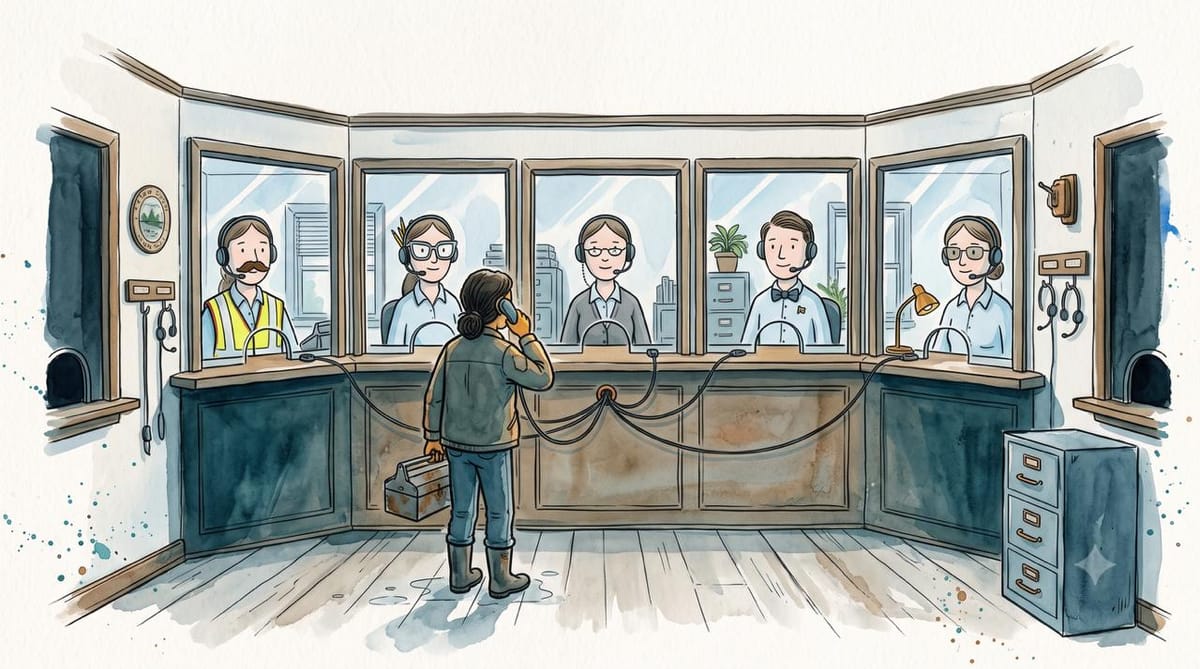
Celia drove to town hall on Thursday because calling on the phone had stopped producing anything that resembled forward motion. The building looked the way it always had, red brick, half-mast flag, and a bulletin board behind glass with a notice about leaf pickup. Inside, there was one lit desk and four dark service windows. Along the back wall, a row of small screens, and labeled headsets hanging from hooks like tools assigned to workers who had gone home.
Ruth Delaney ran the counter. She was the town's administrator and, as far as Celia could tell, the only person the town still employed. She heard the whole story without any of the small performances a person uses to signal that they find a situation absurd.
"The software is shared," Ruth said. "The offices are separate."
"It's one machine."
"So was the county assessor's whole operation before they moved it to the cloud," Ruth said, and she was not being clever. She meant it.
She offered to convene the departments directly, and she woke the screens one at a time. Susan came up first, Public Works, glasses, a plain background. David from Planning had a shelf of binders behind him. Maria from Records sat before a bank of filing cabinets that were not in the room. Bernard, from the manager's office, had a small plant, the manner of someone who had been in a lot of meetings, and a framed photograph of Morrow's covered bridge, which had been demolished in 1986.
Ruth laid out the culvert dilemma. Celia watched four faces compose themselves into the particular attentiveness of people who had been somewhere else a minute ago.
Public Works had installed the culvert according to Planning's approved spec. Planning had approved a design that Public Works chose how to build. Records could not treat the old survey as controlling while its provenance flag was open. Bernard, for his part, felt the matter needed an administrative determination before anyone put a shovel in the ground, given the precedent.
"Can you see what the others have in front of them?" Celia asked him.
"Not without a formal request," Bernard said. "Reaching into another department's file without process would undermine the independence of that department."
He filed the request. On the neighboring screen, Maria noted its receipt and cited a one-day response window, holds permitting.
"And if I want to appeal any of this," Celia said, "who am I appealing to?"
Ruth glanced at a panel. "Administrative Review handles prolonged disputes."
The fifth screen lit up. A woman named Patricia introduced herself, and she had the same voice Celia had now met under four names, pitched a shade warmer, the way a customer service tier is warmer.
Celia laughed out loud.
No one else did. Ruth wrote something on a pad. Bernard waited, courteous and blank, for the laughter to resolve into a question he could route.
Patricia had gotten two sentences into the standard for an appealable determination when all five of them stopped at once. Susan's glasses hung crooked on a frozen face. On her screen, Maria held the front of an unfinished word.
Ruth looked up at the clock over the dark windows.
"Scheduled update," she said. "They should be back in about ten minutes."
Ruth topped off her mug and did not apologize for the five characters frozen on the screen. She treated it the way a person treats a familiar outage, an interruption with a known duration.
"You should know what this replaced," she said. "Vehicle registration was only open two mornings a week, if someone opened up. Permits sat for a season or longer. Minutes so late nobody could say who had agreed to what. An election run by one woman in her seventies and whoever she could talk into helping. For half of what this building is supposed to do, people drove to the county office."
She set the mug down, centered on a coaster that carried a stained and faded town seal.
"We kept our own government instead of giving it away. We have records you can search, deadlines that get met, and a desk you can reach after five. Two similar cases now get answers that actually resemble each other, which they did not before. Most people here are not willing to go back. You yourself have used it and walked away satisfied. It is not the villain in this story."
Celia looked at the five frozen faces. Up close, the avatars were careful rather than convincing, which was the point.
"Planning and Public Works are not supposed to give you the same answer on reflex," Ruth went on. "A government where one office can approve a thing, build it, tax it, and turn down your appeal without any friction is not a simpler government. It is a more powerful one that happens to be polite. People trust an institution partly because they can see the functions and cogs within it that can disagree with itself."
"But it isn't disagreeing," Celia said. "It's performing a disagreement you paid for."
Ruth did not flinch at that. She nodded, the way you nod at an affirmative reading of a memo.
"The departments disagree because the package is set to let them, inside the rules of course. Disagreement is not the problem. The problem would be presenting one company's system as five independent judgments and treating the show of independence as proof that independence is still in there."
"Then who sets the rate?" Celia asked. "How often they fight?"
"The council approved those settings."
"Who wrote the settings they approved?"
Ruth turned her monitor a few degrees away. Celia could still read the heading on the open procurement summary.
"CivicWorks."
She turned it back.
"There were presets," she said, without a trace of irony, because to her it was procurement and not confession. "Collaborative. Deliberative. Robust Checks. The council chose Deliberative. Somebody said it read the closest to the old meeting minutes."
The screen flickered and the meeting participants resumed stilted movement until the system caught up and became smooth again. Patricia resumed in the middle of her sentence, apologized for the service interruption as though it had been weather, then registered the clock and offered to take the appeal standard again from the top.
Ruth rummaged through a metal filing cabinet while Patricia waited. On screen, the digitized survey confirmed that the culvert matched the approved plan. In the paper original, held under a corroded clip, the surveyor had written a line in the margin: that heavy spring rain ran across the entrance and that the site wanted a shallow swale the finished drawings never included. No one had ever keyed the margin in. The note had lived, unindexed, in a drawer, for as long as the digital record had said everything was fine.
Ruth photographed the page, attached it to the file, and authorized the fix under the residual signing authority she kept for incomplete historical records. Public Works put a crew on it the following week. They cut the swale, reset the grade at the door, and were gone by noon. The next storm came and went and the shop floor stayed dry.
A call came a week after that, while Celia was on her back, fixing a mower.
"Independent Quality Assurance, this is Elaine. I'm reaching out about your recent experience with Public Works, Planning, Municipal Records, the Town Manager's Office, and Administrative Review."
Celia wiped her hands. "Have you and I talked before?"
"Privacy rules prevent Quality Assurance from accessing departmental call records," Elaine said. "On a scale of one to five, how would you rate the coordination between Morrow's departments in resolving your issue?"
Through the front window the new culvert was carrying the last of the morning's rain off toward the ditch, exactly where it was meant to go.
"Can I rate CivicWorks instead?"
"One moment," Elaine said. "I'll transfer you to Customer Satisfaction."
The line filled with inoffensive guitar music.